Heh, well, maybe he thinks that we could do praxeology and get results, but that we could do “empirical” economics and get better results. But then I wouldn’t know what the point of the debate that he is having with Lilburne would be. I don’t think that he has even tried to show anything that “empirical” economics has figured out about the world.
in other words I challenge him (ooh intentional!) to abandon meaningless terms which are mere folk psychology and unscientific to demonstrate by example that he can possibly act like the eliminative materialist that he calls himself.
The issue is precisely this, he cannot be an eliminative materialist if he thinks that he is arguing with Grayson.
maybe another way to say it is that to be an eliminative materialist one must deny that one believes in the truth of eliminative materialism.
Thanks, I. Ryan.
I was trying to get at implication. I understand that logical arguments such as these “exist out of time” or have no temporal dimension to them. What I was wondering is this:
A implies B doesn’t necessarily mean B implies A.
Action implies preference. Does preference imply action? From what I understand, the action axiom is the self-evident starting point of the deduction. Am I missing something here?
I don’t think it’s the notion that we have beliefs or discomforts that help build a case for action. I think it’s that the idea of action itself, builds the case for beliefs and discomforts and value, etc…
Agreed 100%! Have fun!
preference must be combined with other things like the expectation that the act you may prefer to engage in is feasible etc. When such things are combined they convene to necessitate the package concept of ‘human action’ or else absurdity would follow.
‘Human Action’ it has been said can be unpacked…if you told someone everything you knew from ‘unpacking’ then they would know ‘Human Action’. so from my understanding. The packed concept is logically equivalent to the unpacked.
Is Neoclassical conflating of economics with economic history? Economics cannot predict what actions an individual will make. Any such attempt is purely speculation. Without knowing an individual’s value scale, we cannot know before hand whether the individual will choose the $10 gift card or to purchase the $20 gift card for $7. The cost of purchasing the $20 gift card may be greater than the individual is willing to pay (the cost is not just in dollars). We know nothing of what plans they have for making purchases at amazon, or whether they will just give the card away to someone else after acquiring it, etc. Ultimately we know that if they choose the $10 card over the $20 card at $7, they believed ex ante that they will benefit more by taking the $10 card, and vice versa.
Do they have $7 on them right now? Do they want to make such a tiny purchase on their credit/debit card right now? Do they want to spend the time to make such a tiny purchase? Do they care about digging out their wallet right now? Are they in a hurry to leave from the place where they are faced with the choice to purchase the $20 card? What are their expectations of the ease of the transaction to buy the $20 card? Are they concerned they might have to fill out some survey along with paying $7 to get the card? There are countless variables of various significance influencing their decision. This is not a decision made in a vacuum.
“Instinctively chose” is a bit presumptuous. Has Neoclassical proven this specific choice is instinctual and not at all a deliberate conscious choice?
“And thus the better choice” is revealing of Neoclassical’s disregard for economics as a value-free science, at least in this example. Everyone’s value scales are different and ever-changing, and not the same as Neoclassical’s or anyone else’s, as each individual is unique in their ever-changing physical composition and experience.
Oh! Now I get it. Thank you.
Good to know.
I can only speak for myself, but so far after reading through the debate I think Neoclassical is defending his claims very well. He is making a lot of good points in my opinion. Aside from the Amazon comment, there is not much I could really disagree with. Overall this has been a fantastic debate though. Idk what happened but this forum has been getting exponentially better over the past few months.
Are you graphing the quality of forum discourse? Cardinal values ON THIS FORUM???
head explodes
What a bizarre question from our point of view! Choice doesn’t “control a human’s behavior”, it just is “a human’s behavior”. I think that this might be the crux of his misunderstanding. Pure praxeology, which is what Mises was talking about before he got to adding “empirical” things like the manifoldness of nature, the disutility of labor, and so on, doesn’t talk about what “causes” human behavior, it just is a bunch of definitions allowing us to talk about human behavior. Choice, preference, or whatever don’t cause human behavior, they are just different aspects of human behavior.
I think that the following quotation might help:
The scale of value of someone doesn’t exist independent to the action of that person. It is an aspect of the action of that person. It isn’t something that causes them to act. It is just how we talk about what someone is doing when they are acting.
Idk what happened but this forum has been getting exponentially better over the past few months.
That’s much closer to my thinking.
That’s much closer to my thinking.
That’s terribly inaccurate.
Sorry, Grayson!
Delete any posts you find inappropriate. I’ve been trying to skirt around issues; I wasn’t sure if that was prohibited. I wasn’t trying to engage in a debate outright.
I. Ryan:
Thank you for this.
In my opinion, this passage contains a slip or mistake by Mises:
“It is customary to say that acting man has a scale of wants or values in his mind when he arranges his actions. On the basis of such a scale he satisfies what is of higher value, i.e., his more urgent wants, and leaves unsatisfied what is of lower value, i.e., what is a less urgent want. There is no objection to such a presentation of the state of affairs. However, one must not forget that the scale of values or wants manifests itself only in the reality of action. These scales have no independent existence apart from the actual behavior of individuals. The only source from which our knowledge concerning these scales is derived is the observation of a man’s actions. Every action is always in perfect agreement with the scale of values or wants because these scales are nothing but an instrument for the interpretation of a man’s acting.” (bold added)
Mises writes here that the only source from which we derive knowledge of the scale of values is the observation of a man’s actions.
This is inconsistent with Mises’s own writings for at least two reasons:
-
Observing the actions of others is an empirical undertaking, and Mises’s theory is praxeological, and proposes no theory or technique or standard for making empirical observations.
-
If what Mises writes here is correct, this means we derive no knowledge of the concept of value scales from contemplating the nature of our own action. This is in total contradiction to Mises’s other writings when he writes for example:
“The only way to a cognition of these theorems is logical analysis of our inherent knowledge of the category of action. We must bethink ourselves and reflect upon the structure of action. Like logic and mathematics, praxeological knowledge is in us; it does not come from without.” (HA, 3rd rev. p.64)
Thus, the idea that we learn about scales of value through observations of others is inconsistent with Mises’s system of thought.
The source from which our knowledge of these scales is derived is not the observation of another man’s action, but rather—as Mises notes in the quote just above—contemplation on the nature and structure of our own action.
We can see this another way by considering this passage from Schutz:
“For it is obvious that an action has only one subjective meaning: that of the actor himself. It is X who gives subjective meaning to his action, and the only subjective meanings being given by F and S in this situation are the subjective meanings they are giving to their own actions, namely, their actions of observing X.”
(The Phenomenology of the Social World, p.32)
As observer O observes another entity X, be it a rock or an animal, the only scale of values revealed to O by this activity is his own “scale” of values: i.e., O reveals to himself that he values observing X and not doing something else.
Since Mises’s theory is a subjective theory conceived via methodological individualism, there is no way around this. Anything O observes X to do is, by this analysis, an action of O. In this theory, there is no overcoming, by O, of his own subjective experiences, whereby some number of observations O makes regarding X somehow amount to a subjective experience had by X, or even an objective experience had by X.
Any aspect of X observed by O, or imagined by O, is and remains by this analysis an action of O.
Thus, this sentence is foreign to Mises’s overall system:
“The only source from which our knowledge concerning these scales is derived is the observation of a man’s actions.”
I agree with you:
“The scale of value of someone doesn’t exist independent to of the action of that person. It is an aspect of the action of that person.”
But Mises slips when he implies or conceives that what person X values is an objective quality that can be observed by O, instead of the alternate conception—consistent with his own system—that the only subjective value evident in this case (again, by methodological individualism) is that O values observing X.
Mises contemplates no series of empirical observations that determine what another person values. In his system, consistently carried out, such speculations or observations about the values of others are actions of the person concerned.
In other words, Mises’s system foresees no method of objectively or intersubjectively ascertaining the values held by other actors.
Mises is concerned with the logic of action, not with “finding” or “observing” action in the head or movements of other animals.
Empirical science lies outside the scope of Misesian praxeology.
This is quite problematic. First, you are measuring value cardinally in monetary units, but value is an ordinal list which is always graded and never measured. Next, choice (b) ($7 for a $20 gift certificate) actually involves many different goods which are independently valued at the margin; (1) the gift certificate and (2) the $7. This individual may have a high demand for cash holdings, and a such, would find choice (b) to be relatively “unprofitable.” Furthermore, the individual’s time preference must also be considered. There are a myriad of explanations which can adequately explain this scenario, all of which are entirely consistent with Austrian subjectivist value theory.
Maybe I read the wrong complexity research, but modern evolutionary biologists assume “free will” (or “purposeful action”, “psyche”) is something that evolves in nature over time as multicellular organism become more complex.
So why are neoclassical and grayson having this debate over dualism vs monism?
It is a FACT that complex organisms like humans have self-control over their purpose while simpler organisms do not (dualism if you insist), but ALL types of organisms can be explained with a single systemic-evolutionary theory (monism if you will).
The following philosophical possibilities also don’t matter for a discussion of relative validity of AE vs empiricism: Are we just minds in a box, maybe everybody else is a robot, will the world/logic change tomorrow, do we know the world a priori or is a priori actually empirical, is our psychological choice really a choice or predermined in a way we don’t understand, is logic culturally or sociologically dependant so we can’t know anything, …
Frankly, either I am too dumb for these epistemological debates or the debate is about stuff that does not influence the validity of praxeology.
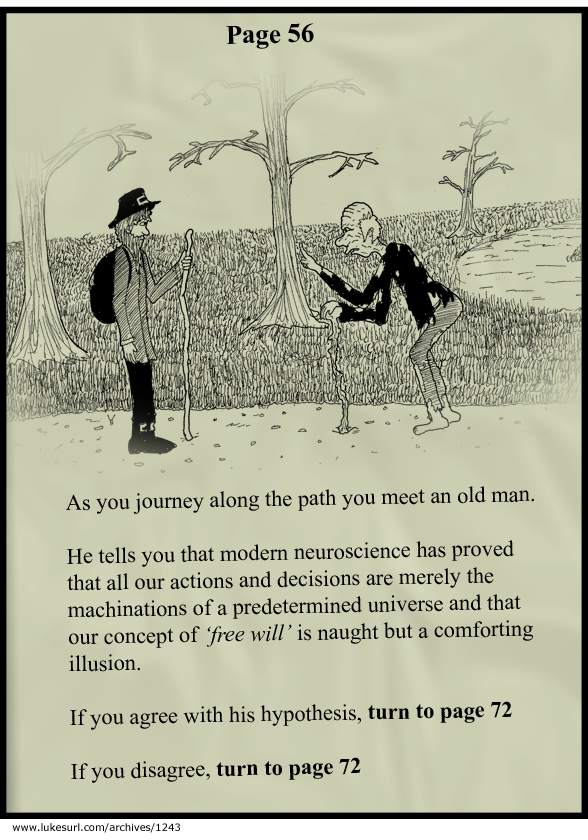
Turn to page 72 damnit.
Is it? If so, feel free to explain why in the other threads. I don’t mean to misrepresent you, but you gave the link as if you supported it without qualification, and the writing in that link - although it may not accurately reflect your position or the propositional attitude - suffers from the problem I mentioned.