Simultaneous Actions

I’m having trouble understanding this part of HA. It seems to me that I can perform two different actions at the same time. For example, with one hand, I could be writing, and with the other hand I could be scratching my leg. These two actions appear to be simultaneous.

Since this seems like a painfully obvious point, I wonder what it is I am missing. Why would Mises say that these are NOT two synchronous actions?

You are performing a single action whose goal is to contradict the misesian hypothesis, this involves various bodily movements performed in conjunction which if performed separately would each have appeared to embody a separate behaviour. In short its an elegant approach that has reductive advantages.

So Mises is just defining the issue away? Calling “writing and scratching my leg” a single action, because its more elegant that way?

In you example do you have one goal or two. I think one. You always have constraints and one physical behaviour you wish to exhibit will need to be reconciled with your free floating wish to do others. It’s going to take an.over arching action to accommodate this. Unfortunately you can’t split of into two human beings that go and do two separate acts. It’s one man one act…

Great question, this one perplexes me. I can pat my head and rub my belly at the same time but is this considered one action because my aim is to show that my arms can perform this way?

This just feels problematic for some reason. Like I can chew gum and walk at the same time while talking on a phone looking at a pretty lady. All my ends here (wanting better breath, want to get from a to b, wanting someone to know something, admiring some nice legs) can be separate and yet can be completed at the exact same time. Just on a normal day not trying to defeat this Misesian hypothesis.

Mises does not speak of the ability of an individual to perform multitasking. Action is in the first place decision making/value judgment among certain conflicting alternatives, not the mere physical execution of tasks. In the final execution, the individual just shows what was decided. And it is of course impossible for the individual to make decisions simultaneously. I think it gets clear what he means by it when you read the example he gives one page later:

“The attempt has been made to attain the notion of a nonrational action by this reasoning: If a is preferred to b and b to c, logically a should be preferred to c. But if actually c is preferred to a, we are faced with a mode of acting to which we cannot ascribe consistency and rationality.6 This reasoning disregards the fact that two acts of an individual can never be synchronous. If in one action a is preferred to b and in another action b to c, it is, however short the interval between the two actions may be, not permissible to construct a uniform scale of value in which a precedes b and b precedes c. Nor is it permissible to consider a later third action as coincident with the two previous actions. All that the example proves is that value judgments are not immutable and that therefore a scale of value, which is abstracted from various, necessarily nonsynchronous actions of an individual, may be self-contradictory.”

Your first task is to realize that synchronous and simultaneous have completely different meanings. Then, come back to this problem and tackle it.

Simultaneous: Happening, existing, or done at the same time.

Synchronous: 1. Occurring or existing at the same time. 2. Moving or operating at the same rate. 3. a. Having identical periods. b. Having identical period and phase.

How do you think Mises is using the term synchronous?

To DD5: WHAT?

Completely different meanings? Perhaps in the way he is using the term. I can’t believe I actually googled definitions for these two words.

Simultaneous:

Happening, existing, or done at the same time.

Synchronous:

Occurring or existing at the same time.

Why do people on this site always say that a person’s definitions are wrong and never proceed to give a definition?

This reminds of a quote by John Searle, quoted in Hoppe’s note on indifference

Ho

I was thinking something along #2 and #3, which is how they are commonly used in the fields of Engineering and Physics. However, I see now that the terms are indeed used interchangeably in some other respects.

I think Mises also had something in mind along #2 and #3 becuase synchronous there also refers only to concerted actions of different entities or devices.

I feel he is talking about other effects not intended by his actions, such as putting wear on his shoes. I see why this couldn’t be called “actions” really. I can sure chew gum with an intention for a good taste in my mouth, while at the same time aim to walk from point a to point b.

If I went from not writing and not scratching my leg, then deliberated over my ends and chose the end of “to have scratched and my leg and written my paper”, then begun writing and scratching at the same moment, then maybe.

But more realistically, I am in the middle of my action of writing my paper, and then feel an itch, and decide to scratch it, all the while I’m still writing. After I’ve succeeded in relieving my itch, I’m still writing. In this case, they can’t be considered the same action. I didn’t decide on one goal and then act, one goal occurred to me first, then while I was acting, another goal occurred to me. But it was the kind of goal that I could satisfy without bothering to stop the action I was in the middle of. My goals were not-conflicting.

I take Mises to mean that actions cannot overlap, that at any moment a man can only be doing one action (Hoppe’s note emphasizes that the action must be described “preferably”, and he is right). So would Mises say I stopped writing when I decided to scratch my itch, and then resumed or begun a new writing action straight after?

Mises didn’t use the term Synchronous instead of Simultaneous just to sound more sophisticated. He had something else in mind. What he had in mind was a concept that applies to concerted action only, but does not apply to a single individual action. That concept is synchronous as in definitions #2 and #3, provided above. Under these definitions, the concept is very much different from simultaneous.

So let me rephrase my initial comment. He (trulib) must first realize that Mises used the term synchronous to mean something different from just simultaneous. Then he should come back and tackle the problem.

And also, chill out!

Yes, so Hoppe says that “putting wear on your shoes” may be a description of your behaviour, but this behaviour is merely incidental to your action, since it is no way the goal of the action. The preferred description of your action is “walking to point b”. So from the praxeological point of view, you are NOT putting wear on your shoes.

A possible solution has just occured to me. Your chewing gum example does seem at first glance to be different, because you do have a goal of having a good taste in your mouth. But at any particular moment you only have one goal “in your head”. So at one moment, you are thinking to yourself “I’m nearly at point b now”. Then a moment later you think “gee, this gum tastes good”. So at the first moment, we could say that you chewing gum was merely incidental to your real action which at that moment was “walking to point b”. Praxeologically, you WEREN’T chewing gum as an action - that wasn’t the preferred description of your action. A moment later, its vice versa, and you are no longer “walking to point b”, from the praxeological point of view, because that is not the preferred description of your action, because at that moment your mind was on the gum, and the walking was incidental.

So would Mises say I stopped writing when I decided to scratch my itch, and then resumed or begun a new writing action straight after?

Why would he say you stopped writing (a behaviour) out for scratching (behaviour) when you said that the behaviours you exhibited were in order

  1. write
  2. write and scratch
  3. write.

, which clearly has you performing two behaviours simultaneously?

But I ask you, at the time you were observed ‘writing’ and ‘scratching’, was your mind a unity that acted in a way that externally could be interpreted as two behaviours or should your mind be interpreted as having undergone a sort of division, cleaving neatly into precisely two sub minds, each responsible for their own discrete parallel task? and thereby excluding an interpretation of a ‘super-task’ as far fetched?

At the least I think its reasonable to posit ‘cross-talk’ between such operational units, and as such I see it as more helpful than mystifying to interpret a super task as existing through which the subtasks are invoked and controlled.

I’d like to hear what you think. Do you think my OP example was simultaneous actions, but not synchronous actions? Why is the distinction important?

No two or more events can literally occur simultaneously. There is no finite resolution of time that one can use to actually determine simultaneous events. The term is mostly useful in everyday speech to describe multiple non-simultaneous events that occur at relatively close time intervals. Synchronous on the other hand is a very useful technical and scientific term that can be precisely measured and applied. Synchronous events, in the technical and scientific use of the term, never occur simultaneously, but at a fixed time interval in relation to each other. The events can be years apart, but still synchronous. It is obvious that this concept can only apply to multiple devices, systems, or actors. Never to a single operating (or acting) unit.

This notion of “preferred description” is closer to the mark, but still too oblique.

The source of the confusion is that praxeological action is different than normal action. Praxeological action does not include involuntary or subconscious actions. In the instant that Greg is struck by the sight of pretty lady’s legs, we may allow that he is in that moment not aware of the “actions” of walking or chewing gum. These other movements are happening without his present conscious guidance or decision, a process set in motion by a conscious decision in the past - to be sure - but that was then, this is now.

The decision (=praxeological action) to continue walking or chewing is not happening now, just as your decision to keep your head erect is not happening now, even though you are doing so. In fact it could be argued that the mastery of some action like walking or chewing is the subducting of that action out of one’s awareness, so that it no longer requires conscious decisions (praxeological actions) to be made every moment.

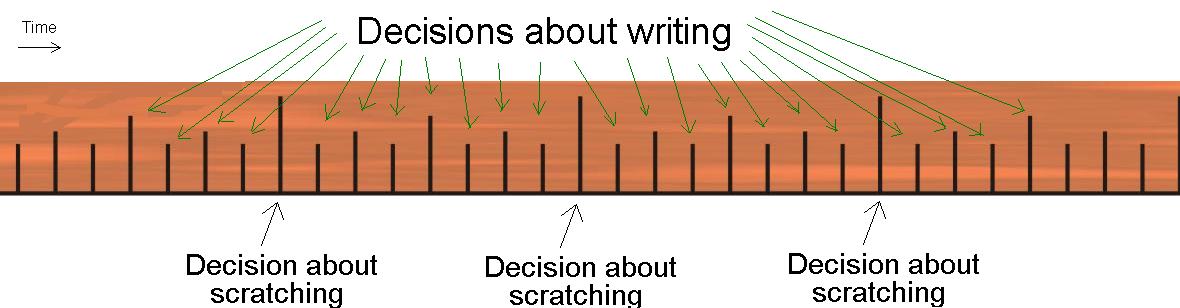
Hence the idea as presented by Mises in the OP seems to be that I can only aim or wish for one state of affairs at once. If I aim to be writing while scratching, all in one go, that would be considered a single praxeological action (decision/wish) because that is exactly my wish as it appears in my mind: in words, “to be writing while scratching.” If, on the other hand, I am engaging in all the little moment-to-moment decisions that writing entails, and in between those decisions I insert a few decisions related to scratching, those praxeological actions (=decisions) are not happening at the same time.

Bewilderment is the predictable result if we allow the notion of “action” to be blurry. If it is fuzzily defined, as it is in everyday speech, to encompass both the decision and the resulting physical movement, we will have the darndest time trying to sort out what is synchronous/simultaneous and what is not. If it is defined more precisely, as only the conscious decision or wish itself, or the periodic succession of such decisions, we can see how two ongoing “actions” are really an ongoing drum beat of praxeological actions (decisions), with none of those being simultaneous:

Time-wise, it’s as if the conscious process is partly a patter of decisions (=praxeological actions). When writing, which requires frequent conscious decisions, most of my attention will be taken up with writing decisions. I might also be scratching “at the same time,” in that while my fingers are typing a few words without any need for conscious decision once the typing process has started, I could in between those decisions about writing make some decisions about scratching. The scratching also does not need constant conscious supervision, so it only takes a conscious decision, say, every few seconds. The resulting patter, set in time akin to how sheet music is, might look somewhat like the marks on a ruler. (See diagram above.)

Now returning to Searle’s quote, the term “preferred description” misses the mark precisely because it is not the words that describe the state of affairs that matter; what matters is the actual experiential qualities of that state of affairs. It is the actual sensations the actor wishes for. Searle stated it better when he said, “in acting, what I am doing depends in large part on what I think I am doing.” And trulib, you seemed to express the same when you said, “But at any particular moment you only have one goal ‘in your head’.”

The reason the actor prefers description A over description B is that description A is what describes the state of affairs he cares about, what he aims for. His motivation for walking in Hyde Park would consist of specific pleasurable sensations like hearing birds sing and feeling fresh air pour into his lungs, and not certain other ones like feeling the hair on his head shake up and down.
Only in hindsight and by the use of measuring what two or more people were doing during a specific time period, is it possible to ascertain that there was a coincidence in action or something that could be considered synchronous had occurred. Synchronism only refers to multiple people acting in a concerted fashion. ie they have all been told to screw toothbrush caps on a certain way and when observed they appear to be synchronised.

Then he goes on to say that there is never the case for two individuals that do exactly the same thing at exactly the same time. But only to make the point that it is misleading to refer to multiple people performing the same action as a coincidence of various actions.

Maybe my interpretation is wrong, that is just how i understood the ops quote.