This notion of “preferred description” is closer to the mark, but still too oblique.
The source of the confusion is that praxeological action is different than normal action. Praxeological action does not include involuntary or subconscious actions. In the instant that Greg is struck by the sight of pretty lady’s legs, we may allow that he is in that moment not aware of the “actions” of walking or chewing gum. These other movements are happening without his present conscious guidance or decision, a process set in motion by a conscious decision in the past - to be sure - but that was then, this is now.
The decision (=praxeological action) to continue walking or chewing is not happening now, just as your decision to keep your head erect is not happening now, even though you are doing so. In fact it could be argued that the mastery of some action like walking or chewing is the subducting of that action out of one’s awareness, so that it no longer requires conscious decisions (praxeological actions) to be made every moment.
Hence the idea as presented by Mises in the OP seems to be that I can only aim or wish for one state of affairs at once. If I aim to be writing while scratching, all in one go, that would be considered a single praxeological action (decision/wish) because that is exactly my wish as it appears in my mind: in words, “to be writing while scratching.” If, on the other hand, I am engaging in all the little moment-to-moment decisions that writing entails, and in between those decisions I insert a few decisions related to scratching, those praxeological actions (=decisions) are not happening at the same time.
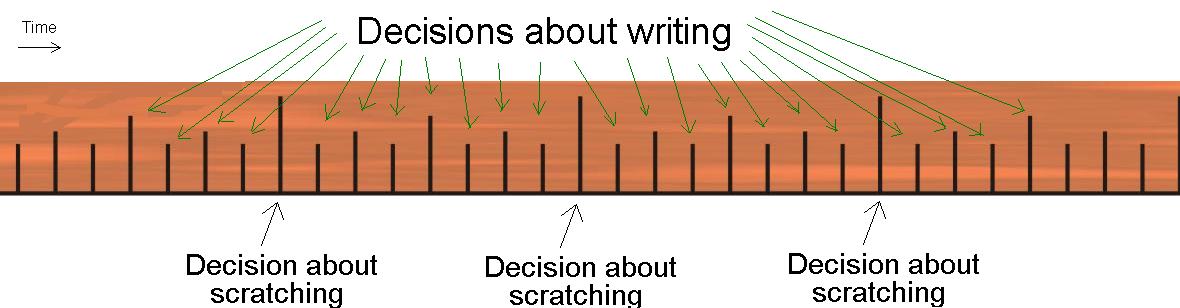
Bewilderment is the predictable result if we allow the notion of “action” to be blurry. If it is fuzzily defined, as it is in everyday speech, to encompass both the decision and the resulting physical movement, we will have the darndest time trying to sort out what is synchronous/simultaneous and what is not. If it is defined more precisely, as only the conscious decision or wish itself, or the periodic succession of such decisions, we can see how two ongoing “actions” are really an ongoing drum beat of praxeological actions (decisions), with none of those being simultaneous:
Time-wise, it’s as if the conscious process is partly a patter of decisions (=praxeological actions). When writing, which requires frequent conscious decisions, most of my attention will be taken up with writing decisions. I might also be scratching “at the same time,” in that while my fingers are typing a few words without any need for conscious decision once the typing process has started, I could in between those decisions about writing make some decisions about scratching. The scratching also does not need constant conscious supervision, so it only takes a conscious decision, say, every few seconds. The resulting patter, set in time akin to how sheet music is, might look somewhat like the marks on a ruler. (See diagram above.)
Now returning to Searle’s quote, the term “preferred description” misses the mark precisely because it is not the words that describe the state of affairs that matter; what matters is the actual experiential qualities of that state of affairs. It is the actual sensations the actor wishes for. Searle stated it better when he said, “in acting, what I am doing depends in large part on what I think I am doing.” And trulib, you seemed to express the same when you said, “But at any particular moment you only have one goal ‘in your head’.”
The reason the actor prefers description A over description B is that description A is what describes the state of affairs he cares about, what he aims for. His motivation for walking in Hyde Park would consist of specific pleasurable sensations like hearing birds sing and feeling fresh air pour into his lungs, and not certain other ones like feeling the hair on his head shake up and down.