First I’d distinguish between economic violence and non-economic violence.
By economic violence, I mean violence with economic motives. The mafia, the State, and ordinary thieves engage in economic violence.
By non-economic violence, I mean violence with other than economic motives. In this category is the husband who kills his cheating wife in a fit of rage, and the wife’s brother who in turn kills the husband out of revenge.
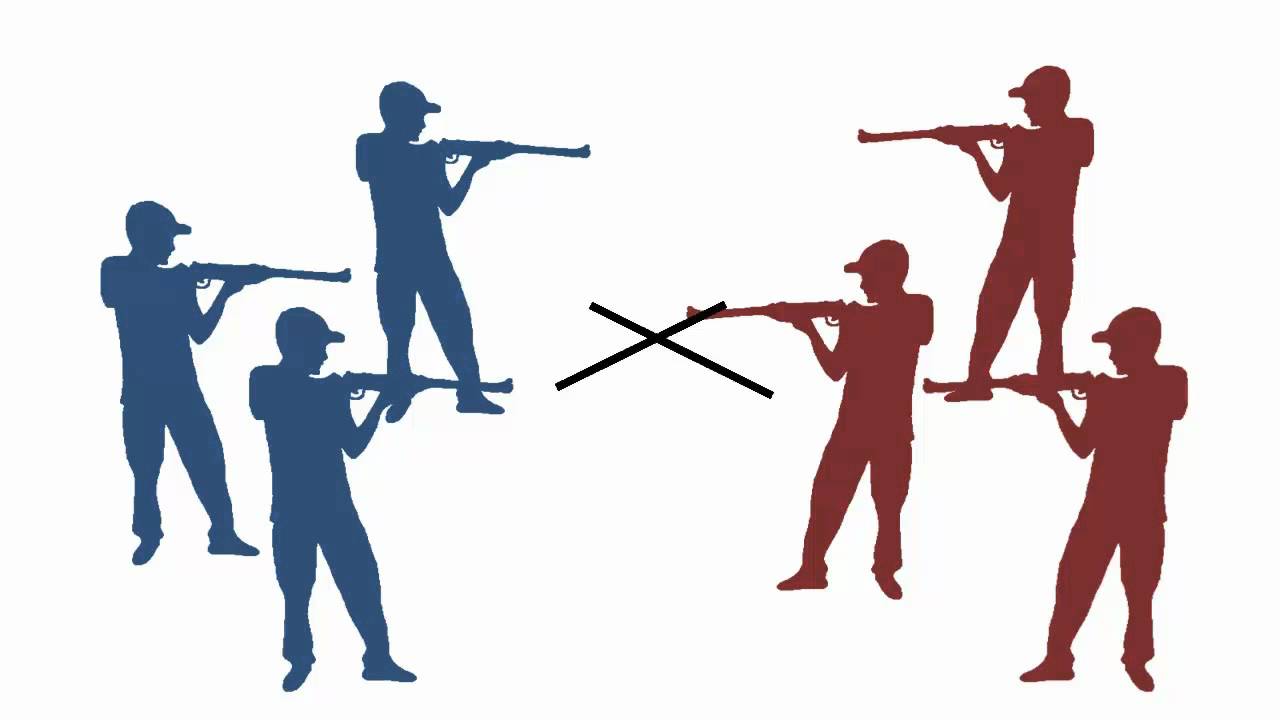
Cases where individuals engage in isolated instances of either economic or non-economic violence are in themselves not much of a problem. Firstly, there’s no way to stop them, with or without a State. There will always be muggers and robbers motivated by profit, and spouse-murderers motivated by jealousy, hate, whatever. The problem is in the consequence of either kind of violence. If the aggressor is not checked (either by his would-be victim or by some third party), the violence will expand indefinitely. The extreme case for economic violence is a thief living in a world of pacifists. There’s nothing to check his lust for ill-gained profits, and so he won’t be checked. He’ll gradually amass more and more until he become the dictator, and the owner of everything and everyone. The extreme case for non-economic violence is the eternal vendetta between families. 400 years ago a Smith killed a Johnson out of anger, and now the Smith and Johnson families devote most of their time to killing each other: for the purpose of revenge.
Neither outcome is desirable, obviously. Both economic and non-economic violence must be checked by something. If you want a stable and libertarian society, you have to either explain how both forms of violence are self-correcting (i.e. their own internal dynamics somehow bring the expansion of violence to a halt), or you have to explain how some kind of third party (e.g. the State) intervenes to stop the expansion of violence.
Again, no society is going to ever be free from violence altogether. Even a hyper-totalitarian society cannot stop all acts of violence among citizens. The traditional logic behind the State is not that it can stop all violence, but that, through punishing acts of violence, it can stop the expansion of violence: i.e. it can prevent the petty thief from making himself a king, and it can prevent the crime of passion from turning into a family vendetta. For anti-statists, the challenge is to explain how this task, of checking the expansion of violence (aka of resolving disputes), can be managed in the absence of the State.
Also note that for anti-statists the problem of economic violence is probably more severe than the problem of non-economic violence. The latter tends to remain confined to the “parties concerned,” i.e. friends and family having a personal stake in the quarrel. Because the violence is motived by things like honor and revenge, it remains limited. Whereas, economic violence has no such limits; the thief doesn’t care who he exploits. The ultimate expression of unchecked economic violence is the total-State.