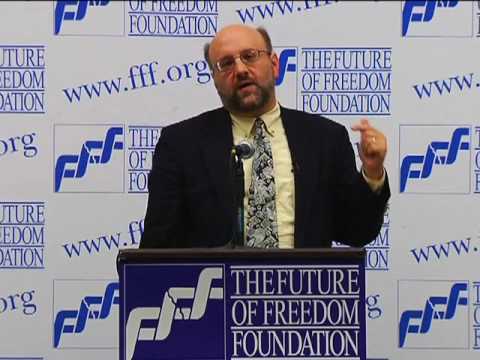
I saw this. Actually made me like Horowitz a lot more. Prior to that, I had coordination problems with his point of view.
What kind of problems? The ‘central’ versus ‘free’ banking discussion or something else?
I was making a joke. He is a member of a blog group that identified themselves as Austrian Economists until Jan 1 2010, when they renamed their blog “coordination problem” in order to re-brand, because apparently Austrian Economics has become too mainstream to represent what they do.
Yes, I got the joke, but I assumed that you were making and a joke and a comment on his work, so I was curious which parts of it. (If it were the free banking/full reserve banking; then I’m not really interested. I’m sick and tired of that discussion; that’s why I asked.)
And tbh I would say that your ‘apparently’ is only supported by assertions (who are, I admit, not completly of the mark), not facts.
Not sure why you assumed that.
We’ll have to differ on that then.
Because if you leave out the joke, you get ‘prior to this, I had problems’ (or something like that) with his work’. 
-
He didn’t explain what arguments ‘crazies’ where using that were false (or why). Plus he created the false dichotomy that EITHER conspiracies or ideological evolution can be true and not both.
-
He didn’t explain how a contraction in money occurred during the depression of the 30s, why it was bad, and what the FED ‘should’ have done (if anything).
-
He didn’t explain why a free market in money and banking would be fractional.
To me, the historical things were interesting (particularly from before 1913), but the rest was a missed opportunity (assuming his ideas are correct, which I very much doubt).
The better question is: “Do We Really Need Fractional Reserve Banking (FRB)?” Without FRB, the need for a central bank melts away on its own. He merely waved off the claim that FRB is fraud (among other things). Claiming that the free market would “better” calculate people’s “demand for money” (than a central bank would) is mind-boggling to me. I have no respect for people like this guy.
Z.
You might want to read his actual work rather than listen to a single presentation, discover that he didn’t respond to all of your person concerns, and dismiss his argument out of hand.
Most of his work is on Monetary equilibrium theory, which absolutely necessitates the existence of FRB. If it’s fraud, or if the market was to eliminate it, then the theory is worthless even before you begin to scrutinize it on other economic grounds.
Yes, one is curious about his choice of words when describing the actions of the Fed. There is usually a reluctance to outright condemn it.
But you can’t scrutinize it on economic grounds. You rely on baseless assertions and meaningless accusations.
I don’t understand your position. Markets work and central planning doesn’t, right? Maybe you should read up on monetary equilibrium theory before you dismiss it? Just a thought.
In the video he actually said (just as Krugman says) that it was the Fed that caused the Great Depression by “wrongly” cutting the money supply by 30% at the “wrong” time. He’s whole argument is that there’s nothing wrong with fiat (invented, created out of thin air) money as long as it’s not the government (the central bank) but the free market determining people’s “demand” for it. The problem is merely one of the calculation kind (i.e. the inability of a central body to calculate the optimal amount of fraud in the system) the solution being to delegate that job to the free market instead. I’d rather not use the words I feel like using for this type of reasoning.
Z.
I don’t agree with many of the free bankers positions, but their framework is logically sound. This doesn’t necessarily mean that everything they say is correct, just that people won’t dismiss monetary equilibrium theory because some define FRB as fraud. Deflation is real, and it can be a problem. Horowitz is most likely talking about secondary shocks brought about by an elevated market rate above the natural rate.
And I think I responded to two very erroneous economic reasoning of yours with the aid of both Mises and Hayek. You never replied.
Not when it’s a market phenomena.
But they don’t. Are you familiar with the criticism of monetary equilibrium theory?
Bingo. FED induced deflation is a problem, not because deflation is a problem, but because the FED induced it. Likewise for inflation.
Really? Prices will decline as a result of productivity gains, but what happens when the market rate rises above the natural rate, and how does this happen? What is Hayek talking about when he mentions secondary phenomena? Why does Hayek say that deflation can be just as ruinous as inflation? Is there “bad deflation” in Rothbard’s world? What is Hayek talking about in Lecture 4 of prices and production (the case for an against elastic money supply)? I have to re-read the book because I was so biased the first time around, let me quote from my notes: Hayek begins to lose his mind and differentiates between a “legitimate” increase in the supply of money which should occur when there is an increase in demand for money which would act as money, as opposed to the situation when there is an illegitimate demand for money which acts as capital.
All you do is presuppose the validity of your argument before the conversation even begins. FRB is automatically fraud, an increase in the supply of money automatically suppresses the market rate below the natural rate, ect, ect. My conversations with you resemble my conversations with Marxists: value is created by labor, and FRB is fraud, period, the end.
What is the difference between the market rate and the natural rate? For a free marketer, I would argue that the natural rate IS the market rate.
I disagree. Money is merely a medium of exchange and a temporary store of value. Any quantity of it is “good” (“optimal”) and there is absolutely no need for any honest agent in a free market to manipulate it. Any agent that circulates notes (claims) on non existent assets is a fraud and the free market will condemn it into oblivion as such.
Z.