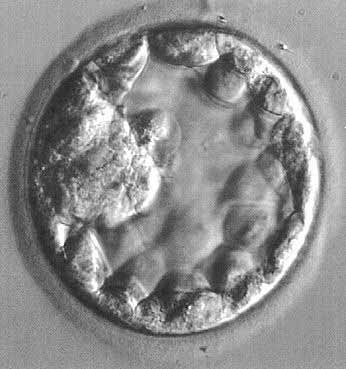
As a theist I am wondering how my fellow an-caps are able to create a consistent argument for embryonic stem-cell research without violating the NAP?
I moved this question to its own forum because I don’t believe this must be categorized as a religious question.
It has been argued that blastocysts are not human, but I point to the obvious in disagreement: Human stem-cells can only be taken from humans and defining a blastocyst as less than or non-human is, in my mind, an equivocation..
I have had verly little difficulty synthesizing biblical principles with an-cap philosophy thus far. As a matter of fact, the two mesh quite well. So, how can the NAP not be violated with embryonic stem-cell research. I am assuming a privately funded situation for this question since the government-funded one seems like a no-brainer here.
I guess so… are there any that have ever not caused friction on their bodies? Even Jainists do that…I suppose only innoccent skill cells that have no volition have never committed the sin of murder, and they are the murdered!
Would you mind critiquing these (though I would certainly welcome anyone else’s critiques as well. As a matter of fact, the more the better to help me understand the an-cap perspective!)? I am interested in how you would formulate an argument against them from an an-cap perspective as it regards the NAP. Obviously they are not written about embryonic stem-cell research, but the questions and logic are very similar. I would appreciate your thoughts and I’m in no hurry for a response. I am very interested in this question for consistency and cogency in the logic. Here are the links:
“When” something becomes a human is a constant gradient. The picture that I posted in the “religion and anarchism” thread is actually a pig blastocyst, and I did that intentionally (I said it was a cow). The point I was making is that it was virtually indiscernable from any other blastocyst. If I told you it was a human blastocyst, there is a considerable chance that you wouldn’t have batted an eye.
I think the way you choose to look at it is that somehow the term “human” is an umbrella term. You believe that a zygote is a “stage” in human development. I mean, if left alone, it certainly will develop into what we think of being as a human. But until then, it seems like it’s a clump of cells much in the same way skin cells are as was previously mentioned. When I think of what a human is, a central nervous system seems like a prerequisite. Probably an identifiable shape (arms, legs, shoulders, etc.). Probably consciousness helps, although then you open up a can of worms saying “what about vegetables?”, but that is an entirely different discussion and they were human once upon a time, so I’m not sure it’s apples and apples.
In essence, I think your “human stem cells only come from humans” is unargued for. Stem cells that can be applied to human biology are certainly derived from a necessary stage in becoming human, but it doesn’t follow that it is a human. I believe you have to make your case, otherwise it’s just an assertion.
Eric080, You are attempting to associate me with a statement I never made. I never said the image was of a human, or a pig, or a cow, or anything else. As a matter of fact, I never said anything about the image at all. At any rate, it’s getting late for me, but I am very interested in this subject so I will come back to it when I can. Have you had a chance to read the articles and arguments I linked yet? If you have (or do), let me know what you think.
nirgrahamUK, I was only trying to illustrate the absurdity that arose from one of the false premises in your syllogism (i.e. just because human skin comes from humans does not make the skin itself a human/person) and thus the fallacious conclusion. Nothing more.
What I am asking is how would you explain this subject to someone totally unfamiliar with it in layman’s terms? One line quips (even if they are logically sound) will not suffice and neither will logic syllogisms, etc. They may make great illustrational tools along the way, but they fall short due to the fact that the vast majority of people do not think in categorical terms nor understand logic structure, hence the necessity for expanded explanations in lay terms. So, how would such a subject be explained to them?
The transformation of fertilized egg cell to adult human is a process through which over time a mere automaton becomes a moral agent imbued with intelligence, self awareness, self-control, responsiblity for its actions.
There is clearly a boundary problem (sorites paradox) as in so many things, however,
holding that the freshly fertilized egg is a moral agent is as absurd as suggesting that only a 40year old human is a moral agent and no one younger.
Now we can have a detailed discussion about what ‘moral agency’ means to us, and what qualities we insist on a moral agent to have and we can go back and forth, but as I have shown in prior posts the mere argument that the fertilized egg is a product of manufacture of an organism in the human genus is not proof of anything or else it proves too much and your skin and hair are moral agents.