I am currently trying to piece together an history of the Anti-Car/Individual Transport Mentality in the West, be it the United States, Germany, the UK etc. I need to know who started it, how they managed to rack up so much support, how the State entered the picture and finally how big car companies jumped aboard themselves, hoping to use legislation to make more money and/or keep the Anti-Car crowd off their backs.
Can’t help you with the history, but it seems to me people don’t like cars because they pollute the air, and the difficulty in suing for pollution goes back to government legislation in the 19th century.
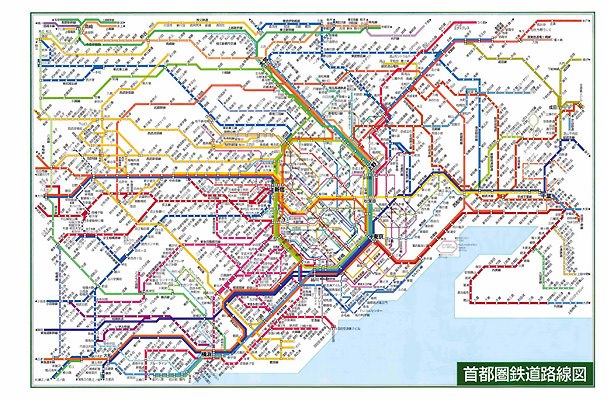
Also, population density is a huge factor. Check out all the (mostly private) railways in a 30-by-30 mile area in Tokyo.
That’s for the people. But why don’t the power elites like cars? Don’t tell me it has to do with pollution.
A hint is to be found in that in many kingdoms of yore it was illegal for commoners to ride horses, at the very least in the presence of nobles, but sometimes also in general.
Where is this “anti-car / individual transport mentality in the west” though? Do you mean recently?
I believe I heard something about this in one of the recent Rothbard lectures? The Great Cooperation? Sorry not sure exactly where. It mentioned Ford, mass production etc… and goes on to talk about the increase in peoples demand / want for “individual transport”. Hope that helps somewhat. [:)]
It may not be as prevalent outside of Europe, but if I’m getting Kakugo right here, I believe he refers to the countless discriminatory policies enacted against car users in EU countries. Examples from where I live:
About 80 cents/litre taxes on gas
Cars are taxed according to their CO2 emissions, formerly according to cubic capacity (just as bad)
A large chunk of these taxes is not used to repair motorways, but to subsidize public transport
Government-sponsored programs are constantly encouraging people to stop using cars
Personally, I think there are two main drives behind it: an aversion against the uncontrollable nature of car traffic, i.e. you can’t boss car drivers around as effectively as the publicly transported, at least not yet. And perhaps the bigger motivation: egalitarianism. Driving a sweet car is the most successful way to produce envy. The crusade against cars is just a side battle in the all-around war against inequality.
There are people who fiercely critique others for their behavior while engaging in the very same activites themselves. It is called hypocrisy, and it is quite common among those who would rather have everyone ride a public train for pseudo-egalitarian reasons.
If all those who battled for egalitarianism in the political arenas of today were to stick to their words, boy, would we save on public expenditures.
I was curious, so I did some digging. Besides Japan Railways (privatized in 2002 but still bloated) and the 20 or so subway lines (these are PPPs) at the core, everything else is fully private as far as I know.
Where it says “citation needed” I can cite, for example if you wanted to go from Shibuya to Yokohama, it’s significantly cheaper to take the private Tokyu line than the privatized-in-2002 JR line. Generally though, the price is about double on a public line or JR than on an originally private line. The municipal railways are pretty good, but the former national railway (JR) is full of terrible design and gets delayed constantly. I remember the JR Takasaki line running north from Tokyo into the mountains would be significantly delayed about one in three times, while I don’t think I’ve ever experienced any delays at all the private Tobu Tojo line that runs parallel to it. Oh and the private line is half the price, faster, and the trains are about 50% more frequent. Oh and they also start earlier in the morning and run later at night.
I’m only half-joking, because really cars are harder to centrally manage than central transportation like railways, so it leaves less of a role for government. (I suppose.)
Actually this sounds like it. It’s not that they are anti-car, but that they will be happy to use the anti-car sentiment of certain environmentalists to justify more taxes and regulations. Just like cap-and-trade for global warming morphed into just more taxes.
The anti-car movement is just a backlash against the pro-car movement that completely remade the landscape around mandatory automobile ownership in the early post-war era.
They have no power whatsoever, at least in comparison to the car lobbies and bureaucracies.
In some cases there’s a fine line between perseverance and trolling. Yes, we know (even newcomers like me) that being this libertarian forum’s token non-libertarian is your shtick, so how about making an argument next time?
The “conflict” is clear. Elitism != egalitarianism. People who want to put plebs in their place by depriving them of independence and confidence provided by a car are not egalitarians. Emperors who made their subject approach them crawling on their belly were not interested in egalitarianism.
What, you mean that anybody at all who has 5,000$ can walk into a privately owned car dealership and get a car?! My, we should put an end to that! Only members of the anointed class and folks with special dispensation from the wise supervisors should be able to go where they want.
Their only problem is they are doing it backwards. They should go to the source and nationalise auto making and distribution. Oh wait… They’re doing that too now.