Total Spending in an economy is equal to total income
In an economy, based on simple arthimetic and common sense, one can see that all spending is equal to income, assuming that the money supply is not increasing. One man’s consumption is another man’s income. If I buy a fruit at the store, then the store has income, which they would not have If I did not spend my money. If for example, everyone saved their money and nobody spent any money, nobody would have income.
Total spending = Total income
Therefore, the more spending that occurs in an economy, the higher one’s income is.
Another way to think of this is the velocity of money:
MV = QP
This is the quantity theory of money. It states that the velocity of money (how fast money is ciruclating) times money, is equal to the quanity of goods and services, times the price of these goods and serves.
M = money, V = velocity of money, Q = quantity of goods and services, P = price of goods and services.
So as one can see If the velocity of money increases, then so do the quantity of goods and services, so long as prices do not not increase at the same rate.
Prices have been observed to be “sticky” or resistent to change in the short-run and during recessions. Therefore an increase in the velocity of money corresponses to an increase in goods and services.
A broken window causes spending to increase
So let’s say someone’s window is broken. This means that someone is needed to fix the window. This corresponds to an increase in income for the glassman and the glassman can use his income to buy other goods and services, and so forth causing a multiplier effect.
Counterarguments to the broken window argument
Propoents of the broken window argument fallacy argue that a broken window is bad for an economy for the following reasons:
a) The broken window means that real resources have to be used to fix the window, some of which could be used for other goods and services
b) It ignores the unseen vs. the seen.
c) The increase in spending will just cause inflation
I will demonstrate why these arguments are wrong.
In a recession or depression, resources are underutilized
A recession occurs If resources are not being fully utilized. This is emperically verified. Many nations have high unemployment and the US has had high unemployment in its past. For example, Greece has an unemployment rate of 25%.
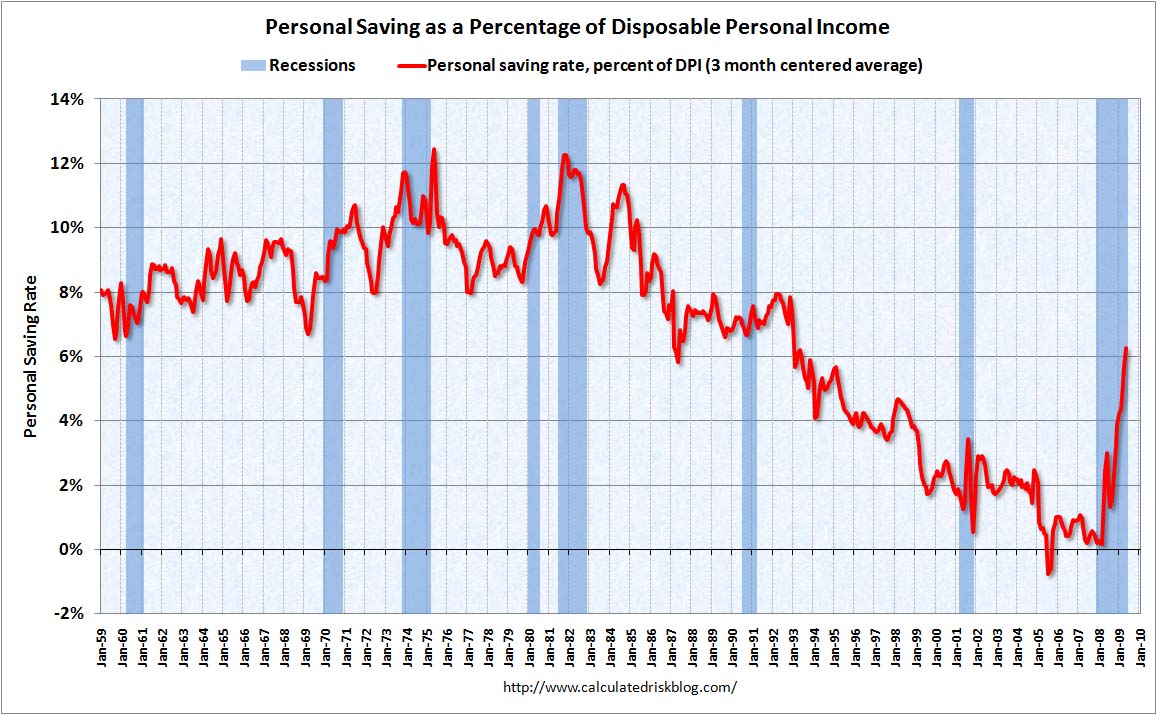
What this means is that people who are willing to work are unable to do so. This also corresponds to factories not producing at full capacity. The economy is not producing at maximum capacity. The reason the economy is not producing at maximum capacity is because people are not spending their money. As one can see in this chart, the 2008 recession is considered one of the worst recessions since the Great Depression and the result is a skyrocket in savings:
http://farm4.static.flickr.com/3616/3662736447_ff57d9af0b_o.jpg
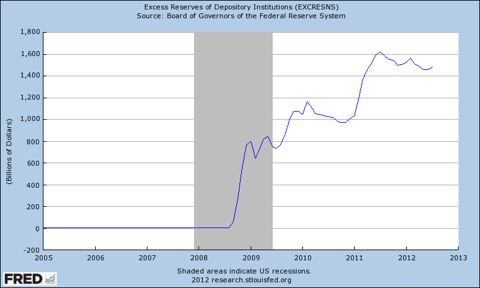
The same goes with banks that are holding excess reserves:
http://static.cdn-seekingalpha.com/uploads/2012/8/31/saupload_Excess_Reserves_Fred_thumb1.png
Therefore there is no need to worry about taking resources from someplace else during many recessions and depressions.
The person with a broken window could have just saved his money, thus producing no real economic effects
A counter-argument is that the person with the broken window instead of spending his/her money on the window, would have spent the money on other goods/services, thus the broken window is a net-harm. However, this ignores the fact that the person could have just saved his/her money instead, which would produce no economic benefit at all.
Prices are “Sticky” so inflation does not necessarily occur. The increase in spending would only cause inflation if the economy is producing near maximum capacity
Prices and wages have been observed to be sticky, For example, during a recession, if there were unemployment problems, then one would expect that wages would just lower and the market would clear itself. However, this has not been observed. One can also see numerous examples of how prices do not change even with changes in demand. For example, movie tickets prices remain the same regardless of how many tickets are sold. The same can be observed with books. The Harry Potter books did not have a spike in prices because there was a spike in demand of people who wanted to read these books. A Harry Potter book costs about the same as most other books.
Emperical Evidence of the “Broken Window Fallacy” in action
One example of the broken fallacy in action is government increasing its spending during recessions/depressions. This is an example of how spending increases the domestic goods and services in an economy. Emperical results have proven that the fiscal multiplier does exisit.
http://personal.lse.ac.uk/ilzetzki/research/IMV_101910.pdf
Furthermore, one can look at history. If one looks at World World II after the great depression, the government spent massive amounts of money on the ar efforts. The result was that unemployment decreased dramatically, almost down to zero.

Economic activity boomed:
http://upload.wikimedia.org/wikipedia/commons/a/a1/US_Employment_Graph_-_1920_to_1940.svg

After the end of WWII, the US was the most powerful economy in the world, and continued to increase its economic growth creating great prosperity.
Conclusion
While the broken window fallacy is a fallacy if the economy is producing at its full potential, this is not a fallacy during recession and depression times. Real variables, that are considered to be economically positive, such as an increase in gross domestric production, occur If there is a net increase in spending, which can be jumpstarted through any event, such as broken windows.