“Potential customers must necessarily pay less than they stand to loose to exploiters.”
okay.
“Therefore, potential defenders must necessarily be able to profit more by exploiting those in need of defense.”
No it doesn’t. The hypothesis clearly states that “potential defender(s)” (plural) are better off exploiting. I explicitly don’t assume that. You pose no argument as to why multiple defenders render the statement false.
State it all you want, it is a meaningless statement. Of course there is no demand for exploitation. That is the whole point of it. The demand for getting exploited (if that even makes any sense) will always and forever be zero. An exploiter is not attempting to meet any market-demand, anticipate consumer-preferences, etc. He is too busy pillaging your village to care. His profits are related only to the quantity he takes minus what it costs him to take it. This should be a fairly obvious point."
Ok, so because there is a demand for defense and no demand for exploitation, you will try to find the best deal? hmmm (as opposed to when you look for the worst deal, i guess)
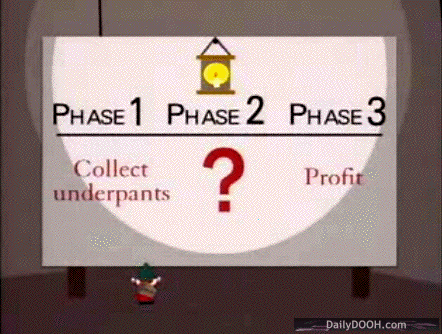
Contract! Did you delete a few sentences there? That was like ‘pahse 2’ of the “underpants gnome’s” business-plan. You forgot the part where they didn’t sign a contract and just pillaged you instead. How did you get a contract. This is the whole question im asking.
Their reputation would improve, because more people would be afraid of them.. They never had any clients to begin with, only victims.
Well, there goes your voluntary society.
Consumers? There it is again. There are no consumers. The use of force does not require a voluntary exchange and thus does not need to be mutually beneficial (or in demand) to be profitable to the exploiter.
I would of thought they would be busy fighting off the aggressive agencies. Isn’t that why they exist?
I will address your Internet thing one more time, in more detail. The Internet example is not of particular relevance to this discussion. Strictly speaking, one can not exercise the use of force over the Internet, any more than i can harm you with a phone call. You can’t actually steal anything over the Internet either, any theft that took place would actually occur at some real point, say at an ATM, bank teller, merchant storefront, warehouse, etc. These acts of theft would/do fall under the jurisdiction of the government, whose activities dramatically drive down the profitability of this type of behavior. Thus all Internet security companies, just like all combination-lock makers, merely augment self-defense measures and do not fall into the category of defense-providers. “Here’s our product, good luck.”
The point is that an aggressor does not have consumer support. You’re saying it doesn’t matter on a mechanical level. It matters on a market level because people who demand security can do something about it.
[quote user"mgmcintyre"]
Ok, so because there is a demand for defense and no demand for exploitation, you will try to find the best deal? hmmm (as opposed to when you look for the worst deal, i guess)
[/quote]
Are you saying i’m just pointing out the obvious? It IS obvious that firms who provide defensive services can obtain revenue voluntarily from their customers. They do not have to fight with their customers or other PDAs for income. Fighting is expensive.
[quote=“mgmcintyre”]
Contract! Did you delete a few sentences there? That was like ‘pahse 2’ of the “underpants gnome’s” business-plan. You forgot the part where they didn’t sign a contract and just pillaged you instead. How did you get a contract. This is the whole question im asking.[/.quote] They offered it to you in order to obtain exclusive rights to your revenue without fighting with other PDAs or customers. Minarchists seem to think that life is just a big game of Risk…
They would have no voluntary customers. They would have to fight with everyone everwhere they went. This might be profitable if they have laser cannons and everyone else has clubs, but there are market mechanisms for dealing with this kind of problem.
Cute. The point is that we don’t have to be afraid of companies systematically breaking their contracts.
Defensive PDAs have consumers. You take it for granted that all PDAs will be engaged in all out war against one another and regular citizens. Did it ever occurr to you how expensive this would be? That the market might be able to find some other arrangement?
Assuming aggressive agencies did exist, which they would go broke very quickly, defensive agencies are simply hedging that they can obtain more long term revenue by defending people than attacking them. Which makes sense because wealth is constantly increasing in a capitalist society. Also because if you attack people they can fight you back. Even if they can’t win the fight, they can make it a pyrrhic victory for the aggressive PDA, defeating the whole purpose of pillaging.
This is copied and pasted from before, and my rebuttal went unanswered. Again though…
It doesn’t matter what your philosophy of violence and theft is. There’s a way to “pillage” consumers on the internet and a way to “protect” consumers on the internet.
So you don’t own your facebook account? Is it okay if I hack it and do a bunch of crazy stuff for fun? Is it okay if I keylog your passsword to your bank account and then wire myself your money (ONLINE?!?!). This statement is either so dishonest or you have no idea what people can do on the internet.
Empty statement. Prove it. The internet is international. I would wager that 99.99% of spam and identity theft is stopped by private companies. The .001% is stopped accidentally by governments coincidentally killing these people in real life.
Even if we lived in an alternate universe where the American Government did a superb job of protecting us on the internet, other country’s governments don’t. There are countless developing countries with next to nil internet rules. And basically every country has no de facto internet rules.
Again, you are guilty of expecting all security to look like the status quo. I have stated twice now that our “security” system is from the stone ages. The model of policing where officers ride around lookin fer trouble is stupidly inefficient. Trials are so long and costly the majority of criminal cases are plea bargained. There is no justice. Jails are ridiculously cost ineffective. I’m sure you’ve heard of the prison industrial complex?
It is not cost efficient to throw hackers in jail. It is not cost efficient to have live security guards watching every website. I don’t know what your expectations are, but internet PDAs keep the vast majority of users safe, and that’s the whole point of security.
And remember my analysis which said we should expect internet security to fail more than real life security? Because individual laymen cannot enter the market of security. Because hackers can launch thousands of attacks simultaneously with a click of a button. Because you have to install third party software on your computer, which could easily be patched for aggressive purposes. Because most people have NFC what a firewall is and can’t make educated comparisons between different products…
Your arguments basically boil down to speculation that no one can come up with any way to protect consumers. This is ridiculous because if its such a difficult problem, there will be big bucks for anyone who solves the problem. Even if the market fails the way you speculate, anarcho capitalism still has the best set of incentives of any system to correct the failure.
To press with your analysis, you have to prove a priori that it is impossible for there to be strictly defensive firms on the market. I hate to be blunt, but it seems pretty obvious that one way you could solve principle-agency problems (click on the link for other ways) is to simply make the principle and agent the same entity. I.e. have a consumer owned company. You’d probably speculate that they could then use these gunz to go attack other people not part of the company, ignoring other people’s ability to defend themselves with similar structures, ignoring opportunity costs of focusing on warfare rather than production, and ignoring ostracism, which has proven historically to be a very effective means of enforcement.
I don’t know why it is that when you talk about defense, which is obviously a scarce good like anything else, all of a sudden, all of the oldest economic fallacies about markets come back to play.
Really, it is much easier to dominate you by starving you to death, therefore, it is not wise to let the market feed you? Or provide you with shelter or clothing? All of the reasons you’ve stated are not unique to defense. If they are true, then they are true for everything else that can be provided by the market.
And I’m also curious why and how it is that a small minority that requires your voluntary funding and constant approval to maintain its capital value, can begin to dominate the vast majority by coercion? Absent of legitimacy granted by the vast public, I claim it is economically and practically impossible. Or at least very close to that.
If you want to claim that people will remain statists at heart, and work towards the establishment of a State again, then that is a different argument and a different problem. But this is not what the concern here is about. It is about how the Ancap society, which would at large, view any attempt by some firm to dominate by coercion as illegitimate, come to dominate anyway. It is precisely economics science that can demonstrate how such an even is highly unlikely.
I already replied to his post. I demolished it line by line. He didn’t even attempt to answer the question. He simply assumed he got a defense contract from people who could have stolen what he needed defended. His argument might as well have been “because i said so.” Also, I said put your best argument in one post … not another pointless, swirling, conversation where the main point of the question is dodged again and again.
The only people I’ve seen here who can’t formulate a logical response and/or assess a basic one line statement is Sabien and Autolykos. Coincidence???
Uh, didn’t you see where he responded to your “demolition”? You have yet to respond to that. Please, I know you’re not blind…
And who cares about you saying “put your best argument in one post”? Since when are we supposed to listen to your arbitrary commands?
Perhaps you’d like to enlighten me on how I “can’t formulate a logical response and/or assess a basic one line statement”. Otherwise this is just a drive-by posting intended to stroke your own ego.
Also, just for grins and giggles – can anyone tell me whether writing posts consisting solely of the word “bump” is a common practice around here? My admittedly limited experience suggests it isn’t. That’s why seeing both mgmcintyre and xarthaz each “bumping” a thread seems so unusual to me. If bumping threads is common around here, I’ll gladly stand corrected.
*And who cares about you saying “put your best argument in one post”? Since when are we supposed to listen to your arbitrary commands?*
I started the thread and intended to format it in a specific way. If you don’t like, go start your own. Or continue to troll here with your childish “i won’t cooperate with you” attitude, i really don’t care. Im just gonna ignore you from now on anyway.
Bumps: I guess if this is the only froum that you have ever been on and you “don’t understand computers,” then you might not of heard of bumping posts. So yes, again, you stand corrected. And no, I didnt respond to Sabien’s (your?) other post because he didnt say anything new related to the question.
If you forgot what that was, go read the origional post.
Also, a bump every day or so is completely appropriate. There are a lot of topics, and sometimes orphan discussions drown out these ones that require much more thought and consideration with each reply.
I can assure you, I’m not trolling. My intention is not to get a particular emotional response from you. Rather, it’s to point out the foolishness of trying to control how people post in a thread, even one that you started. If you find non-cooperation to be childish, then I’m guilty as charged. Anyway, it seems you’re ignoring me at least half the time already – ignoring me all the time won’t make much of a difference to me.
Sieben and I aren’t the same person. Nor do I think that you and xarthaz are the same person, though to be perfectly honest, I suspect the two of you may be “tag-teaming” around here.
As I think I stated clearly in my last post, I hadn’t seen anyone bump in threads on this forum. Then again, I’m also new to the Mises.org community. Based on what Liberty Student has said, I’ll gladly stand corrected on this one.
Fair enough, and thanks for the heads-up. Again I stand corrected.
Well there are a whole ton of arguments in my post mgmcintyre hasn’t ever addressed. Its easier for him to imagine that I am trying to debate by being vocal rather than through sound argumentation.
The real core of what he’s saying is that he knows a priori that all the market participants can be tricked, and none of them can figure out how to avoid this one particular market failure. Even though you can redistribute liabilities through contract and have next to no communication costs.
It would actually be an interesting conversation if he were familiar with game theory. Well I’ll have one of those conversations some other day. Stay tuned!