I am currently taking a class entitled “Politics of the Global Economy,” and today we had a class discussion of the ethics/morality/solutions to sweatshops in undeveloped countries.
Thus far in my life, I have only ever added menial tidbits to such discussions, but today I jumped in with my strongly developing free market impulses.
At one point the professor said something to the effect of, “…countries then have incentives to reduce regulations pertaining to environment, labor, etc, etc…” I raised my hand and asked, “So what you’re saying is that drastic reductions in regulation by the government causes business and industry to flock to those locations?” When he answered in the affirmative, I said, “Alright then. Let’s do it.” This received scoffs from some of my classmates, which is amusing to me since I got to a “relatively conservative” engineering school (I’m a mathematics major).
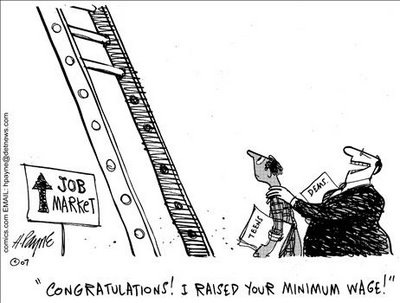
We then discussed whether there should be an instituted minimum “living” wage (which would necessarily be substantially over the minimum wage we are familiar with). Here, I hit them with the “if minimum wage is so good, why don’t we just make it $75 per hour for everyone,” and tried to explain how the minimum wage increases unemployment, again to a less than warm reception by my classmates.
I advocated as well that if we wanted to help these “poor exploited peoples,” we should just invest in more capital in their countries and bid the price of their labor higher. This degenerated into an argument over American educational institutions, with no one but me apparently understanding that wages don’t increases due to a perceived level of intelligence, but rather due to an increase in producivity (generally brought about due to increased capital). We ended class with a “to be continued,” set for tomorrow.
I have to say, even though none of them seem to get it, it was quite fun to get into. I think I may look into economic grad school.
I just woke up, read this, and had a good laugh. Your professors won’t like you, but I love reading reports like this where people are challenged to think.
It is such a shame that the future masters of the universe coming out of America’s political science programs know so little of basic economics. God forbid they make them take basic macro and micro economics courses.It’s not like the major is the least bit difficult in it’s own right.
Good work, but stick to math and skip the economics grad school, unless you want to waste more of your time being “taught” by professors like that one.
From my experience, if you can express yourself civilly and intelligibly your professors will love you, even if they disagree with you. I have known professors to fail students for answering questions in the final with “Keynesian theory”, when during the entirety of the semester they’ve argued for a more free-market approach, when these same professors are Keynesians. I have yet to get less than an A in a political science or economics class, even though I consistently argue with my professors (and I answer tests as I see fit ,and if they grade me down I will make a case for each individual question), and my professors have offered me even internships. It’s because I have shown ten times the dedication to economics than any other student in my classes, and professors respect that.
I’m sure this is not true of all professors, though.
Sounds like you held down very well. And just in case you haven’t realized yet, “fairly conservative” for colleges means, in real terms, "not quite so socialist that they think that absolutely everything should be hyper regulated/ taken over by the government entirely
The professor was having a good time, to his credit. He was mainly pitting us against each other. The only thing I don’t like is that he never tells us what his own views are, so we don’t generally get to argue directly with him.
there are two types of sweat shops. The type that is free market, and the type that are government run. Paraphrasing Tom Dilorenzo, if you do a study of the free market sweatshops, their wage rate is typically 2-3 times higher than that of surrounding jobs. So it seems kind of trivial to claim “well, its not exploitation if these people work for sustenance wages on their farms, but it is exploitation if the get paid 2-3 times higher just because its so much less than what we’re used to”.
Then the government run/aided sweatshops work like this. A company will make a deal with some corrupt government, like Indonesia, and the government will agree to be their enforcement arm. So the corporation lures in a bunch of foreign workers via indentured servant contracts. Then the company breaks the contract by not paying them what they previously had agreed upon, while still insisting that the workers uphold their end of the bargain to pay off the debt they owe to the company. Congratulations, you are now a slave for the next 10 years. We are obviously against this type of thing.
If socialist countries are so compassionate, how come they have closed borders to millions of starving people? If France wants to pay everyone a minimum wage because its the right thing to do, why doesn’t the french government extend benefits to participants in the french economy who live overseas? They don’t, because all socialism can do is stagnate and leach off the productivity of others.
How much innovation comes out of europe, and how much of that innovation do they depend on for their quality of life?
Ironically, the one time we had capitalism was the one time refugees from war and poverty were allowed to immigrate. Yes their lives look bad by today’s standards but it was the first time in human history that the common man moved above sustenance levels of living. If the exploitation theory of capitalism were true, why do real wages and purchasing power increase 1850-1910? Why does the working week for Americans drop from 60 hrs/week to 48 if they are being exploited? I wrote about it in this thread.
If socialism were so good, why don’t people voluntarily form socialist communes? Why do people have to be forced into it via government violence? Why can’t democrats have THEIR health care plan and leave the rest of everyone out of it? The answer is because its not. All socialists can do is soak up money from “bad” groups, like the rich, and give it to “good” groups like the poor. But what if everyone were poor? What would a socialist do with that society? They can’t do anything because there’s no free market inequality to leach off of…
I just had a thought when reading this statement. Isn’t the business world and even perhaps the familial world based on a division of labor? The division of labor is perhaps the worst institution within capitalism according to socialists.
That’s what I think about as well. Exchange and the division of labor is the basis for society. Heck, I’m considering being some kind of “househusband” and doing minimal work from home while teaching kids and keeping the house together. Only because most women I know feel compelled to “get out there and work”
I don’t know if you know, but that is basically how england worked during the industrial revolution and probably how america did too. Just giving you more “ammo” in your fight against fascism-socialism.
and say “it makes sense to me, what am I missing?” lol. Also maybe clarify that it’s not just the dems that are the problem, but also the republicans.
Throw in some political correctness for them to choke on… “The minimum wage hurts minorities the most”… “It is a barrier of entry for these individuals to get a job”… “It is essentially discriminatory”…
I concur. Get a graduate degree in mathematics (so you can put some bread on your table) then become an academic associate of LvMI where you can apply your mathematical skills to decoding and debunking Keynesian bullshit.