We just covered externalities in my Econ class and I am left quite displeased. If you forget the graph involved, here is the positive externality graph:
The conventional wisdom says that for some goods, there are benefits to people who do not participate in the transaction. This is added utility and should be treated as part of the demand curve. Hence, there is some “social benefit” curve which rests above the demand curve and is the “socially optimal” level at which the economy should be running. Therefore, we need subsidies.
I feel that there is something really wrong with this graph, some fundamental assumptions and fuzzy math that make this graph incorrect.
Here is what I’ve been able to come up with so far:
- Economic calculation: how exactly do you calculate “social benefit”? If the government can calculate social benefit, why not calculate the entire market? Why have any price system whatsoever? This logical conclusion violates the socialist calculation problem. Hence, we cannot calculate “social benefit.” The counter to this first statement, however, would be that there is some level of benefit above what the market includes.
- Because there is no actual market for this social benefit, we cannot know how much people value it (goes along with the above. Due to the idea of centralized benefits and socialized losses, interest groups may lobby vocally for something which could benefit very few people. Even if it benefits 40% of the public, the other 60% has not had its say to affect the outcome. When there is no market, the whole idea of “willing and able to pay” is thrown out of the window, as anyone can blow hot air claiming he needs roads. There is no normalizing factor (as relative utility valuations need), which means that demand may approach infinity.
- The social benefit curve is all talk. It’s a representation of “it would be nice” and not “I actually want this.” Because demand for goods which have a market is essentially infinite, this means that “it would be nice” to have an insane amount of all goods, making all the social benefit curves pointless as the “it would be nice” approaches infinity.
- The curve makes the assumption of objective value. The actual demand curve tells us what the subjective value of goods is. However, the social benefit curve makes assumptions about inherent value of goods and services which never emerges in the market. Take the example of immunizations (you getting immunized helps your neighbor, as you can’t pass diseases onto him) and consider these two scenarios:
This is what a shall analysis shows:
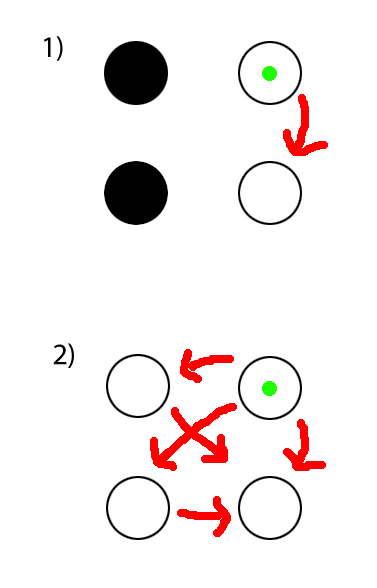
In example 1) the black circles are immunized, the white circle with green is sick, and the white circle is not immunized. Because of the immunizations, there is only one attack vector for a virus to take to infect the white circle.
In 2) there are no immunizations, and hence that same last circle may get sick through 3 attack vectors (where the previously-immunized circles are now not immunized and can infect the last white circle if they themselves get sick)
This is what is seen, and it makes sense. Immunizations are good for society (some aggregate) because they decrease chances that any one member gets sick.
However, I contend that this ignores what is not seen. That white circle which chose to not get immunized in 1) has a concrete utility function. Given the information available to it, it has chosen to not immunize itself. Hence, that means that it gains more utility out of spending money elsewhere than getting immunized. Hence, diverting money from the economy into the immunization of that white circle decreases societal utility. That circle would have used the money elsewhere to gain greater utility.
Here, the bureaucrats assume that they can maximize people’s utility better than they can, which is not true, as you cannot measure anyone’s utility function - you can only approach it (and that is achieved through the free market).
- The money for increasing the quantity consumed must come from somewhere. It will probably come from taxes. However, while the benefits of a certain action (immunization) may be more easy to see (and more centralized), the cost of this taxation is unseen (as the alternative, free market actions never get carried out) and is decentralized (the money not spent on immunization could have been spent on thousands of different parts of the economy, which makes cost calculation extremely difficult).
- When there is a market, it is dynamic and it reflects changing consumer preferences. Subsidies to industries, however, are not dynamic and ever-changing. The market allows for a different amount of resources to be diverted into different sectors of the economy, but subsidies lack that inherent characteristic due to being created in the bureaucracy. Hence, keeping a subsidy over any period of time inherently creates inefficiencies due to a lack of market which shows how much subsidies different causes should get across time.
Do I make any sense or am I just flailing at an inconvenient truth?