For now I am convinced that bitcoin system is basically only new payment system like paypal. Bitcoin unit is needed to participate in this new payment system - it is useless outside of that. As long as people value properties of bitcoin payment system to transfer what is considered estabilished money around there will be demand for bitcoin units. Are bitcoin units as a means necesary to participate in bitcoin payment system a commodity?
- About the Yap Island money. They present no theoretical difficulty, satisfy the regression theorem perfectly, and have nothing whatsoever to do with bitcoin.
Most of it is just normal sized coin shaped money, with a few exceptions. They are valued for their prettiness [= not applicable to bitcoin] and the story behind them [= not applicable to bitcoin], and size [=not applicable to bitcoin]. In other words, they are what a Westerner understands as works of art. Later they became legal tender [= not applicable to bitcoin].
From Wikipedia:
Yap is notable for its stone money, known as Rai: large doughnut-shaped, carved disks of (usually) calcite, up to 4 m (12 ft) in diameter (most are much smaller). The smallest can be as little as 3.5 centimetres (1.4 in) in diameter.
Their value is based on both the stone’s size and its history. Historically the Yapese valued the disks because the material looks like quartz, and these were the shiniest objects around. Eventually the stones became legal tender and were even mandatory in some payments.
The bitcoiners are befuddled by these stone coins, because they think Mises was saying coins have to be made of a material that has “industrial use”, which they think means a use like making a sword out of them or something. This is because they did not bother to actually read, or else failed to comprehend, the regression theorem. Little do they know that Mises makes quite clear that all they need to be valued for something other than shopping with them. These Yap stones are works of art to the islanders, and that is their non shopping value.
-
I like that Pete thinks he refutes Prof Shostak’s cogent arguments by writing “that will no longer be true if and when so and so happens to bitcoins”. He doesn’t get that Prof Shostak is saying that the so and so, not being linked to dollars, will never happen, because that would violate the regression theorem. In other words, the good prof is arguing that pigs cannot fly, and Pete is refuting him by saying that if pigs had wings they could fly with ease.
-
Faithful readers of these threads, and/or my many articles on bitcoin, know that the nerd cred and math beauty nonsense is just that. First of all, it’s a myth. Nobody has ever bought a bitcoin because it is beautiful, [because it’s not, it’s invisible], or to get nerd cred from it. And of course, the Yap Islanders are a whole economy. That stupid nerd is one person, if he ever existed, which he didn’t.
-
The bitcoiners still have not met my challenge of listing what they have actually bought with bitcoins. So I continue to assume they have bought nothing, and are gamblers and speculators who are hoarding them, but have never actually used them to buy anything [besides Pete buying a slice of pizza with a bitcoin he got for free at some bitcoiners meeting].
true to form, Dave denies the existence of people whose existence contradicts his faith-based opposition to bitcoin.
Ever heard of the beauty of math? Many geeks and early adopters wanted bitcoin precisely for its uniqueness of beauty of the idea and execution.
Bitcoin has an awesome story behind it. A mystery creator, implementing a currency as an attempt to solve certain financial problems that have plagued humanity since the dawn of trade. You kidding me? Each bitcoin may not have a story in the way that each Yap stone has one, but they don’t need to. To own a bitcoin means you can be part of a philosophical revolution, to share in the liebrtarian leanings of the founder of bitcoin.
Bitcoin’s formlessness is actually a very cool thing, imo.
Ever heard of code as art? I have.
Bitcoin is being used as tender now, and is currently legal if not legally mandatory in that sense.
I’m surprised you’re admitting to this, because this is precisely what bitcoin-supporters have been arguing, that bitcoin can still function as money without commodity value in the traditional way an item becomes money as long as it first has any other kind of value, be that coolness factor, geek-cred, mathematical beauty, or any of a host of other reasons that someone might value them.
So you’ve essentially destroyed your argument here.
This isn’t cogent enough to respond to.
This is what you must believe, for your premises require it if your position is to be sustained. But in fact, you’re wrong.
I told you I spent 102 of my 131 bitcoins. Now you demand to know what on? Screw off. Go look at the list of businesses that accept bitcoin now, people are buying stuff on there. Do you honestly think Bitpay did $1m+ of business last month without people buying actual stuff? Bitpay works for retailers, it’s not a bitcoin exchange at all. And I spent through Bitpay myself. Another purchase I sent money directly to the business without using Bitpay, easily done. I was shocked how easy, quick, and awesome it was to use compared to credit cards, and it was a really cool feeling to be one of the few people on the planet who’ve ever bought anything in bitcoin (because most people still don’t know about it in the first place).
So you’re calling me a liar?
Why don’t you tell us what you’ve bought with gold? At least I’ve bought something with bitcoin. I bet you’ve never once in your LIFE bought anything with gold, yet you will readily agree that gold is a money.
Lame.
Fr33 Aid has now become a Bitcoin-based organisation.
From their website:
How about photos of people actually buying product at a retailer, using bitcoin? How will Smiling Dave spin this? Or will he finally begin to frown?
"After years of being relegated to a seedy online market, Bitcoin is creeping into the mainstream — including a Midtown lounge that began accepting the digital currency as a method of payment recently and has since racked up $7,000 in electro-cash revenues…
Staff at EVR use tablets to pull up a service called BitPay, which functions like a credit-card processor. BitPay calculates a dollars-to-Bitcoins exchange rate and generates a unique code, which customers can scan to transfer money…"

“IPAID: Customer Pinsi Lei uses Bitcoin on her phone to pay the tab at EVR lounge on West 39th Street in Manhattan last week.”
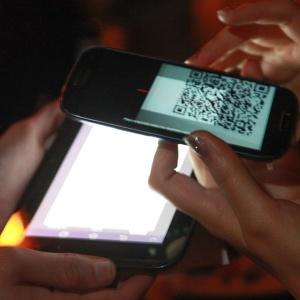
"On a recent evening at EVR, Gabe Sukenik, 24, paid his $45.73 bar tab with .3843 Bitcoins.
“Rather than handing your card over to a server and having to sign for it, a server can just come to you once and be done with it,” Sukenik said.
“I would use Bitcoins every day over dollars.”"
Two words: Fuckin’ awesome.
Yeah fcking awesome indeed. I just see no difference here, from usability standpoint, from paying using PayPass card or NFC terminal.
if bitcoin doesnt provide any benefits for you, then bitcoin doesnt provide any benefits for you. I guess you can just categorize this post with all the posts on the ferrari forums where people come in just to say “that car is too fast and italian! it provides no benefits over my beat-up kia” etc.
So like cash, but with the transaction being recorded and saved for eternity on millions of computers. My! The world is sure evolving fast…
BTW, who’s the troll this time? “How will Smiling Dave spin this?”
Hornswaggled!
http://finance.yahoo.com/news/bill-gates-hates-cash–here-s-why-185938362.html
"Transparency: Less corruption and theft when payments can be easily tracked. In Afghanistan, U.S. aid agencies use it so workers aren’t so vulnerable to robbery.
Security: The money gets where it’s supposed to go.
Financial inclusion: Electronic payment is a way for unbanked people to establish a record of on-time payment of their bills. This can be an “on-ramp” for them to get other services, such as loans, speakers said.
Cost savings: Moving physical cash around is costlier than zipping electrons. Many poor people, however, still find it cheaper to use cash, because some cashless networks charge high fees.
Access to new markets: This benefit is mainly for providers of financial services."
Yeah, Bill Gates just wants to help the poor people. Like he does with his predatory vaccination programs. But this is different. It’s grass roots or revolutionary, or some other BS word of the day.
One question I have and it may have been answered before. If something hasn’t proven itself to be a “store of value”, then does that disqualify it from being money?
Not really. It’s a question of relative terms. Something losing value rapidly is a bad money compared to something losing value less rapidly, but both can be used as money.
What do you mean by “proven itself”?
Something is money insofar and as long as people are willing to use it as a buffer commodity to ease transactions.
There are no quintessencial “value-storage” property that categorically proves its moneyness.
Something that was money in a certain period and location and among certain groups can cease to be in a different place and epoch and peoples.
Some forms of money can be very local and have very short duration.
For instance, these tickets that serves as cash substitutes to purchase food and beverages in certain public gatherings and festiveties, so people don’t need to transact in cash all the time.
The anti-bitcoiners are coming up with these obscure, useless and meaningless criteria for moneyness just because they don’t like the fact that bitcoin does not seem to fit their preconceived notions of what it takes to be considered money.
You are way too defensive. Bitcoin provides value for me. I just don’t see anything special or unique about what was shown before.
yes, I am “too defensive” because I didnt bother to relieve you of your ignorance as to bitcoin’s objective superiority in that context, trusting instead that if you cared, you would discover it for yourself. wow.
theres obviously nothing special or unique about bitcoin, you must have stumbled into the wrong thread. cheers!
What do you mean by “proven itself”?
Bitcoin has only been around for a few years. It didn’t become money through the conventional way (i.e. regression theorem).
A “theorem” is a piece of abstract theory or knwoledge, and not the real process whereby something comes into being or becomes something else.
Sometimes I feel like people here don’t understand or underestimate the difference between theoretical knowledge and concrete reality.
the regression theorem applies to bitcoin in the same way it applies to all other forms of money. it is merely a description of actions and motives that is derived from praxeological means, rather than from experience.
regression theorem is apodictically certain and helps us to answer questions like “what makes money valuable?” in the case of bitcoin, people must have valued it as a means of exchanging data on the bitcoin network, or they would never have exchanged other valued goods for it. having this value (enabling reliable and pseudonymous digital communication) means that, if people stop using bitcoin as money, the bitcoin can be used for something else (communication).
One of the key misunderstandings of poeple reading the regression theorem is they focus on the word ‘commodity’ and then knock bitcoin as having no commodity value.
Money needs to be a commodity only because each unit needs to to be identical to the next one so that they’re equal units, and they have to be broadly available so that they’re fungible (ie: if there was only 1 lb of gold in the world it would be useless as money).
Commodities have thus filled this gap and served as money. It’s not that a money -must- be a physical commodity, only that commodities possess these qualities a money needs.
Bitcoin too allows each unit to be identical and allows very many of them to exist and for them to be easily subdivisible.
To the serve as money, the RT says it must have been initially valued in some way to later serve as money.
Clearly bitcoin was valued, for it was produced at a cost by the early miners. Miner’s chose to create it and pay for the cost of creation with dollars, over the cost-savings of not creating it. That gave it a non-zero value at that point.
It could’ve been that only its creator would be interested enough in it to do so, but that was not the case. Time passed and others became very interested in the qualities of bitcoin, and valued it for a host of reasons, either for the coolness factor or the potential value gain–speculation or investment value.
That’s all it needed, some non-zero value at some point in order to eventually become a money. The ship has sailed, it’s now used as money every day by those who use it so. It’s market cap as a currency already exceeds the market cap of several smaller nation’s currencies. It’s accepted by over 5,500 businesses which freely trade goods and services for bitcoin.
It is money. The experiment has proven successful.
Those still claiming bitcoin isn’t or cannot be are essentially claiming the earth is flat or the sun goes around the earth. And their logic is of the kind that says if the earth were round and spinning instead of the sun going around the earth, wouldn’t we all be thrown off the surface of the earth from its angular momentum? It’s logic that at first glance seems to make sense but misses the finer points and emphases.