What Bitcoin is

Debate about Bitcoin has remained extremely murky, leading to a sort of gridlock with entrenched views, particularly as to whether bitcoins are money. With this post I hope to shed some light on Bitcoin with a view that I think transcends the central points of debate as it has so far transpired.

Step 1 in clarifying discussion about Bitcoin is to distinguish between Bitcoin (the protocol) and bitcoins (the token units). Bitcoin is a transaction system; bitcoins are the “things” that are being exchanged.

That brings us to Step 2 in clarifying discussion about Bitcoin: if we define money as a “physical object that serves as a medium of exchange,” bitcoins are certainly not - and can never be - money. They are something different, yet they serve the same purpose. No, in fact it’s more elucidating to say that the system (Bitcoin) serves the same purpose.

Step 3 is to discern this connotation that perhaps “money isn’t needed anymore” from the leftist, Zeitgeister call for the elimination of money (really the elimination of transactions and hence the division of labor). Since transacting using the Bitcoin protocol, insofar as it is sound, would not in any way entail the destruction of the division of labor (in fact a great enrichment of it), this would only be a kneejerk response. Bitcoin - the system - simply obviates the need for money (and money substitutes) in many situations.

The following story illustrates a situation where a division of labor can function without money (“physical object that serves as a medium of exchange”) or even money substitutes.

A bunch of college students decide to do a houseshare. They take turns making dinner. One day the dinner guy (A) is too busy, so he asks someone else (B) to fill in for him, with a promise to return the favor later.

Everyone in the house witnesses this, remembering that A owes B one.

There are many people in the house and this starts to happen a lot. People’s memories get fuzzy, and some are not around to witness the transactions. So they decide to put a whiteboard on the fridge keeping track of who owes who how many dinners.

Some people start to rack up quite a tab. Eventually it is decided that no one can owe more than three dinners; if they skip three times they can skip no more.

To keep track of this, each person’s name is written with a number underneath it. Everyone starts with a 3 underneath their name, like this:

Guy A Guy B Girl A etc…

3 3 3

Then if A skips because B agrees to fill in for him, the board now looks like this:

Guy A Guy B Girl A etc…

3 3 3

2 4

[signatures of every person in the house]

Everyone signs off that they witnessed the agreement for this transaction.

Cumbersome as it may be, this is now a working transaction system. We could call the units “housecoins.” Later, for instance, Girl A can offer 2 of her housecoins in exchange for a DVD that Guy B owns. Everyone signs under the change to the ledger and it’s a done deal.

What are these housecoins backed by? Nothing, in the usual monetary sense. However, they can be used reliably as long as the system remains popular with the house residents and people don’t find a way to cheat the signature system.

I’m sure it’s easy to see why this is so incredibly impractical that it has never been done before on a large scale. The existence of a ready medium of exchange makes this even more unnecessary for local commerce. Before the Internet and before public key cryptography, such a system would have been completely unworkable, and locally often unnecessary.

However, the Internet makes it possible for remote participants to sign off on transactions. With the Bitcoin protocol, the system is backed only by the willingness of people to participate, and the protocol prevents cheating by rewarding the transaction validators (“miners”). Technically anyone could change the protocol to benefit themselves, but that would result in a fork in the blockchain (two different public ledgers) and probably no one would use the rogue version.

Now there are a few more details that need to be seen in order to grasp how the system is able to function as it does, but the above should show that money (physical medium of exchange) and “backing” are not absolutely necessities for a division of labor; “housecoin”-type systems have failed to spring up so far simply because the technology known as “physical media of exchange” is a far easier one than the Internet, cryptography, “proof of work” systems, and the Bitcoin protocol that ties these together.

A physical medium-of-exchange system is only one type of transaction system. At a certain level of technology, others become feasible or even superior.
Question for those reading the above: What elephant in the room has that long article ignored?

I’m going to guess the timespans in which the differential obligations are “paid off”?

Elephant in the room: Mises’s regression theorem, or since bitcoins are not money we can talk directly about them having no starting value.

However, the “no starting value” argument died for me the day I realized that sending money home from Japan would be way cheaper and faster if I used Bitcoin.

We can simplify things by forgetting history: all we know are housecoins can be used for getting out of having to make dinner, and bitcoins can be used for sending money (dollars, etc.) quickly. How Bitcoins got to be valuable as an instrument for international wire transfers may be viewed as up for debate, but the fact that they are is not. Notably, the group of people who want cheaper and faster (and more private) international wire transfers is not a tiny nerd subculture.

So to me the regression theorem debate has been rendered moot by history; that horse has already left the stable. The above post is to address the “it has no backing” arguments and others that stem from equivocation on the word money (on both the pro and con side).

Bitcoin is a digital currency, it is not money.

To be money it has to be the most liquid good. US Dollars (in America) are more liquid than Bitcoins.
If Bitcoins manage to become more liquid, more widely and generally accepted as currency of exchange than US dollars
within the terriroty of the USA, then Bitcoin will have become money. On the day when Bitcoin becomes money (if that day should ever come)
it will not have become money due to a fiat declaration, no one will have imposed it as money onto all economic agents in the territory,
rather its new found status of money will be traceable by Misesian regression to its days as a ‘non-money’ economic good.

@OP: I agree with the deflationary picture of Bitcoin - its proponents make way too much out of what is, at root, actually a hodge-podge of mundane computational tasks.

That said, I think you are mistaken to characterize Bitcoin as “cumbersome” precisely because it consists of mundane tasks that are all fully automated by software. Bittorrent “Magnet URI” links, for example, comprise a lot of the same kind of mundane computation and distributed network synchronization that Bitcoin does, but no one can dispute that Bittorrent is useful and exists independent of maniacal hype.

This is just part of a larger pattern of control versus innovation.“Congress will [likely] attempt to outlaw the behavior that results from its outlawing of behavior, and the market will route, again, around legislative failure.” The Establishment creates a status quo and new innovations seek to “route around” these obstacles. The computer is the ultimate “control evader”, if it is properly harnessed. So far, we have some small wins but I’m starting to think that the balance is, once again, tipping in favor of the Establishment.

Clayton -

Actually I agree. The fact that the process (of keeping a universal public ledger) is so cumbersome is what would have prevented it from happening before computers and the Internet. Now with these technologies it has become feasible for the first time.

As to the natural order re-routing around state control, Japan just enacted a law yesterday that sentences downloaders of copyrighted content to up to two years in prison. The privacy movement is still nascent by mainstream standards, but I think draconian laws like this are going to kickstart it bigtime. The more states tighten their grip, the more control mechanisms will slip through their fingers. It seems like a privacy arms race of epic proportions could start someday soon, especially if Bitcoin or similar massively disruptive technology takes off.

Perfect. Real world praxeological evidence that Bitcoin’s value as a medium of exchange explains why it has a non-zero value on the market.

Exactly.

True, it is a group that potentially encompasses all people.

I don’t necessarily agree with your OP, but these points here have been spot on.

The regression theorem has been heavily misunderstood, misrepresented and obfuscated. But it is actually quite simple, it talks about how prices and liquidity form on a free market, and how both price and liquidity are prerequisites for a medium of exchange (i.e. need to be chronologically antecedent to the use of media of exchange). Bitcoin fits into this without problems, but again it is heavily misrepresented and misunderstood.

Media of exchange emerge because they decrease transaction costs. Economists often form the problem that media of exchange solve as “double coincidence of wants”. That’s just a particular aspect of transaction costs. Economists also typically try to backtrack the emergence of media of exchange to a pre-monetary, barter, society. But now we don’t have barter. We have a monetary system. If we already have a monetary system, a new money does not have to be backtracked to barter (if it would, it would mean that nothing that was invented after people started using money can become money, which is absurd). However, how new money emerges on a market and replaces old money has not been investigated to a large extent by economists, including the Austrians.

New money must decrease transaction costs, otherwise it cannot replace the old money. Old money would beat the prospect on liquidity. If we already have money substitutes, unless the old money collapses for some reason (e.g. hyperinflation), or is pushed out through Gresham’s law, the only thing that can replace it is a purely virtual commodity. Physical commodity cannot beat money substitutes on transaction costs, so it cannot replace them. This is also why Rothbard criticises Hayek in The Case For A Genuine Gold Dollar: merely abandoning legal tender laws does not give any new prospect the ability to overcome the liquidity of the encumbent dollar. But virtual commodities can beat the transaction costs even at lower relative liquidity, because they present a technological improvement which neither fiat nor physical commodities can match. Unlike gold, or Hayek’s competing papers, virtual commodities have the potential to outcompete fiat. If they are more difficult to regulate than money substitutes, even better, that just increases the comparative advantage if the reaction of the state is to increase regulation.

Virtual commodities already exist, Bitcoin is not the first one. A prime example are IP addresses, which are abstract and therefore unconsumable, yet they decrease transaction costs of communication if one builds systems based on that common protocol. The ability to decrease transaction costs makes them into a good, even if without the context they become useless. They have a restricted supply, and they are tradeable on market (even though they are not a good medium of exchange).

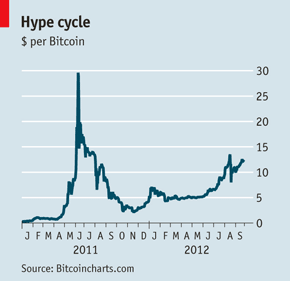
After a spectacular crash, an online currency makes a surprising comeback

“GIVE me control of a nation’s money supply, and I care not who makes its laws.” So said Mayer Amschel Rothschild, founder of the Rothschild banking dynasty. What would he make of Bitcoin, an online currency with no issuing authority whatsoever? Despite being written off following a speculative bubble and crash last year, the online cryptocurrency is still going strong, not least thanks to its ability to circumnavigate the law.

AJ, excellent post! I am thinking about Bitcoin in a whole new way now. The housemates analogy is ingenious.

I am wondering about the terminology. Would you still call Bitcoin a medium-of-exchange system - but a non-physical one? Or would you say it is not a medium-of-exchange system at all because there is no “medium”? The housemates system seems to involve no medium (nothing changes hands), making all the exchanges between the housemates direct exchanges (but disjointed in time, with the whiteboard-on-the-fridge protocol keeping track). Is Bitcoin the same in that respect? There doesn’t seem to be anything analogous to bitcoins (the tokens) in the housemates system.

What is interesting to me is that if your statement above is accurate, money can be seen as a temporary workaround that our species has come up with to solve the problem of the whiteboard-on-the-fridge protocol becoming unworkable. When Zeitgeisters commented on my Government Explained video asking how come the alien knew what money is, my response was that the alien must come from an advanced society and all advanced societies must use money to enable economic calculation. But now, I am thinking they may be right (although for completely the wrong reasons). Maybe the alien would be baffled at why our system involves and relies on exchanging pieces of paper between ourselves - and the alien would surely be no less baffled if we were exchanging shiny coins between ourselves.

If the Bitcoin protocol expands and becomes the primary transaction method for most people, I see no reason why they wouldn’t start using bitcoin tokens as their unit of account. So here we have an interesting conclusion: economic calculation doesn’t require money! This is not to say that Mises was wrong, but that perhaps he never considered that the unit of account could be something other than the unit of the commonly accepted medium of exchange.

Um, Graham, I’m shocked to say the least. Money doesn’t just say “what belongs to who” as a ledger system does… it is a good in itself. The “offline” and “anonymous” aspects of cash/coins are a feature, not a bug. I don’t understand why this is constantly overlooked.

Clayton -

What part are you shocked at?

That part. And the rest.

Please read this, starting from chapter 2. Money is a necessary but not sufficient condition for economic calculation. Destroying money (as all systems of debasement, including central banking, do) destroys economic calculation but it is not the only way to destroy economic calculation. A system for indirect exchange - whether based on fiat ledgers or actual money - is not sufficient for economic calculation. In order for there to be calculation, there must be actual choice, actual taking of entrepreneurial risk, because of the ever-present fact of uncertainty. This is why economic calculation is not just a knowledge problem. If there were no uncertainty about the future, it would just be exactly a knowledge problem and nothing more.

Clayton -

EDIT:

/rant

[view: http://www.youtube.com/watch?v=gDeOS4MkaqQ]

An interesting article just posted yesterday on Forbes by Jon Matonis that also remember us the story of e-gold:

“Bitcoin Prevents Monetary Tyranny”

excerpts:

Bitcoin is not about making rapid global transactions with little or no fee. Bitcoin is about preventing monetary tyranny. That is its raison d’être.

[…]

Just as the Second Amendment in the United States, at its core, remains the final right of a free people to prevent their ultimate political repression, a powerful instrument is needed to prevent a corresponding repression — State monetary supremacy. That task has fallen to an unlikely open source project that is based on cryptography protocols and peer-to-peer distributed computing. As the mechanism for a decentralized, nonpolitical unit of account, the Bitcoin project uniquely facilitates this protection.

The timing of Bitcoin’s appearance, and subsequent growth, is no accident either. If one follows the relevant sentiments and trends, it’s evident that society was approaching a breaking point. Essentially, bitcoin is a reaction to three separate and ongoing developments: centralized monetary authority, diminishing financial privacy, and the entrenched legacy financial infrastructure. An alternative money provider that was centralized would probably not survive long in any jurisdiction. The emergence of Bitcoin was baked into the cake already.

[…]

I’m shocked that you think I was making that mistake. What I said seems to follow from what AJ said.

Economic calculation requires two things: 1) a unit of account, in which all goods have a price, and 2) those prices have got to be meaningful, i.e. they have got to embody/convey accurate information about supply and demand conditions. Crude socialists can’t calculate because they have no unit of account. Market socialists can’t calculate because their “prices” don’t convey accurate information about supply and demand. Historically, these two requirements have led to the conclusion that we need 1) money, and 2) free markets.

If we posit that the Bitcoin protocol becomes commonly accepted, then as I said, people might start using bitcoin tokens as their unit of account. It would make more sense than converting so many of your purchase/sale prices into dollars/pounds/grams/whatever and then calculating in that unit. And the bitcoin-prices of goods are every bit as meaningful as prices of goods in terms of a traditional money unit. Here they are not at all like the so-called “prices” in the socialist schemes where bureaucrats “play market”. The prices are formed by genuine free exchange of goods and services, so the information they convey is accurate. So the Bitcoin protocol meets the two requirements for economic calculation; economic calculation can be carried out using bitcoins as the unit. Do you deny this?

Then it becomes a question of terminology, hence my questions to AJ. Assuming they are commonly accepted, do the bitcoin tokens meet the definition of money? Money is usually defined as a commonly accepted medium of exchange, so this question becomes: are bitcoin tokens a medium of exchange? This seems to hinge on whether “medium” implies something physical. I don’t think it necessarily does, so the bitcoin tokens could indeed be called a medium of exchange, in which case the conclusion that “economic calculation doesn’t require money” is not true. The correct conclusion in that case would be that “economic calculation doesn’t require physical money”, with the important caveat that “so long as there is a unit of account and the prices of goods in that unit convey accurate information”. Until now, the only way to generate accurate information has been to use a physical money, but Bitcoin presents the possibility of a non-physical money generating accurate information.

AJ is using a non-standard definition of money… he has added the term “physical” which is not usually part of the definition. Using AJ’s terminology “physical money” is redundant of course, and so the correct conclusion is indeed that “economic calculation doesn’t require money”, since, as AJ explicitly says, bitcoin never can be money.

AJ… can you explain why you have added the term “physical” to the definition money? And do you agree that if we use the standard definition (and also use a broad definition of “medium” to include non-physical things), then bitcoin tokens can be money (and will be as soon as they are “commonly accepted”… if that ever happens, which is a whole other debate).

But this premise entails extensive government control of the economy because Bitcoin is an unbacked money. Government interference in the market would have to be at least as extensive as it is under the central banking system. I contend that these two premises are immediately contradictory:

  1. Bitcoin widely used

  2. Free market

Clayton -

That’s a very strong statement and I don’t see how you can justify it. You could say those two premises are unlikely to both be true at the same time, but they are not “contradictory”, so there’s nothing wrong with using them as premises together.