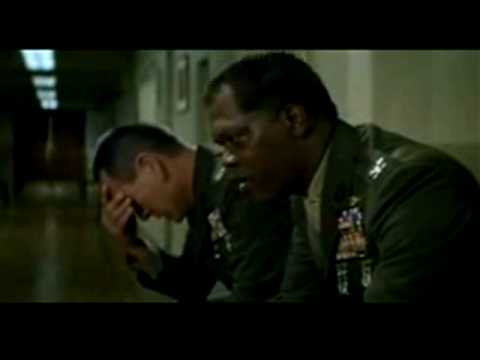
William Friedkin, director of the masterpiece The French Connection, made this movie 10 years, which was about a US Marine who killed 80 villagers - men, women, and children - in Yemen.
Apparently, evidence is withdrawn by top government officials that could have won the sympathy of other Marine jurors in the military court trial, and allow him to walk free. But it is established that he did indeed kill those people. It is even established that the same Marine once executed innocent civilians much earlier in Vietnam.
It’s this movie, by the way.
Now, after having seen quite a bit of this movie while I was working out in the gym, I must ask the locals here what they thought was up with the plot. The movie is complete fiction with no inspiration from any real life story, but it seems to be hinting at a message by the makers.
Was the government burying evidence, because its pacifist civilian branch has a deep dislike for the excesses of the military branch, and wants to crucify their soldiers, because they want to bring them in line?
Was the government burying evidence, so they could make one soldier a patsy, and thus abstain from taking any responsibility for the deaths of 80 Yemenis?
Was the government burying evidence, because it wanted to win elections by appealing to left-wing and libertarian voters, by punishing a soldier for a highly publicized massacre?
Was the government burying evidence, because top government officials genuinely saw it as a wrong deed, and wanted to prevent any evidence that that could have the man walk free from a technicality?
Was this a movie of military apologism and right-wing rhetoric, which tries to criticise society for not appreciating their armed forces and only focusing on their negative deeds?
That’s what I am wondering. Remember, William Friedkin’s earlier award-winning The French Connection portrayed police officers as being as depraved as criminals, and showed them as people who cause as much, if not more damage, in their forceful violent solutions to even minor problems like drug smuggling - and that movie ended with more people, innocent or criminal, dead than alive just for catching a group of French and Italian American drug smugglers. In that sense, this movie seems like a reversal from that earlier tune - now trying to defend the necessary-but-dirty work by organisations of violence for keeping society safe.
I think Americans need to learn that they aren’t actually supposed to make these sort of movies. At least if they mean to make them public. Samuel L Jackson is vindicated in the end so the filmakers must think there is nothing particularly wrong with mowing down 80 non-combatants because a few agent provocatours embedded themselves among them. Obviously there is still plenty wrong with it. And it does not matter an iota how many people would do the same in his position.
As a similar but more extreme example of this I suggest viewing mini-series Generation Kill. It is a super-realistic portrayal of one unit’s role in the 2003 invasion of Iraq. It has American military personell do all sorts of ville stuff, without there being a moral condemnation of any sort imbedded in the work. Its portrayal of depravity in neutral terms de facto makes a case for extreme amorality.
Yeah, the whole “Wouldn’t you have done the same?” logic is fundamentally flawed.
If I were, say, the CEO of a large corporation, and I end up firing good members of top management, because some of them made disgusting jokes about me behind their back, and this costs the corporation a few billion dollars due to the loss of essential talent - I will sure as hell come in front of the shareholders, and say, “Wouldn’t you have done the same?”
IT DOESN’T MATTER! You were a person with extra baggage of responsibilities on your hand, and you had to learn to be prudent according to the situation. It’s why you were put in that position and the average Joe was not. That’s what the rigourous selection process is about - getting people who don’t fuck up, but then you still get someone who fucks up.
It is strange, however. This movie came out in…2000. This was before the Iraq or Afghanistan war. It wasn’t a time when people had strong feelings about war at all. Why create this fictional situation about a US Marine killing 80 Yemenis?
It was, however, after the Gulf War, Bosnian War, and the Somalian intervention. Now, barely any major news media mentioned the terrible US excesses of these wars, especially the Gulf War. So it means the average American probably never cared about any excesses in the first place. But if a movie made in 2000 is dealing with excesses, then I can only guess…that deep down Americans knew that terrible ghastly things were done in these wars. But before a single person made any criticism of US military actions in Gulf War, there were already apologetics for it. Apologetics for something that nobody stood up and said, “This is an outrage!” No, they got onto the defensive, before that, much before the first US soldier was even dropped onto Afghanistan.
That’s how scared the Establishment is about protecting its moral position.
Its portrayal of depravity in neutral terms de facto makes a case for extreme amorality.
I respectfully disagree. It makes a case for what the journalist observed. people are to bring their own morality or amorality to bear upon it at the stage of interpretation
It used to be that a work of cinema like this would be sanitised. Things would be left out and censored. If they were not, then the movie was one that had an anti-war message. But now it has become acceptable to make movies that are not sanitised, jet have them be totally neutral on the issue of war.
It serves to normalise war crime. It is fine for a movie like this to leave space open for people to make their own conclusions after bringing their own morality “to bear upon it at the stage of interpretation”. But it has to nudge the viewer towards doing so. Generation Kill does no such thing. The viewer can easily get away from the series without having ever thought of the things taking place on the screen in terms of morality.
Now you can enjoy watching a super-realistic portrayal of a current war without the danger that it will discomfort your moral sensibilities. The veterans and the military worshippers love it. It is a stand alone product, one that does not need to be interpreted.
That a mini series such as this exists is a huge condemnation of a state of a chunk of one society. I would have preffered a hypocritical, sanitised series, because it would showcase that at least the filmakers are aware that decent human beings are not supposed to shoot a product that includes war crime in an ongoing war and not take steps to nudge people in the direction of actually thinking about what they are seeing.