I understand (basically) how “the bubbles” of the fiat economy were created and that they were unsustainable. But specifically WHAT determines WHEN the bubble busts? Take the present crises or any other, but please provide examples or theories of why the crash TIMES as it does! Why didn’t this financial collapse come one year earlier?
Has it to do with how the (industrial) capital structure is shaped?
Has it to do with the maturity of outstanding debt?
Is it a decision of one single influencial individual?
Has it to do with the “psychology” of investors?
Are there mysterious “cycles” that govern this?
If anything can be held against the Austrian school today, it would be that it/they/I/you/we predicted the calamity too often and too early. What tools has Austrian economics developed in order to explain the timing of the boom-bust-cycle, and what remains to be donein that area?
Peter Shiff was amazingly accurate about the timing of the present crisis. Was he just lucky, or what does he knows that I don’t?[;)]
At some point the inflation in the currency becomes too high for even the central bank to ignore. When that takes place, the inflationist policy is ended by the central bankers, interest rates rise, and the speculative structure of investors must adapt to this new, higher rate of interest by liquidating positions.
Central banks certainly fear hyper inflation, which would make their currency worthless and definitely pulls their plug. I can basically understand that a central bank tries to pop their baloon before it gets so big that its final burst might later destroy the currency of the CB forever.
However, I want to get MORE SPECIFIC here!
Like for example: what interest rate decisions, at what dates, of the FED made this bubble burst? Did the Bush administration deliberately burst the bubble before they went on their four years vacation? Could they have made the bubble hold up for another year? if so, with what policy?
You can read through Gary North’s past columns to get the precise dates. He started warning people immediately when Ben Bernanke started tightening interest rates.
It’s not really one event that causes it, because usually the central banks cut rates in one dramatic slashing, but raise them only progressively.
So the interest rate increases 2004-2006 made all well-read Austrians go “aha, 2008-2009 the depression will start, which didn’t happen in 2000!”?
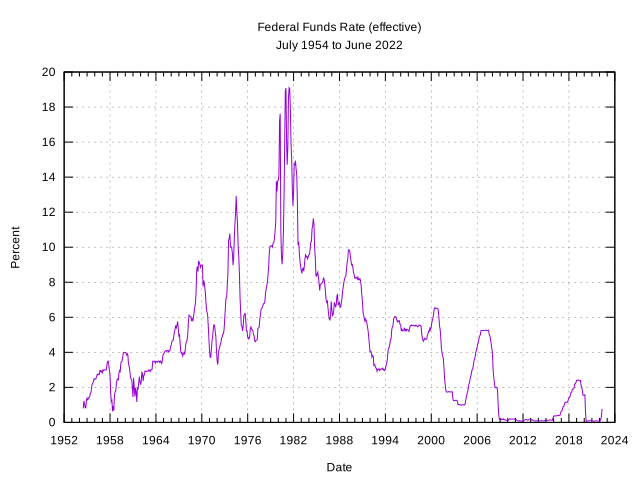
Actually, there seems to be quite a good fit between FED increasing the interest rates and the burst of financial bubbles. From rather smallish ones like the one 1999-2000, and the bigger 1990-crisis. Maybe the 1994-94 interest rate hike isn’t connected to any burst that I can refer to straight away (I’m not American, and maybe not old enough to remember about that time in economic terms). Also the 1984-85 hike doesn’t ring a bell to me. Earlier than that, the stagflation crises, yes. In general, the Central Bank increasing interest rates more than, say, 0.5% does seem to be a very very serious alarm bell! As simple as that.
Maybe central bank interest rate increases during certain conditions do give fully reliable signal that a boom-bust cycle is about to peak out?
But again, more specifically, how could one tell HOW HIGH interest rates would have to go before the bubble would burst? The last 20 years the sizes of interest rate hikes seem to have been 2%, 3%, 4% and 5% respectively. Are there ways to estimate the capital structure of current industries, the maturity of outstanding debts, the deficits of the government or some variables like that, in a way that makes it easier to time the burst of the bubble once it has been built up and the Central Bank starts to increase interest rates?
Such “timing mathematics” would certainly not add anything to the foundations of Austrians economics, nor to the moral conclusions onecan draw from it. I only ask if maybe that kind of issues maybe leave some room for looking into by coming Austrian economic research: The disecting of how and when these bubbles burst, rather than only why. Maybe much work has been done already, but then it hasn’t been readily available to me anyway.
Yes, I agree with you. It is the actions of many persons in many different kinds of competences (from FED-chairmen to single consumers) that cause such “timings” of price changes which I refer to as “crises”.
FED-policy is obviously extremely important for when the bubble will bust. Ahead of the point in time when they calculate that they risk hyper inflation due to their bubble, the Central Bank will bust the bubble by increasing interest rates. But with exactly how much interest hike or during how long time noone can know.
I just wondered if there were some easy-to-recognize patterns to look for the “next time”. And yes, that the central bank increases interest rates seems to be a very strong “indicator” of a coming bust. (But now that interest rates are already zero, what else can they do next!?! [:S])
So it seems as if my question has been answered. Maybe econometrics could add to this somewhat. But then again, maybe not, since measurable circumstances will be so different “next time around” again, basically because other people will be around who want and offer other things.