Well first of all, if you notice, they had to correct their own article:
"An earlier version of this post incorrectly stated in one instance that the tax cut portion of the chart refers to tax cuts for the top earners. In fact, the Bush-era tax cuts apply to a broader range of income levels."
[as in, all income levels. Everyone got a tax cut under the so-called “Bush tax cuts” (at least, everyone who paid taxes, of course. But then again, check out that link. Even people who didn’t pay any taxes benefitted.]
So that’s one thing right there. You’ll find Leftists always like to pull out this class-warfare card of how tax cuts are only for the rich. For one thing, as the Huffington Post had to admit, Bush cut taxes for everyone, contrary to what their narrative says. But on top of that, you’ll sometimes hear the claim that cuts “only help the richest people.” And they’ll use ridiculous charts like this one shown in the film Inside Job:
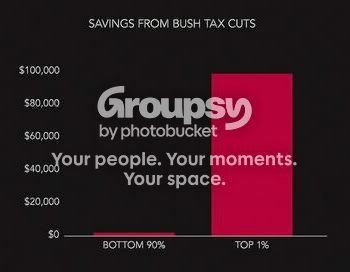
And Matt Damon says “most of the benefits of these tax cuts went to the wealthiest 1% of Americans.” (This film won the Oscar for best documentary, by the way.)
Gee…The people who pay the most in taxes saw the most savings when tax rates were cut. So you mean if I pay $1 million in taxes, and tax rates go down 10%, I actually get to keep $100k more of my money that I earned…and the guy who pays $0 in taxes…he doesn’t save anything? What the hell. Yeah I see what he’s getting at. That’s fucked up. If you virtually don’t pay any taxes already and rates go down, you should actually get money. That’s only fair. Oh wait…They did.
Yes. The bottom 40% of “income tax payers” didn’t pay any income tax starting as early as 2002…thanks to those “only for the rich” Bush tax cuts. In fact, not only did they not pay any income tax, they got checks from the government. [See the links above].
This goes to the whole “barstool economics” story. (For a text version, you can check here.)
Next, you have to realize the worldview people and articles like this are operating from. Take a look at the very first sentence: “If the Bush-era tax cuts are renewed next year, that policy will by 2019 be the single largest contributor to the nation’s public debt…” The most obvious part of this is the fact that they are using projections out to over 8 years from now. They can’t even project into the next quarter accurately. And we’re supposed to believe they know what things will look like almost a decade from now?
But let’s put that statement into simpler terms. “If people are allowed to keep more of their own money, that will be the largest contribution to the nation’s loan obligations.” In other words, somehow, letting people keep more of their money contributes to the government going into debt.
Notice how they tie the dirty word of “debt” to the notion of cutting taxes. Again, they are asserting that when you let people keep more of their money, it equates to increasing the national debt. The key point here is it is a total neglect of the true cause of any debt: spending. Next, that chart they show is possibly one of the more dishonest things I’ve seen in a while. (Almost as much as the one shown above). Seriously think about it. How does cutting taxes increase a debt? For one thing, it doesn’t. But the implication is that there is less revenue for the government, meaning that if spending stays the same (or increases, as is the true case), and revenue is less, then debt rises.
This of course assumes two things: (1) the tax cuts reduced tax revenue, (2) the current level of government spending (and the level of growth in spending) is completely unchanagable (as in, it is impossible for the government to function while spending less money).
For number 1, we have plenty of evidence to the contrary:
DWYER: Bush tax cuts boosted federal revenue
The Washington Post’s Weak Case for Ending the 2001/2003 Tax Cuts
Ten Myths about the Bush Tax Cuts
And again, we’re talking about government tax revenue…they’re definitely not starving for funds:
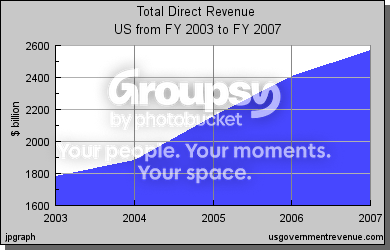

Even the Washington Post admits the “Bush tax cuts” aren’t the cause:
“In 2007, well after the tax cuts took effect, the budget deficit stood at 1.2 percent of GDP. By 2009, it had increased to 9.9 percent of the economy. The Bush tax cuts didn’t change between 2007 and 2009, so clearly something else is to blame.”
But more importantly, how in the world they purport to know what percent of revenue shortfall below expectations (you have to say it that way because overall it hasn’t declined…it has risen)…but how in the world they know what percentage of that is due to tax cuts, and what percent is due to “the recession”, and what percent is due to bailout programs, and all the rest of it, is just asinine. How do they even quantify lower (than expected?) tax revenues due to “the recession”? You can’t.
We’re not even close to being done yet. Think about #2. The suggestion is that we don’t have enough money…but as we can see, revenue has continued to go up and is now roughly $2.5 Trillion annually. In other words the government has never taken in more money in its history…and for some reason we seem to be in the biggest deficit in history. Revenue is obviously not the problem. Do you realize that in 2001 the federal government was spending a little more than half that (inflation adjusted)? I remember 2001…that wasn’t that long ago. Was the economy in shambles? Was the world coming to an end? And we’re supposed to believe that everything the government is spending today is absolutely necessary…so much so that any decrease in tax revenue adds to the deficit?
And then you might say government spending should be measured as a percentage of GDP. Okay. In 2001 the percentage was a little over 33%. This year it will be at least 41%. Again, do we really need government to account for that much more of the economy? It’s just a given that 41% is absolutely necessary? (When obviously 33% was managable a decade ago?) That much has to be spent by the government, even if it means we go further into debt? Nonsense.
And then, we just absolutely have to increase the size of government 8% every decade? (Remember, this is as a percentage of GDP…government itself has grown much more than that…i.e. doubled in size. This begs the question…8% more of the economy has to be government-controlled every 10 years? When do we stop? How much is enough? 50%? 60%? 95% of the economy?)
Then you hear that even tax revenue should be measured this way, as a percentage of GDP. This. Is. Absurd.
What gets me in all this is people just automatically assume that whatever the governement spends is a given…it’s written in stone as if a commandment from God. It’s just what needs to be spent. Period. And if we don’t have enough money to spend that much, well then that’s obviously not because politicians are spending too much, no, it’s because they just haven’t taken enough of everyone else’s money. We need to raise taxes. We need to raise the debt ceiling so we can borrow more. Because there’s no way in the world that civilization could survive if the government spent less money.
Then you have to understand the implication of this notion that a tax cut is a “handout” that is “expensive”, and would “cost” a lot of money that we would have to “borrow” to give them. Seriously. Not kidding. Listen to Austan Goolsbee, Obama’s former head of the Council of Economic Advisers. Think about that. We have to borrow money, to let people keep more of their own. Here again we see the exact same mentality that the level of government spending is a given. But more importantly, notice what this also implies. This notion that cutting taxes (letting people keep more of their own money) is a “handout” literally implies that the government owns 100% of everyone’s income and it decides how much we can keep. I would love to hear a Leftist own up to that. (And I bet if you push them enough, they’ll finally just break down and admit that they believe yes, the government does own your income.)
See the next post for the response to the conversation you posted.