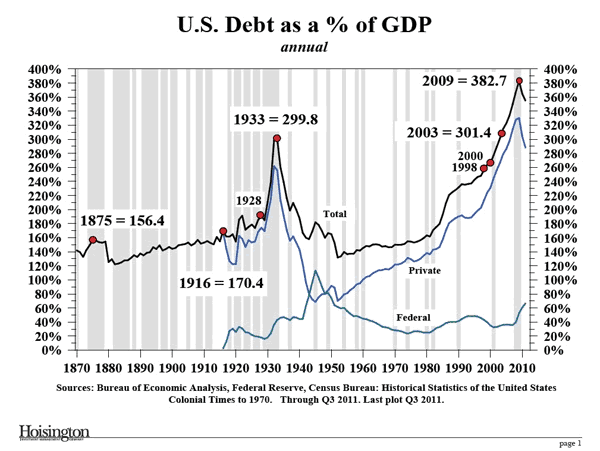
Bryan Caplan writes:
Thoughts, ideas and opinions about this common explanation?
Bryan Caplan writes:
Thoughts, ideas and opinions about this common explanation?
I’m of the opinion that it was the levels of private debt raked up in the years preceding it that led to a long period of delevereging that stifled demand.
The cause of the Great Depression was the interventionist policies of the administrations of presidents Hoover and FDR. The cause of the market crash of 1929 is quite a different issue.
I’ve read that Friedman and Schwartz just showed a correlation, but gave no logical explanation of causation.
Why does a monetary contraction cause a depression? It should be just the opposite. Monetary contraction means there is less money pursuing the same amount of goods. Which means whoever wants those goods will pay less for them. Great. Isn’t the whole point of economic progress that things get cheaper?
Imagine if someone worked ten hours a day and then went home and, instead of spending his paycheck, burned it. That essentially means he worked for free. If you had someone working for you for free, would you be richer or poorer?
Now in the case of the worker who burns his paycheck, or let us say burns his dollars up, somebody loses. He had money and lost it. But in a monetary contraction, that money that contracted did not come out of some ones pocket. All that happened is that banks lost the ability to create new money out of thin air. Nobody lost a dime.
Only if you subscribe to the Austrian theory can one understand why a monetary contractions harmful. And it’s not the contraction that is harmful per se, but the expansion of the money supply that preceded it and caused malinvestments, aka burning up precious resources [as opposed to imaginary money]. The contraction merely reveals and lays bare the already existing disaster.
Consumeriat,
Why didn’t prices drop enough to revive demand?
Also, when one deleverages, that means one repays ones debts. So the money X has just is handed over to Y. Y can now spend it. Why does demand drop?
“Imagine if someone worked ten hours a day and then went home and, instead of spending his paycheck, burned it. That essentially means he worked for free. If you had someone working for you for free, would you be richer or poorer?”
If I was relying on that same employee to use the money to purchase what was produced, then I would certainly be poorer because I would not be able to sell my product. Also, whilst the worker may have ‘worked for nothing’ in a colloquial sense, from the employers perspective it only matters that the wages were paid in the first place. So no, the employer is not better off.
“But in a monetary contraction, that money that contracted did not come out of some ones pocket. All that happened is that banks lost the ability to create new money out of thin air. Nobody lost a dime.”
I’m not a hundred percent sure what you mean by this, sorry.
“Why didn’t prices drop enough to revive demand?”
Well if there is deflation at a time of high indebtedness, the debts rise in relation to people’s income. This means that people are even less likely to spend, and eventually will have to default. Debt-deflation occurred like this in the first few years of the GD; you can see an initial spike of private debt between '29 and around '33 on the graph I posted. That was the result of this process.
“Also, when one deleverages, that means one repays ones debts. So the money X has just is handed over to Y. Y can now spend it. Why does demand drop?”
As I say, not all debts will be repaid because of an increased chance of default. Also, even if the debt does get repaid it is most likely repaid to a financial institution who, in a time of depression, are keen to shore up their reserves rather than lend out the money.
Why are you relying on that same employee? Plenty of fish in the sea. Let’s look at it from another angle. If someone came to your place of business and said he will work for free, will you send him away, saying “Oh no, if you work for free, that will just make me poorer, because I cannot sell you my product. I’ll only be richer if I pay you. Decreasing my costs of production will totally ruin me.”
Are you familiar with fractional reserve banking?
There is a law of supply and demand. If people cannot afford stuff, the price will drop until they can. Why are they less likely to spend? Are they less hungry than before?
As for the increase of debt to GDP, that happened because GDP dropped [due to previous wasting of resources, explain Austrians], not because debt increased. How could broke people suddenly get a loan?
As for default, people defaulted on their loans because they foolishly borrowed money to buy stocks they could not afford, gambling the price of the stock would rise. They made their bed. Someone will have to lose money, of course. But someone else had already gained money by selling them that worthless stock. Purchasing power does not just disappear because of defaults.
As Say explained so brilliantly, purchasing power comes from production, not from money supply. The obvious conclusion is that it doesn’t go away due to changes in the money supply. Of course, it can be redistributed by giving one fellow a lot of new money, thus taking it away from someone else, but that is another story.
A. A depression is caused by defaults, because otherwise everyone would just spend.
B. But defaults are caused by a depression, for otherwise everyone would just pay their bills.
Are you claiming both A and B? If yes, how do you resolve the contradiction inherent there?
Okay, but . . .
Expanding the data even further back, it doesn’t look like anything significant happened with debt levels in the 1920-1929 period, especially not when contrasted to the 1981-2009 period. If it’s just the debt levls, is there some sort of “tipping point”? And why wasn’t there a depression in the 90’s? Also, why should debt levels be measured against GDP? And what do you think the contributory factors to increasing private debt levels were?
Why are you relying on that same employee? Plenty of fish in the sea.
I assumed you were making an analogy where the employee represented the workforce of a country, I represented the firms in a country. I may have misinterpreted you.
Let’s look at it from another angle. If someone came to your place of business and said he will work for free, will you send him away, saying “Oh no, if you work for free, that will just make me poorer, because I cannot sell you my product. I’ll only be richer if I pay you. Decreasing my costs of production will totally ruin me.”
Well of course if someone came and offered to work for me without pay, I would be better off. But your first example had me paying out wages first, and him then going and burning his money. Him burning his money has no bearing on the fact I already paid him; I am out of pocket until I manage to sell the goods we produced. Anyway, I’m not sure where this hypothetical scenario is meant to be going.
Are you familiar with fractional reserve banking?
Yes
There is a law of supply and demand. If people cannot afford stuff, the price will drop until they can. Why are they less likely to spend? Are they less hungry than before?
Well people don’t spend simply because they are hungry. People will have many places where they can cut back on spending before they are down to living a subsistence life. They might stop buying DVD’s, or beer, or potted plants. Demand can drop by a fair amount without the floor of hunger imposing a limit. Unless of course you mean “are they less hungry for potted plants and DVD’s?”, in which case the answer is yes.
As for the increase of debt to GDP, that happened because GDP dropped [due to previous wasting of resources, explain Austrians], not because debt increased. How could broke people suddenly get a loan?
I think maybe I did not explain myself clearly. I am not saying that broke people were able to take out more loans, I am saying that in a deflationary situation a fixed amount of debt will become a higher burden to an individual because of a declining income.
You are of course correct in saying that some of that increase in debt was due to a decline in GDP, and that is kind of linked to what I am saying – incomes fall but debt levels stay the same, and as a result become more of a burden. Debt rises as a proportion of income.
As for default, people defaulted on their loans because they foolishly borrowed money to buy stocks they could not afford, gambling the price of the stock would rise. They made their bed. Someone will have to lose money, of course. But someone else had already gained money by selling them that worthless stock. Purchasing power does not just disappear because of defaults.
- When a debt is not repaid, that doesn’t decrease purchasing power in the economy as a whole. The money is there. nobody sent it into the phantom zone.
A. A depression is caused by defaults, because otherwise everyone would just spend.
B. But defaults are caused by a depression, for otherwise everyone would just pay their bills.
Are you claiming both A and B? If yes, how do you resolve the contradiction inherent there?
I’m not claiming that a depression is caused by defaults. You are correct in saying that a default does not diminish demand in the overall economy. In fact, one way in which the economy would correct itself is for the debt to be wiped out in this process of widespread default. The debt can never be paid down in a debt-deflation scenario, and so won’t be. Once people stop trying to pay off a debt that can never be paid off, and instead go back to consuming, then goods start to circulate again.
As Say explained so brilliantly, purchasing power comes from production, not from money supply. The obvious conclusion is that it doesn’t go away due to changes in the money supply.
But money is required to lubricate that process, and so if it is not flowing sufficiently in the right places, a blockage can occur in the system.
As Say explained so brilliantly, purchasing power comes from production, not from money supply. The obvious conclusion is that it doesn’t go away due to changes in the money supply.
But money is required to lubricate that process, and so if it is not flowing sufficiently in the right places, a blockage can occur in the system.
There we go. The we agree on all the important stuff. What is left over is one tiny detail to discuss. Mainly, is money some kind of lubricant that has to flow sufficiently, or else there will be a blockage in the system?
Let me give you my take. I have the impression that you are sincere, truly think that your teachers taught you the right stuff, and [and I’m going out on a limb here] you are open to changing your mind if presented with the evidence.
Tell you what. I don’t have anything original to contribute. All I do is popularize those few tidbits of AE [=Austrian Economics] that I manage to understand. And I’ve written about this already.
So you can visit my blog and look around, or go to the sources themselves and look around mises.org for discussion of the above point. Also, of course, there is the howling error most people are taught, that spending is what grows an economy, an error that needs to be addressed.
A link would be nice, SD.
http://smilingdavesblog.blogspot.com/2011/08/classic-keynes-and-why-credit-card.html [=Keynes is wrong empirically].
http://smilingdavesblog.blogspot.com/2012/04/marxs-refutation-of-says-law.html [=if Say is right in barter economy, he must be right in money economy].
http://smilingdavesblog.blogspot.com/2011/09/problem-according-to-keynesians.html [=list of links to refute this Keynes stuff from all angles].
Deleveraging was not the major cause of the Great Depression, as it seems that a great amount of deleveraging (i.e. the recovery) had already taken place by mid-1930 - the true problem was the interventionist policies of Hoover and FDR:
“Unemployment peaked at 9 percent, two months after the stock market crashed, and began drifting generally downward until it reached 6.3 percent in June 1930. That was when the federal government made its first major intervention into the economy, with the Smoot-Hawley tariff.”
Notice that unemployment was far worse throughout the entire decade of the 1930s than it was at the worst point of the 1929 market crash.
Expanding the data even further back, it doesn’t look like anything significant happened with debt levels in the 1920-1929 period, especially not when contrasted to the 1981-2009 period.
I’m not sure what you mean. It was high and rising over the course of the 1920’s (one decade), and high and rising over the course of 1981-2009 (three decades). Is it surprising that three decades of rising debt would see more of a rise than one decade?
If it’s just the debt levls, is there some sort of “tipping point”? And why wasn’t there a depression in the 90’s? […] And what do you think the contributory factors to increasing private debt levels were?
I believe that the first two questions can be answered by first answering the last. I am presently of the opinion that Hyman Minsky’s theory of Financial Instability best explains what we see with regards to private debt levels. Quoting at length from here:
Hyman Minsky has proposed a post-Keynesian explanation that is most applicable to a closed economy. He theorized that financial fragility is a typical feature of any capitalist economy. High fragility leads to a higher risk of a financial crisis. To facilitate his analysis, Minsky defines three approaches to financing firms may choose, according to their tolerance of risk. They are hedge finance, speculative finance, and Ponzi finance. Ponzi finance leads to the most fragility.
· for hedge finance, income flows are expected to meet financial obligations in every period, including both the principal and the interest on loans.
· for speculative finance, a firm must roll over debt because income flows are expected to only cover interest costs. None of the principal is paid off.
· for Ponzi finance, expected income flows will not even cover interest cost, so the firm must borrow more or sell off assets simply to service its debt. The hope is that either the market value of assets or income will rise enough to pay off interest and principal.
Financial fragility levels move together with the business cycle. After a recession, firms have lost much financing and choose only hedge, the safest. As the economy grows and expected profits rise, firms tend to believe that they can allow themselves to take on speculative financing. In this case, they know that profits will not cover all the interest all the time.
Firms, however, believe that profits will rise and the loans will eventually be repaid without much trouble. More loans lead to more investment, and the economy grows further. Then lenders also start believing that they will get back all the money they lend. Therefore, they are ready to lend to firms without full guarantees of success. Lenders know that such firms will have problems repaying. Still, they believe these firms will refinance from elsewhere as their expected profits rise.
This is Ponzi financing. In this way, the economy has taken on much risky credit. Now it is only a question of time before some big firm actually defaults. Lenders understand the actual risks in the economy and stop giving credit so easily. Refinancing becomes impossible for many, and more firms default. If no new money comes into the economy to allow the refinancing process, a real economic crisis begins. During the recession, firms start to hedge again, and the cycle is closed.
In other words we have a behavioural explanation. A period of financial stability after recovering from a recession will lead to conservative behaviour on behalf of both lenders and borrowers. Once memory of the recession begins to fade, people become riskier and riskier until the point when people are fooled into adopting ponzi schemes by seemingly never-ending asset price rises. Of course this situation is unsustainable without rising debt to service old debt, and the ‘tippping point’, as you describe it, comes when firms begin to default on larger scales precipitating a collapse in lending.
Also, why should debt levels be measured against GDP?
If I was to draw and analogy between an entire economy and an individual household (which I am loathed to do because this often leads to aggregation fallacies when done in other situations), debt in itself is only dangerous in relation to the income of that household. If you are on minimum wage and have a debt of a £1000 that needs to be repaid by the end of the week, then you are in trouble. If you are a billionaire, however, that £1000 is nothing to you. So it is the ratio of income to debt that is the proper measure of ability to service that debt. The same logic applies to the entire economy, with GDP being a proxy for income.
Let me give you my take. I have the impression that you are sincere, truly think that your teachers taught you the right stuff, and [and I’m going out on a limb here] you are open to changing your mind if presented with the evidence.
First of all, thank you for being so polite in your response. More than anything I hope that I am able to keep an open yet critical mind as I progress over the years in my understanding of economic systems. I’m sure I don’t always live up tp that ambition but I do like to try. I have no formal economics education, btw.
[…] is money some kind of lubricant that has to flow sufficiently, or else there will be a blockage in the system?
I think this is once of the roles that it fulfils, yes. Other roles are as a store of value and a measure of ‘value’ (whatever that might be).
So you can visit my blog and look around, or go to the sources themselves and look around mises.org for discussion of the above point. Also, of course, there is the howling error most people are taught, that spending is what grows an economy, an error that needs to be addressed.
I haven’t yet visited your blog, but will certainly do so when I get the time. As for the issue of spending growing an economy, of course it is not sufficient to do so, and production is the source of wealth at all times. However, prodution cannot take place sustainably without the equal and opposite force of consumption, and it is money that enables these two sides of the process to coordinate.
Deleveraging was not the major cause of the Great Depression, as it seems that a great amount of deleveraging (i.e. the recovery) had already taken place by mid-1930
Maybe we have different understandings of what deleveraging is exactly. When I use the word, I intend it to mean ‘the paying down of debt’. This process began in the early 30’s and finally bottomed out in the mid 40’s.
[…] the true problem was the interventionist policies of Hoover and FDR: “Unemployment peaked at 9 percent, two months after the stock market crashed, and began drifting generally downward until it reached 6.3 percent in June 1930. That was when the federal government made its first major intervention into the economy, with the Smoot-Hawley tariff.”
This is one explanation that is sometimes given, yes. However, I do not know enough about the details of this theory to comment too much. What intervention is it that you speak of specifically?
I do not have any data on the monthly unemployment stats for that period, but here is the yearly in case it is usefull:

is money some kind of lubricant that has to flow sufficiently, or else there will be a blockage in the system?
It seems to me that what drives an economy, meaning what motivates a person to increase his production, is a desire to get what he needs. Money is a convenience, but people are quick to find other ways to exchange their goods if they have to. In other words, money not flowing is at worst a symptom of something else. People are not able to find a market for their goods, is what is happening, not a lack of money flow causing a blockage.
It’s not like an economy is an indoor plumbing system. Even if meant as an analogy, there has to be some logical explanation to support the analogy. Whether people spend their money or not is not due to some magical property of the money itself, or because it got clogged up somewhere, but because they don’t want to spend it. Fiddling with the money supply will not solve that [except for so debasing the currency people will want to be rid of it. But that is throwing out the baby with the bath],
However, prodution cannot take place sustainably without the equal and opposite force of consumption,
Which always exists, by Say’s Law.
and it is money that enables these two sides of the process to coordinate.
So a barter economy cannot function, because it has no money?
Also, money is not what co-ordinates consumption and production. For example, say 50 people in a village make all kinds of stuff, much more than they need for the 50. And there are 500 people in the village who are broke, sitting at home twiddling their thumbs. At current price levels, if we gave each of those 500 people a thousand dollars, they could buy up the surplus.
What will happen if a law is passed, giving each of the 500 a thousand dollars, either from taxes or from newly printed money or from dollars borrowed from China. They all go to the stores and buy everything. The market has cleared, as they say.
Is everything honkey dorey now? Of course not. A great disaster has occured. 500 thousand bucks worth of stuff has been consumed [=destroyed, vanished, eaten up] with no replacement in sight. That village is now impoverished.
Only if money is given to someone in return for his working and producing can the village sustain itself. Becuase that way nobody gets to consume unless he has produced an equal amount first. In such a case, money serves as an indication that he has already produced, for otherwise he would not have money.
But in a pinch, this can be done without money, Barter will do just fine.
Bottom line, what has to be co-ordinated is not supply and demand in the sense of having enough mouths to eat everything and enough food to feed them. The co-ordination has to be between the mouths, and some way of making sure that what they eat gets replenished.
Again, Say’s Law explains that this is always the case, because [absent govt meddling] nobody gets the right to consume unless he has produced something to gain that right. So that Total Amount of New Consumption = Total Amount of New Production.
But this is the thing; we don’t live in a barter economy. We live in a mass-production, industrial economy with credit money. Loans cannot be repaid without money, large quantities of produced goods cannot be exchanged or bartered efficiently. If I was a manufacturer of engine pistons could I barter my output for hours of programming, or tonnes of iron ore? In theory maybe, but not in reality.
After all, what would I do with all those bartered goods? I want money so that I can reinvest with ease, and produce more pistons to acquire yet more money. This is the way the world works, and needs to work, so that allocation of resources can take place on a large scale. Without that efficient allocation, a barter economy would lead to medieval standards of living.
On the issue of Say’s law, this is another area that I would like to bolster my knowledge on. Would you say that Say’s law is as applicable to a credit/monetary economy as it is to a barter one?
What you say is true, of course. That money makes exchanges much much easier. But…
Let’s examine these two assertions:
Money makes exchange easier.
The more money, the easier is it to exchange. Maybe there’s even an equation E=kM, meaning Ease of exchange is proportional to amount of Money existing, with k some proportionality constant.
1 is true. 2 is false.
Also, once money exists, it cannot get clogged up somewhere, and no encouragement is needed to make it flow.
The short free book, What Has Govt Done to Our Money, by Rothbard explains it all.
As for Say’s Law, Keynes of course hated it, because it denys everything he stood for, meaning his theory that the more you spend the healthier your economy. Since Say makes so much sense, Keynes had to go along with Karl Marx and admit its truth, but claim it doesn’t apply in a money and/or capitalist economy.
Marx said a money economy creates an abundance of insane psycopaths called capitalists, whose sole interest is hoarding money, thus making Say’s Law inapplicable, so he thought.
Keynes was a little subtler, claiming that a money economy is a sign of a wealthy economy. A wealthy economy means people don’t have to spend all their money to get all they want, because they are wealthy, meaning they will have tons of excess money that they will just hide under their mattress. And again, claiming that hoarded money destroys Say’s Law.
The two refutations I’ve seen of Marx and Keynes are that first of all, a very very trivial amount of money gets stashed away. What is not spent is put in a bank, meaning invested, meaning put right back into the economy. The second refutation is a corrolary of the beginning of this post, that any amount of money is enough to keep things moving. The value of the money that is not hoarded will rise, thus replacing the hoarded money.
Sources for Say’s Law: The free pdf or epub file, Rothbard’s History of Economic Thought, Volume 2. From page 27 on he talks about Say’s Law and all the absurd rebuttals proffered against it.
Say himself, very readable: http://www.econlib.org/library/Say/sayT15.html#Bk.I,Ch.XV
Summary of Say’s Law, and the various attacks on it: http://www.martinfrost.ws/htmlfiles/sayslaw.html
This link cleared a lot up for me about Say’s Law. Sadly it looks like the link is down http://ryansafner.com/papers/The%20Duality%20of%20Say%27s%20Law.pdf
My good ole blog has plenty of articles about Say’s Law in informal language.
The interventionist policies?
Hoover: Smoot-Hawley tariff, higher taxes, higher spending, the creation of the Federal Farm Board which set agricultural prices and restricted output.
FDR: Everything that is lumped under the heading ‘The New Deal’.