There is no doubt that at least in Argentina that the workers can run a factory once they have one to run. The real question is where did they get the factory?
Do such co-ops only work when they Take an existing factory? I find it ironic that the workers movement in the book you site is called ‘The Take’
Or system here in the U.S. is certainly free enough that a large groups can get together and do the co-op thing. Why do you think it is not as prevalent as the “entrepaneuer puts things together and then hires workers” model.
I don’t understand your obsession with definitions.
I can define a square circle for you: an object with 4 right angles and 4 sides of equal length, and all points on the object are an equal distance from the center. Now does that help you understand at all what a sqaure circle is? No! I can do the same for justice: a system of rights and ethics rooted in fairness and equity which is primarily manifested as property, but can also include moral commitments which do no interfere with property.
There! I constructed a definition which does what you ask! This is stupid though, becuase it merely asserts the very thing in question. Its seems to me that what you really want is an explanation, not a definition.
What? What is external reality? Is it outside of plain old normal reality? Is there an internal reality?
Anyway, I don’t see how saying “X is not a mystery” implies “X exists in external reality.” If I said “the love I have for music is no mystery” – does that mean my love of music exists in external reality? I mean, I think love exists in reality (I think there is only one kind of reality too) but I don’t think that statement implies its existence anymore than “Harry Potter likes magic” implies the existence of Harry Potter or magic.
And I don’t know what you mean by “how”. How does a tree exist in external reality? What kind of answer are you actually expecting here? An adverb?
When someone says “if you want to learn about the NAP, read Rothbard” do you feel inclined to say “you mean if you want to learn about what Rothbard thought was the NAP”? Do you see how tedious and pointless your distinctions are becoming?
That’s fine, you don’t have to understand my “obsession” with them. But I will be as “obsessed” with them as I want to be, thank you very much.
Are you here implicitly distinguishing the phrase “square circle” from that which you label with it?
That’s just it. Justice doesn’t exist outside of the mind, so all I see it as is a definition.
By “external reality”, I mean reality outside of our minds.
In “the love I have for music is no mystery”, I assume you’re referring to the existence of a mental state that you call “love” imputed to a phenomenon called “music”. That seems different to me from saying “the virtues are no mystery” - this phrase sounds to me like an assertion that “virtues” exist independently of the mind. However, if “virtues” are value judgements, then this is impossible.
I asked “How do [virtues exist in external reality]?” as a rhetorical question, really - because they don’t.
No, because the NAP itself is not a value judgement - it’s a proposition asserting a value judgement.
Especially considering the adamancy that everything is releative, words don’t have meanings, and more or less everything is anything and anything is nothing.
See, this is what I don’t understand. We spent several posts going back and forth on this issue, when the whole time you knew what you wanted to say. The socratic method of questioning is a great way to get someone to think about a topic they’ve never really thought hard about, but to someone who has put plenty of thought into the topic already, its extremely frustrating. I answer your questions assuming that you genuinely don’t understand, but you are really just trying to trip me up.
The other thing is, you end up attributing an entire metaphysical stance to me in the course of this, a stance that I don’t hold. I certainly don’t separate external and internal reality – there is just reality. So when you ask if justice or this or that exists in external reality, you really mean “does it exist independent of the mind?” My answer to this, is no, of course not. But does it exist in reality? – Yes.
Justice is a concept, and concepts exist in the mind’s relationship to the world. They are objective, but not mind-indepent. Justice is no more a subjective thing than the concept of a square is. So when you say “what Aristotle thought the virtues are,” its just an absurd distinction. Its no different than saying “what Pythagoreas thought a triangle was” because both are discussing concepts which can ascertained by any mind.
My apologies. I actually wasn’t trying to make you look bad, assuming that’s what you mean by “trip me up”. I’m sorry for giving you that impression.
I think the internal/external, subjective/objective distinction is useful, because it allows us to differentiate facts which are observed and values which are imputed. The phrases “independent of the mind” or “in external reality” both point to the same underlying notion.
I’m used to people talking about values as though they were facts, so again that’s my mistake. But I consider simply talking about things “existing”, with no distinction between subjective (mind-dependent) and objective (mind-independent) existence, to be too ambiguous with topics like this one.
John James: “aka, it’s not correct, coherent, or relevent, so I’m not going to go into it because it would make everything I just said irrelevant.”
What I’m saying is, unless you’re having trouble with logic at the moment, you can recognize the different definition of capitalism as different (not necesarrily correct), and then the term “free-market anti-capitalist” is only contradictory after you examine its premises as you would do with any other idea you come across. But doing that would depend on you getting off your high horse for a minute and actually give Left-Libertarianism as a body of ideas some of your time, which you have already done throughout the 4 pages on this thread despite your insistence that it’s a marginal and irrelevant ideology. That’s the contradiction I see.
Roderick Long’s ‘left-libertarianism’ is substantively no different from the normal non-‘leftist’ libertarian position (of a Rothbardian kind, in this case). Differences lie in the terminology and conceptual framework used to argue for the position. Ignoring the confused and confusing terminology, the weakness and near-absurdity of that “left-libertarian” conceptual framework was drawn out in the comments on this Roderick Long blog post from a number of people as well as subsequent response from Stephan Kinsella. See also this post by Bryan Caplan and this one from David Friedman on the topic.
All of this is irrelevant bullshit until somebody can prove to me that the concept of ‘left wing/right wing’ has any logical coherence whatsoever in being used as a way to accurately quantify and classify political ideologies.
Sorry, but I have long considered all theories of ‘political spectrums’ to be among the most inane and fallacious methodologies in political science and partly responsible for the mass dearth of critical thinking today.
All of this is irrelevant bullshit until somebody can prove to me that the concept of ‘left wing/right wing’ has any logical coherence whatsoever in being used as a way to accurately quantify and classify political ideologies.
Left-libertarians are mostly socialists. Charles even admitted to being a socialist and anti-capitalist/anti-boss/anti-property rights.
I kind of thought of it like a scale…like what is described here:
(granted, he comes to incorrect conclusions, but the scale description is at least useful)
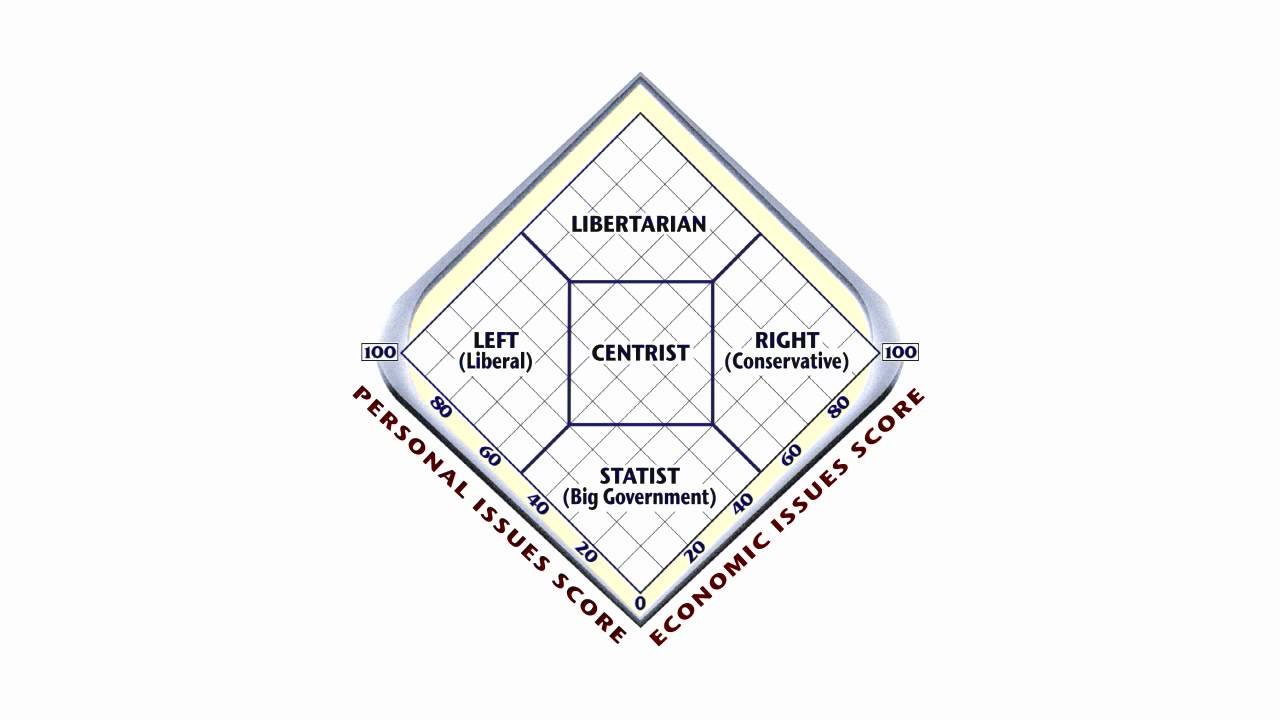
Of course, there are other orientations as well. There’s a graph shown here that can be useful for people who want something a bit more telling, but as you can see the “left wing / right wing” is still there:
my problems with this method is that people spend more time thinking on what makes something ‘right’ or ‘left’ without justifying why there should be a ‘right or left’ in the first place.
How many logical traps, circular battles, futile arguments and pointless divisions have arisen due to an over-reliance on this method by both intellectuals and the public?
It’s a diversion. It’s an added layer of obscurantism that does nothing to further understanding of political science.
Not to mention it makes people identify to ‘teams’ and say inane things like ‘libertarians are on tha left for social issues and on tha right for economicz lolol’
it allows liberals and socialists the opportunity to evade the implications of their own arguments when they can hide behind further inanities like ‘Hitler was right wing’, whatever the fuck that means.
I make an effort to avoid using such ‘wing’ terms in my writing. I do acknowledge the use of terms like ‘liberal’, ‘conservative’ ‘libertarian’ etc in terms of their historical value while realizing the subjective circumstances and fluidity of language that allotted these terms the definitions they currently have, as well as the definitions they used to have in the past.
I’d say at worse it is unscientific because the idea of ‘left and right’ cannot be falsified.
It has been shown that there are indeed differences between people who identify as “left” and who identify as “right”. When I say difference I don’t just mean on the mundane level of policy prescriptions; the differences are on a moral level. There are also differences in the way they think. Which is why people on the “right” and “left” disagree with each other so intensely, or rather the average person on the “left” and “right” disagree so intensely. (When it comes to politicians they, as I’m sure you’re aware, don’t care much about anything other than stealing as much as possible while in office. Staying in office is the other thing they care about.)
I agree with you in that it seems to be a waste of time arguing over if “Right” is closer to freedom or if “Left” means closer to freedom. The issue of where to draw the line between “Right” and “Left” is problematic as well. There are differences nonetheless.