Well, in that case, the assertions that the Civil War destroyed the States’ sovereignty are unfounded, no?
The thing I don’t understand about the incorporation is: what difference does it make whether the 14th Amendment incorporated the Bill of Rights specifically?
In other words, first of all, it did incorporate something. It does forbid the States to oppress some kind of individual rights. I don’t know whether that extends to a right of jury or a right to abortion or a right to bear arms. But individual states cannot commit genocide, for example. So, that already is enough to ask the question about the reversal of sovereignty.
(You are right, it’s not clear from the Constitution what the consequences of the idea that the States may not coin money are. It could be that the States merely willingly gave up that right. If a state exercised its right to coin money, other states could have excluded it from the Union, cut down its participation in the Congress, or whatever. Also, if you read the argumentation of the defenders of the Southern States’ right to secede right around the Civil War, they use words like: “The States willingly gave up some of their rights. Now they are taking them back.” So, at least in these people’s minds, this “giving up of rights” was not the same as the 14th Amendment. But then, the same is the case with the 13th Amendment.)
Also, I don’t really understand the outrage of some anti-incorporationists about the 14th Amendment. For example, in this paper, Laurence Vance agrees that
if the Fourteenth Amendment incorporates anything it incorporates the Civil Rights Act of 1866, which was passed over the veto of President Johnson. This was the view of virtually every member of Congress, Republican or Democrat, who participated in the debates on the Fourteenth Amendment. Senator Trumbull, the draftsman of the bill, stated that the first section of the Fourteenth Amendment was “a reiteration of the rights as set forth in the Civil Rights Bill”. […]
The author quotes someone about what rights the Civil Rights Act gave to the freedmen:
In the first section of the Civil Rights Act Congress has given its interpretation to these terms [privileges and immunities], or at least has stated some of the rights which, in its judgment, these terms include; it has there declared that they include the right “to make and enforce contracts, to sue, be parties and give evidence, to inherit, purchase, lease, sell, hold, and convey real and personal property, and to full and equal benefit of all laws and proceedings
for the security of person and property”
[quoted in Berger 1989, p. 40]
.
At the same time, the author argues against the Supreme Court taking the Kelo case, since the 5th Amendment does not apply to the States; it was never the 14th Amendment intent to incorporate the Bill of Rights.
But so what? The 14th Amendment did provide for the right to hold property – a right which the government had violated with the imminent domain policy in the Kelo case. So, what difference does it make if the Federal Government enforces the right to hold property or the 5th Amendment?
The same goes for those who criticize McDonald vs. Chicago case when the Court rulled that the 2nd Amendment was incorporated. So, if it wasn’t incorporated, then what? I would say that a right to own a gun is a fundamental right, because it’s an extension of a right to own property. Why would the anti-incorporationist have the Court not examine this case? The same goes for the anti-sodomy case, in which the Court declared it unconstitutional for Texas to poke its nose into somebody else’s bedroom.
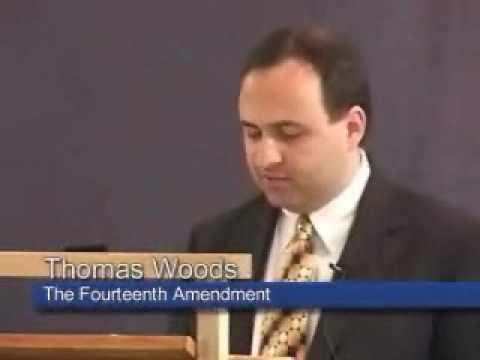
Which brings me to Tom Woods. The reason that I called him a minirchist is that he engages in what Jeffrey Rogers Hummel calls “constitutional fetishism” in his review of Tom Woods’ PIG book (the same goes for the author of the article about Kelo case):
Chapter 6 boldly declares that “the Southern states possessed the legal right to secede” (p. 62). Here Woods lapses back into constitutional fetishism, of a particularly silly form. Why should any libertarian care one whit whether secession was a legal right? The vital, unaddressed question is whether the southern states had a moral right to secede. With respect to evaluating the American Revolution, do we ask whether it was legally justified or whether it was morally justified? If the secession of the slave states was truly immoral, than of what possible import was the legal right? On the other hand, if they indeed had a moral right to leave the Union, so what if doing so was illegal? Only a legal positivist would let the legality determine the morality of the act.