A friend of mine recently visited Japan. There was a strong shift in attitudes about consumer credit after the 80’s. There is no longer much of a consumer credit market at all. Credit cards are rare. Even ATM’s are relatively rare, compared to here.
I have heard that banking is now over-regulated. Whether their regulations are designed to prevent risky loans or to force loans to politically popular areas, like housing for low-income earners, it means there are less people willing to enter or remain in the banking business. Profit opportunities are prevented, and risky activity is likely encouraged. And given that the Japanese witnessed the government prop up the worst of their banks, they don’t respect them or trust them.
Also, the Japanese have never been given a good explanation about what happened to their economy. I doubt the Austrian Business Cycle Theory ever got mentioned in their nightly news. The government’s official line is likely similar to our own - greedy jerks wrecked the economy with their greedy wrecking balls of leverage. I assume they told them they needed to spend their way out of the recession, and everyone grinned awkwardly. I do not actually know what the headlines said, but given the policy response WHICH CONTINUES TO THIS DAY, it seems apparent the normal Keynesian BS was barked through every loudspeaker in the nation.
All these things point to three common truths.
- Cash is the primary medium of exchange for commonplace consumer purchases.
- Mistrust in the economy as a whole pushes most Japanese to save heavily.
- Incredibly low interest rates and mistrust of banks discourages saving in banks.
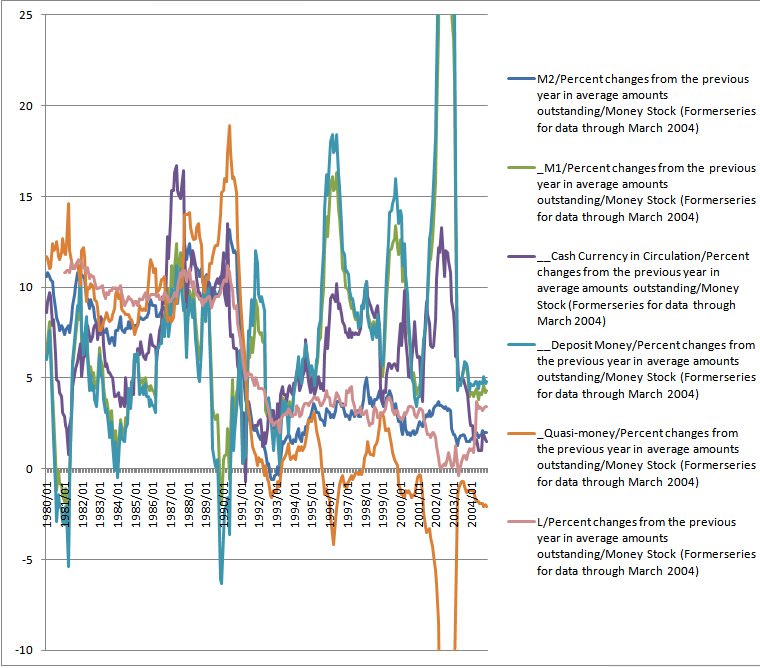
So, people are saving cash. Even as the Bank of Japan pumps out more cash, it is taken out of circulation by individual savers. Thus, it has little opportunity to influence prices. Banks cannot create money via loaning, because they cannot secure “deposits”.
Ironically, Japan is the best case we have to show how artificially low interest rates can produce stagnation rather than an artificial boom.
I am curious to know exactly how much cash the BoJ has created. If large chunks are hiding under matresses, a quick bout of price inflation could trigger hyperinflation, if interest rates don’t rise to push this money into the credit market.
Of course, I think America has the largest chance of hyperinflation, with a lot of our base money sitting overseas.