Reason #1, Record Low Yields:
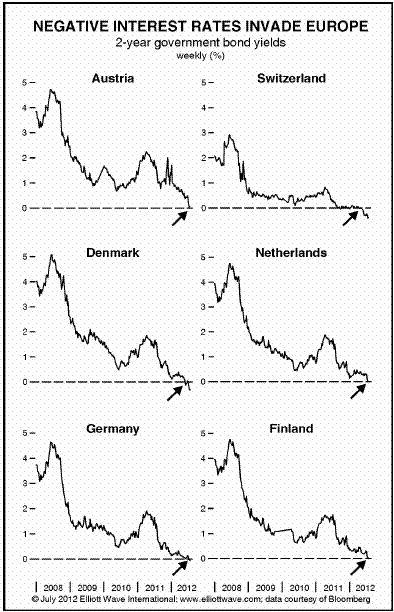
The US 10 yr Treasury note yield recently hit an all-time record low of just below 1.5%. The 30 yr, just under 2.5% - also an all time record. Yields on 2 yr bonds are in negative territory in Switzerland, Germany, and Denmark. The persistently low yields are exactly the opposite of what should be happening during inflation.
Reason #2, Excessive Debt:
The world is not so much awash in money, as it is awash in debt. Much of the new money created has merely gone to servicing debt. Our period of inflation has relied on continuous borrowing and continuous spending. Government cannot force people to borrow and cannot force people to spend.
Reason #3, Fear:
This is an excellent post by “lubbad” from the Kitco forums (boldface, underlining, and italics are mine):
“The problem with economies is that they are not machines. An economy is not controlled by the monetary policy of governments or central banks. Evidence of this is QE1 and QE2: the liquidity did nothing to free up credit markets. The QE did not work because, fear has taken center stage. People are not buying homes because it is hard to catch a falling knife-they are scared of depreciation and they are not secure in their jobs. Economies are controlled by people within the economy. People spend fiat when they are sure of their job security, and they have faith that the future will be secure. Fiat works well when people are secure. Machines do not have desires, and fears about the future…
…
Jim Powell explained velocity: And that brings us to what economists call velocity. Money responds to the law of supply and demand just as everything else does. Velocity is the speed at which money changes hands. When demand for the money is high, money changes hands more slowly, and velocity is low. This is deflationary…When demand for the money is low, velocity is high.
A key point is that velocity and money supply can act as substitutes for each other. A 10% rise in velocity has the same effect as a 10% rise in money supply. The biggest problem with velocity and money demand is they can turn 180 degrees overnight. If people trust the currency, and suddenly perceive some kind of big threat to their futures, money demand can shoot up.
If you don’t spend your money, that’s the same thing as taking it out of circulation. This can instantly cause the equivalent of a sharp deflation of the money supply by 10 or 20 percent, or more.
That’s what happened in the Great Depression. The Fed was inflating. In 1932, the money supply was $20 billion, and by 1940 it was $38 billion. But fear was so great that velocity was falling faster than money supply was rising. This is why Franklin Roosevelt said in his first inaugural speech, “The only thing we have to fear is fear itself.” People were afraid to spend their money, as they are now, and velocity was falling, which has the same effect as deflation, because if you don’t spend your money, it’s not in circulation.
These wild shifts in money demand and velocity have the same effect as massive, instantaneous shifts up and down in money supply. It’s like we’re having a huge inflation, then a deflation, every few hours — because our fears change every few hours — because the politicians have all this arbitrary power and we don’t know what they’re going to do to us!
It is important to see that the economy is not a machine. Machines don’t feel, they don’t have fear…But people, biological organisms, do have feelings. They do fear, and their fears can change instantaneously.”