I don’t think I’m fast but I think the quickest was is to keep reading, and learn as many new words as you can. I read Ron Paul’s The Revolution A Manifesto in 2 days (I had time on my side those two days, wasn’t busy).
It’s funny you bring this question up. I could easily read books on theoretical physics and sciences rather quickly. However, now that I’m reading on libertarianism and economics my reading speed has moved to a crawl. It takes a long time for me to digest the material, and find it a little more demanding than learning a subject matter like thermodynamics. I’m assuming it’s primarily because of the new vocabulary that I’ve had to learn.
I read quickly, I just can’t read for very long periods of time.
Anyone know how fast Rothbard, Mises, or Hayek read? I know Rothbard read pretty quick but just don’t know how quick.
I have two reading speeds.
-
Normal moderate speed
-
Human Action snail speed!
That is unless you do a Leon Walras and try to make economics thermodynamics! I’ve been wanting to write a critique of the Walrasian translation of equilibrium concepts in economics for a while now. Do you have any thoughts on the matter?
In response to the earlier post, I tend to read things slowly and focus as much on absorbing the details as possible, which is why I often prefer shorter, more dense books in Physics. It’s also why HA is taking me ages…
For me, I find my speed dependent on the work.
Even for fiction, if its done well and I’m really into it, I can zip thru the book. If its not so easy, or hard to get into, its can be slower for me.
For non-fiction, if I really have to think about it, it can be slower. I sometimes find I’ll have to re-read a section because I just didn’t understand it or get it.
I’m not familiar with Walrasian concepts but I’m not a fan of economics grounded on deep mathematical concepts. Case in point, The Black Schole’s Equation (used in market derivative pricing), a partial differential equation is entirely based on the heat equation from thermodynamics. I feel it’s incredibly dangerous to use mathematics in an attempt to mimic economic behavior & outcomes. As a scientist, I’ve learned that mathematics is within itself limited (I can thank Gödel for that). What is your interpretation? I’ve had the good fortune of working with a chaotic model once-the Brusselator equation. I must say, it’s called chaotic for a reason. I will look up Walrasian translation… sounds interesting.
I agree wholeheartedly on dense physics books. At times, I’ll read several books on a particular subject matter to understand the material from as many points of view as possible. Currently, Jim Al Khalili is one of my favorite authors/physicist. He has an incredible gift of describing complex theories such as quantum electro weak theory, QFT, and quantum chronodynamics.
I’m still digesting your research topic about isotropic systems and quantum phase changes. Your research sounds fascinating. I’m assuming an isotropic system and limits close to 0 Kelvin to simplify your model as much as possible. Also, when you state a XY model, are you describing a two variable system? Are you using Density Functional Theory, and does your model incorporate wavefunctions that adhere to Hilbert Space (inner product spaces)? Lastly, are you pure theorist? If so, I commend you on your educational endeavors. I’m only a mediocre theoretician. I take it back, I’m a lousy theoretician.
No I’m the lousier theorist! Perhaps we may begin competing for the title.[:P] In response to your question, yes I am a pure theorist(or theoretical physicist). I haven’t had to do lab work since the first year and I’m glad, l’ve never been very good “hands on.” I don’t mind interpreting the results of experiments that much, but I don’t like doing them.
Honestly I only think it sounds complicated because I’m often terribly bad at providing clear explanations, though I’m glad you find my research interesting. The isotropic model has been picked for its simplicity, though I’m now analysing the generic model too (wish me luck, my dissertation’s in next Friday![+o(]). Also, I should have been more specific, the XY model is a one dimensional ring(since I’ve assumed cyclic boundary conditions) of connected particles that may each have a spin(1/2) in the x or y direction, in the presence of a magnetic field applied in the z direction. I’ve also assumed only nearest neighbour interactions between spin particles as being significant. Also, as we’re dealing with quantum phase transitions, we are only interested in zero kelvin quantum fluctuations with thermal motion neglected.
I have not been or not needed to be using density functional theory or anything fancy like that, since I’m just doing many particle physics with summed spin operators. The analysis has been much simplified with the use of Jordan-Wigner transforms to represent the problem fermionically, to get to the point I now have a diagonalised Hamiltonian from which I am calculating properties for entropy and free energy at will. Interesting entropic behaviour occurs within the region between the 2 transition points for the isotropic case, and indeed entropy even becomes nonanalytic in the vicinity of the transition points themselves, before becoming zero everywhere the field is strong. The reason for this interesting behaviour at zero kelvin when we normally expect zero entropy(following from the 3rd law of thermodynamics) is that the excitation spectrum is gapless at certain points in the phase space for both models, producing a degeneracy of the ground state.
Finally, of course the wavefunctions do occupy Hilbert space, except my entire approach has not been to deal with many particle wavefunctions directly, but to utillise the action and relations of the operators that act upon them as shown via second quantisation.
Wow, I must apologise for hijacking this thread into a small essay on my research project! Let’s keep pseudophysics out of economics![8-|]
Same with me. I read Atlas Shrugged in 2 days. (I was on holidays, heh)
The second book I ever read on anything regarding logic, ethics or anything like that from the classics was - Aristotle’s Nicomachean Ethics. The first being Plato’s Republic.
Talk about being ‘thick’, but I really enjoyed it. I had come to the same vague conclusions, but couldn’t put it into words or a system of thought. Although I had to read some pages several times, to try grasp what was being said. It was worth it.
Another factor that plays a part is, whether you know the stuff already… or think you do.
So people who’ve done lots with ethics, know natural law, logic etc - may find it hard going reading it, and lack the enthusiasm to get you over the line.
Also taste, I’m more into political philosophy that economics (passion for justice etc.) - naturally they compliment eachother though. So I was really enjoying HA, read that super fast - until it got to Cattallatics, lol. I feel like I know it already, not enough incentive to plough through it (more valuable things for me to read and spend time on), though I have the study guides for that and MES. I will get to it eventually, so don’t you fret! [:p]
PIG: The great depression, End the Fed, Meltdown, and “Can Capitalism Survive” took me a weekend, each.
I never read more than a chapter of HA in a day, though. I read one chapter, or work on it slowly to let things sink in.
This. lol.
I read other books to take a break from HA. I know I’ve probably read them in reverse order, but when I’m done HA I’ll get and read MES. I imagine I’ll get through that pretty quickly for a ~1000 page book.
After that, a few more smaller books and then either Mises’ Theory of Money and Credit or Socialism.
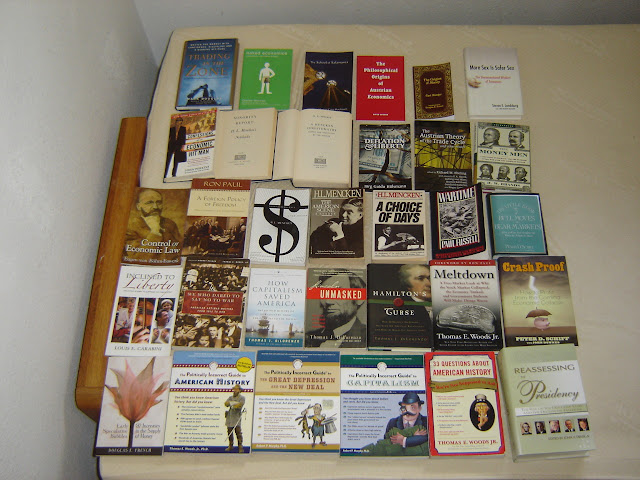
New additions:
Why American History is Not What They Say: An Introdustion to Revisionism by Jeff Riggenbach
Men of Wealth by John T. Flynn
God’s Gold: The Story of Rockefeller and His Times by John T. Flynn
The Private Production of Defense by Hans-Hermann Hoppe
The Anti-Capitalist Mentality by Ludwig von Mises
Against Intellectual Property by Stephan Kinsella
The Concise Guide to Economics by Jim Cox
The Austrian Theory of the Business Cycle and Other Essays by Richard M. Ebeling
The Socialist Tradition: Moses to Lenin by Alexander Gray
The Privatization of Roads & Highways by Walter E. Block
Common Sense Economics by Hahn
Requiem for Marx by Yuri N. Maltsev
The Complete Libertarian Forum: Volume I
The Complete Libertarian Forum: Volume II
The Place for Economics Learning by Ludwig von Mises (not pictured)
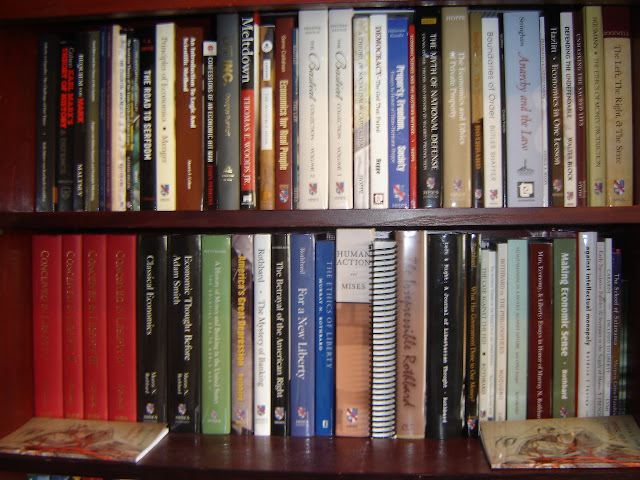
The updated collection:
From top to bottom:
The Revolution: A Manifesto by Ron Paul
Economics in One Lesson by Henry Hazlitt
Economics for Real People by Gene Callahan
The Ethics of Liberty by Murray Rothbard
The Creature from Jekyll Island by G. Edward Griffin
For a New Liberty by Murray Rothbard
Meltdown by Tom Woods
Socialism by Ludwig von Mises
Man, Economy, and State w/ Power and Market by Murray Rothbard
An Introduction to Economic Reasoning by David Gordon
And the book in the middle is, obviously, the MES study guide by Robert Murphy.
Also featured: My Mass Effect novels (Laughing Man would appreciate that – the other novel is behind the study guide), some Series of Unfortunate Events book I never read, A Child Called ‘It’ (which I never read), Skeleton Key (which I bought at a book fair at my elementary school some 8 years ago or so…), The Infernal City (based off the Elder Scrolls video games), Atlas Shrugged, and five of the Harry Potter books (the fifth one is missing, though, and I never bought the seventh).

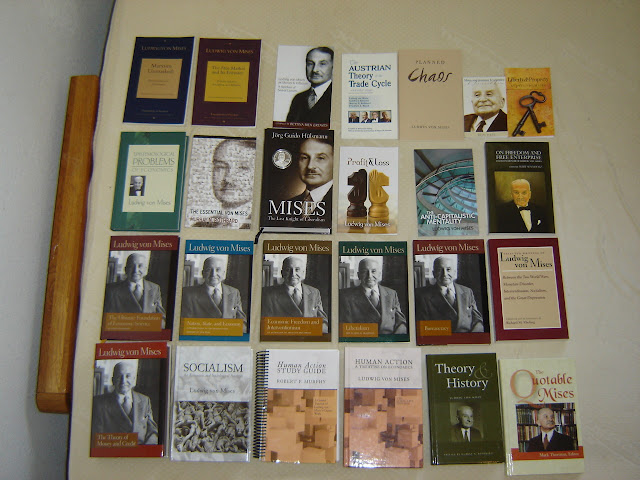
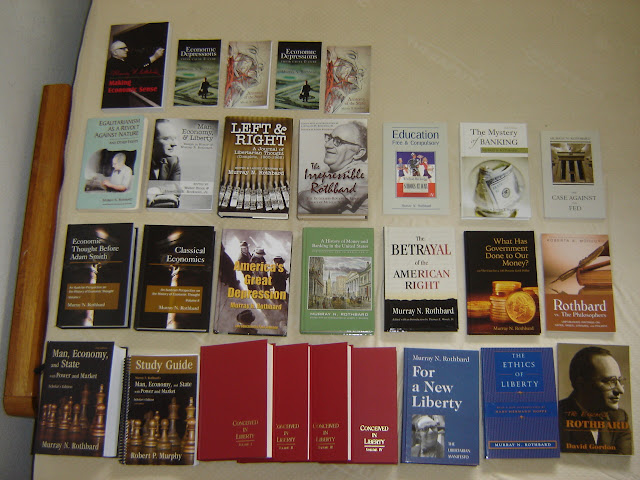
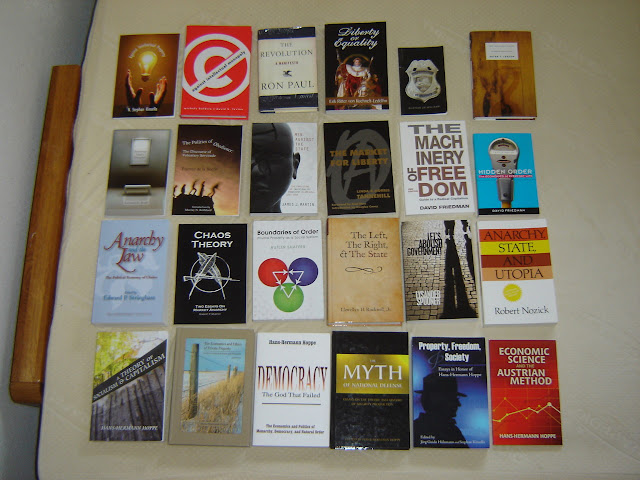
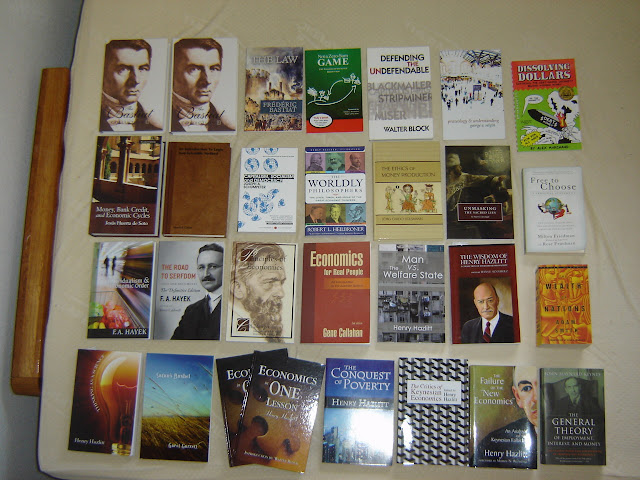
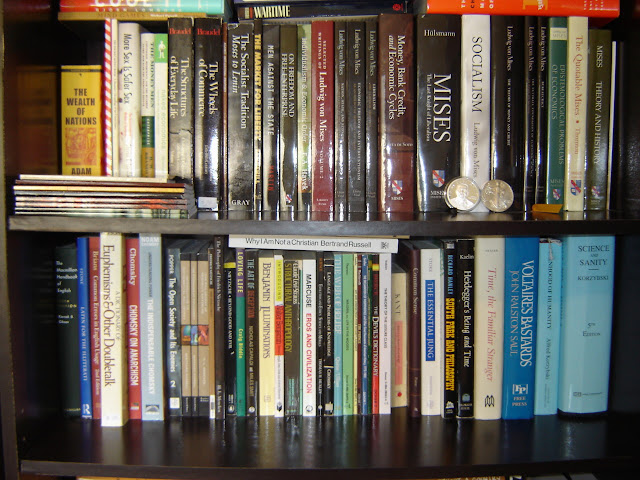
My current Austrian Library:
(I actually have 3 of them atm, and I intend to give 2 away)
What do I win?
@h4x5k8
Wow, that is a very nice collection. That probably is a lifetime of reading material for the average academic. Did you buy them in a set?
Thank you.
No, unfortunately I didn’t buy any of these through the “Author Collection” deals on mises.org. I’ve been collecting most of the Mises Institute books over the last two years. A little Rothbard here, some Mises and Hoppe there, etc. A lot bought online and many at their conferences as well (even found a trove of L.v.Mises at the used bookstore). I had pretty low living expenses and a decent paycheck for a while, so I figure I’d build my library. Also, nearly all of family is directed to my wishlist at the Mises Store for x-mas and birthday presents – that has helped a ton.
It’s funny, high school gave me a hatred for reading. I remember liking when I was young, the teachers said I had an above average reading level. When I got into high school, I couldn’t stand the crap they made us read, and unfortunately I didn’t go the extra step to try and find material I might actually enjoy.
It wasn’t until a few years ago that I realized I loved reading, and it’s been a non-stop intellectual adventure ever since. I found my first anarchist, Robert Anton Wilson. I got into Ron Paul’s campaign during 2007, read ‘The Revolution’, which led me to an interest in economics and naturally the Mises Institute, which led me to another anarchist, Rothbard.
Once I found Rothbard I knew I had found home.
Just finished ‘The Road to Serfdom’ (and ‘Dune’, for nonfiction). Now onto ‘Democracy: The God that Failed’ (and The ‘Fountainhead’).
Thats exactly how I do it. I always read a fiction and a non-fiction. Sometimes you need the break!
@ h4x5k8
What are those blue books at the bottom of the first picture
The Annals of America - 22 volume collection of historical writings. Got it for free from my Mom’s cousin.