OK, this has been really helpful to hear. I just now realized that it is definitely Gaede’s use of the term “science” that is the problem. He simply delineates the boundaries of what he wants to call “science” more narrowly than is now common. I think he should just call it explanation, and his entire point is that mathematics has nothing to do with explaining a phenomenon (though it certainly can have something to do with characterizing that phenomenon). The lever equation, for instance, is very useful, but it is just a characterization - just a succinct encapsulation of the observed data.
That is really all modern physics does: it gives succinct (if we’re lucky) encapsulations of observed data. Bill Gaede hates that that seems to be the sole goal of science these days, and I have to admit I find it very disappointing as well. Whatever happened to “how it works?” The sense of discovery is totally missing from science these days. It feels empty, unless of course you buy into the fantastical ideas of wormholes, time travel, particle-wave dualities, dark energy, and the like.
The Ptolemaic “explanations” given by relativity and quantum mechanics come in the form of what appear to the layman to be “actual” particles and “real” curvature of space, but that is just a semantic/mathematical blanket covering over the fact that they’re only offering descriptions of what is observed, not explanations of how the observed could have come about.
All sorts of odd mathematical notions are around. It just so happened that imaginary numbers found a use, which is why we learn about them in highschool. Had it been quaternions or something else, we would have learned about that instead. So I think it’s more that the concept was there (among many others), and then an application came along. No application came along for the others, so they are forgotten or only studied by mathematicians. Then it looks like the physical world acts like numbers, when actually the physical world acts like one of the many esoteric mathematical entities dreamed up over the centuries.
Re: the discussion with Orthogonal, one inefficiency in Gaede’s conception is that he uses the term “exist.” He can do without it. Gaede’s entire approach to science can be encapsulated in a few words: mechanical movies of what phenomena are proposed to underly observed data.
The word mechanical invokes that basic fact of human experience that there are objects that cannot pass through each other.* They push, pull, and collide with each other. That one fact accounts for most of even a child’s knowledge of how to navigate and manipulate the physical world. It is surely hardwired in us to a degree, and even if not, so much of our understanding of the world is based on it. Our very thinking is surely based on physical metaphors as well.
Now, numbers have no place in mechanical movies proper. Of course numbers can tell us if those movies are plausible (for instance, the movie of how gravity works had better show how the objects in the movie interact to produce the inverse square in the gravitational equation), but they have no place in the movies. We use an equation to summarize the observed data (yes, pencil falls toward earth at this rate of acceleration, yes, again, yes, verified again, ok now we have a neat equation that summarizes the data), then we theorize about the (unobserved) physical mechanism by which that data could have been produced. Then we check it against the data (equation) again. And back and forth like that, between data and explanatory theories.
Also, we can visualize rocks, but we cannot visualize numbers (except maybe as movies, or we can visualize 4 rocks, but not the abstract number “4”). Math is useful, but it is not what we put up on the big screen when we want to present our explanation of how we think an observed phenomenon may have come about.
*Unfortunately his rope hypothesis violates this, so it’s not yet fully viable.
Re: the discussion with Orthogonal, one inefficiency in Gaede’s conception is that he uses the term “exist.” He can do without it. Gaede’s entire approach to science can be encapsulated in a few words: mechanical movies of what phenomena are proposed to underly observed data.
Everything follows from that. The word mechanical invokes that basic fact of human experience that there are objects that cannot pass through each other.* They push, pull, and collide with each other. That one fact accounts for most of even a child’s knowledge of how to navigate and manipulate the physical world. It is surely hardwired in us to a degree, and even if not, so much of our understanding of the world is based on it. Our very thinking is surely based on physical metaphors as well.
Now, numbers have no place in mechanical movies proper. Of course numbers can tell us if those movies are plausible (for instance, the movie of how gravity works had better show how the objects in the movie interact to produce the inverse square in the gravitational equation), but they have no place in the movies. We use an equation to summarize the observed data (yes, pencil falls toward earth at this rate of acceleration, yes, again, yes, verified again, ok now we have a neat equation that summarizes the data), then we theorize about the (unobserved) physical mechanism by which that data could have been produced. Then we check it against the data (equation) again. And back and forth like that, between data and explanatory theories.
Also, we can visualize rocks, but we cannot visualize numbers (except maybe as movies, or we can visualize 4 rocks, but not the abstract number “4”). Math is useful, but it is not what we put up on the big screen when we want to present our explanation of how we think an observed phenomenon may have come about.
*Unfortunately his rope hypothesis violates this, so it’s not yet fully viable
The first 20 mins or so of this (but the whole thing is fascinating):
You are aware that Wittgenstein also wanted to create a visual language? He eventually gave up so that might be a cautionary tale. Leibniz was interested in what I believe Steven Pinker has finally begun to do and that is to try to identify the “alphabet of thought”, the basic building blocks of human thought present in any human language. Leibniz felt that we could analyze language and strip it down to its bare structure (a kind of mathematical/logical structure) and this structure would be the very alphabet of thought. Nothing more basic than these structures could be conceived. Pinker elsewhere talks about the contrast between his work and Chomsky’s works and his description of Chomsky’s work sounds a lot like the approach that Leibniz had in mind. I think the evolutionary psychology approach, however, is more concrete and makes more sense to me.
Maybe we have a disagreement about the nature of visualization, then. Even Gaede uses idealizations that do not correspond to mechanical reality to illustrate his “thread theory”. Visualization is not simply the construction of miniature models, e.g. a planetarium. Visualization/idealization is the intentional and direct utilization of the features of human language (and, hence, brain) that permit us to “slice up” the physical world into geometric abstractions. Mathematics is “parasitic” on this built-in feature which did not evolve for the purpose of doing mathematics. It just happens to enable us to do mathematics.
My point about real numbers is that physicists have (perhaps unwittingly?) surreptitiously imported an infinitude into the physical world from the idealized world of mathematics - the infinitude of infinite divisibility. Real number space is infinitely divisible, no matter how many times you have divided a piece of real number space, you can always keep dividing it further. This flatly contradicts the Planck distance which means that real-number space is simply a bad model of the physical world, it actually contradicts the phenomena. If the Universe were infinitely divisible, there would be no Planck limits.
This is part of my motivation for proposing a “ratio-like physics” where all quantities in the Universe are in fact whole number multiplies of something else and all relations are ratios between those whole numbers. This limitation would apply at the smallest scales so that we cannot speak of a “physical point”, as in, a geometric point that is infinitely small. Such a point would require infinite divisibility which contradicts the Planck limit (an observed property of the Universe).
Yeah, but I think he understimates the power of inference from observed phenomena to extend our resolving power of the Universe itself. Let me explain. Without a microscope, all you have is the unaided eye. You can’t see very much. You need a technological tool, a device, to amplify your ability to see small things. This is the microscope. Now, even with a microscope, there are limits to what you can see. What can go past that? Well, we have electron microscopes, interferometers, particle accelerators (basically, these are just ridiculously large and expensive microscopes pointed at fundamental particles). But how can we go past that?
Well, we can use deductive methods to extend our conception of the physical world beyond what is observed with the caveat that such extensions are precarious… a single contrary observation can collapse the entire house of cards. And for a long time, this is all we had… the ancient Greek, Chinese, Indian and later philosophers used deduction from geometry (which was based on scientific observation of the nature of ordinary objects) to speculate about the nature of the physical world beyond what they could directly observe. Democritus, for example, famously postulated that everything in the Universe is made up of tiny atoms (though he wasn’t absurd enough to treat them as point-particles as modern physicists do) and that the bumping together of these atoms like billiard balls gave rise to all physical phenomena. Down to the level of chemistry, he would later turn out to have been precisely on the mark.
So, I see two prongs to science, a technological prong and a conceptual prong. The technological prong is dependent upon new devices with greater resolving power. The conceptual prong is dependent upon deductive methods, that is, the state of the art in logic and mathematics. It is the combination of these two that enables us to perform a “heuristic search” of the Universe. Without the conceptual prong to generate speculations by which to guide our observations, we’d have no idea what to look for. And without being able to see things one way or another, we’re often stuck saying “Well, it could be A, B or C… or something else completely.”
The trouble with modern physics is that it has become wholly obsessed with the technological prong. It’s all about building a bigger accelerator. But I don’t think we’ve really digested all the observational data which has been generated since at least the early 20th century. There are other, entirely different ways of thinking about those phenomena which have hardly been explored at all. We’re blindly proceeding down one path at full tilt, heedless of the costs of being wrong. What if all this money poured into these accelerators has just been a waste and we should have been doing something else instead if we really wanted to get meaningful answers about how the world operates?
As I’ve written elsewhere, I believe this is a symptom of public science funding and the “monopolistic theory” or “king of the hill” effect it creates within the sciences. One conceptual framework comes to dominate and sucks up all the oxygen but this actually makes us conceptually blind. That one framework receives basically all funding and the other conceptual possibilities languish, unexplored.
Go read Mach. It’s more than that, it’s a manifestation of a deeper physical principle called moment. Mach specifically exposits the lever principle in order to guide the reader to this deeper (as in, more general) understanding of the mechanical world. He shows how the history of thought about the lever led by halts and starts to this final conception of the moment and how it is the most general and elegant way of understanding the lever principle.
As for the point about Conservation of Momentum, you should read the section where he discusses Galileo’s thought-process. You will see that Galileo did not just “encapsulate observed data”… he actually thought-experimentally continuated the observed data beyond what could ever be observed and used this to deduce a generally useful law of physics, the law of Conservation of Momentum. This is an illustration of how the conceptual prong of science can be used to extend the technological/observational prong.
I will concede that mathematics is originally anthropological, that is, human mathematics reflect the built-in circuitry of the human brain and are really a manifestation of our brain’s way of thinking about and organizing the physical world.
However, complex numbers are very special. They are different than rational numbers or even real numbers or bizarro numbers (e.g. surreal numbers). Their first special property is that all the basic operations of arithmetic (addition, subtraction, multiplication, division, exponentiation, root and logarithm) can be performed on complex numbers and the result will always be another complex number. This is not true of the real numbers, for example. If you take the logarithm or root of a negative real number, the result is not a real number. The second special property is that there are certain “special” complex functions which have the behavior that every other complex function (with certain natural restrictions) can be “mapped” onto the special function. This means you can choose a single function to represent all possible complex functions which are just parameters to the special function.
There are more interesting properties - fractals and waves (both of which occur very frequently in Nature) are very natural within the complex numbers. And, as I mentioned already, the correlation between electrical phenomena and the complex number system is truly jaw-dropping… it’s like the complex numbers have just the right shape to describe electrical phenomena. They are a “perfect fit”. To cast that aside as “excessive arithmetization” of physics is as silly as throwing out Euclidean geometry in describing the world of ordinary experience. The correlation is beyond coincidence.
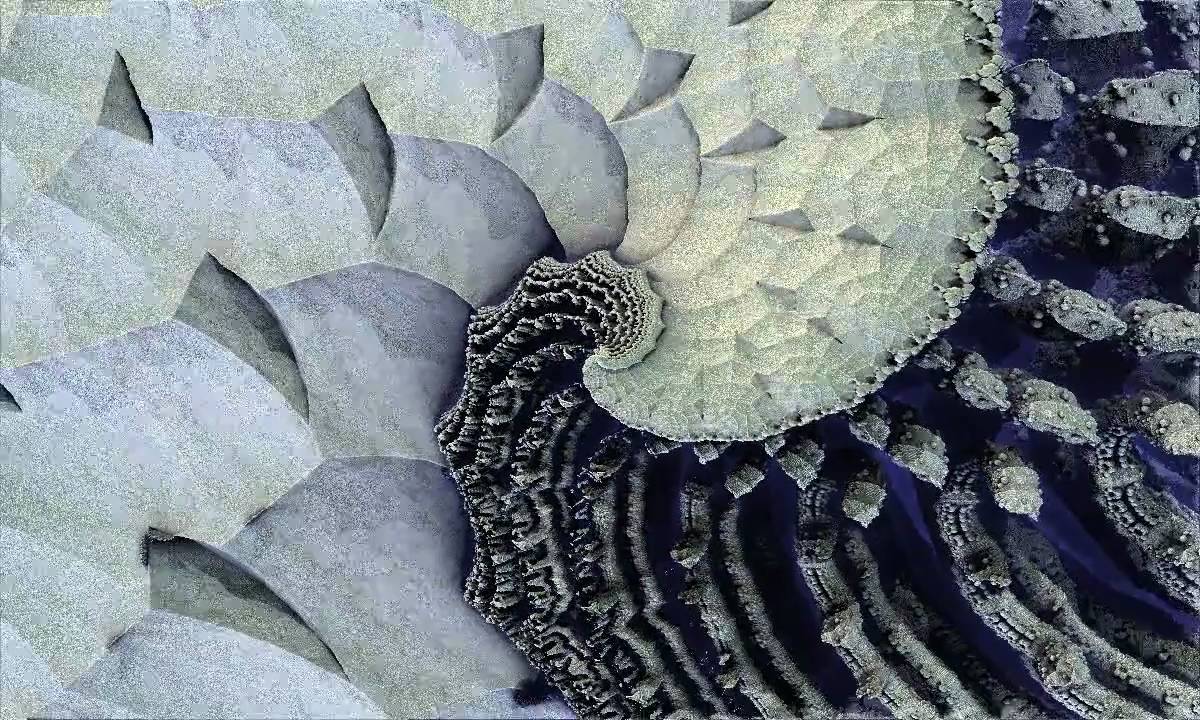
The power of complex numbers and computers together is stunning:
In a metaphorical way, it looks real. It has all the features of the real world as it looks when we investigate it at all scales… a perceptible order that has been slightly skewed and has deep structure as far as you can manage to look. Living organisms, galaxies, ice crystals, all of these and more exhibit this kind of “fractal” structure to them. I believe (as in faith) that the Universe is ultimately something very much like this. At root, the Universe is number because what else could it be other than pure pattern? It doesn’t just exhibit structure, it is structure.
And I believe this structure is very “fractal” and “complex-number-like”. The laws of the Universe appear at once so mathematical (orbit of the planets) and yet so bizarre (nuclear radiation) because we are dealing with pure structure that is immensely deep. Deep structure can appear very “ragged” and “misshapen”. I believe the raggedness in the structure arises from the “lossiness” of the Universe’s propagation of state information. Not all information present in a physical system is preserved in time, some of it just “gets lost” and this makes it impossible to run the Universe backwards (time has an arrow) and it causes increasing disorder (entropy) which gives the Universe an “uneven yet structured” appearance.
This is precisely how these fractals get generated… you choose an equation but you don’t want to choose an equation that is too elegant, or else the fractal structure is too smooth, symmetrical and repetitive, you choose an equation that is a little “lop-sided” and then you get these amazingly organic-looking structures. I don’t think these animations introduce noise into the fractal but you can create even more “realistic” fractal structures by introducing noise… which is just lossiness in the transmission of state information.
Well if the world were made of some basic building block that had a very simple shape architecture (ex: pyramids), I guess it makes sense that that would result in a lot of fractal structure at every level, and also some simple math would be able to characterize it elegantly since the basic structure is physically simple.