Hey Mises Community members, I’m back with another question. I’ve been trying to figure out why we have a fiat currency system. There is a ton of information on the 'net about the DISadvantages of fiat currency, but few resources that address its advantages. The best I’ve found so far is the disadvantages of a gold standard from Wikipedia. I’ll give my amateur thoughts, but I’d greatly appreciate input from those more knowledgeable than I.
Deflation rewards savers[20][21] and punishes debtors.[22][23] Real debt burdens therefore rise, causing borrowers to cut spending to service their debts or to default. Lenders become wealthier, but may choose to save some of their additional wealth rather than spending it all. The overall amount of expenditure is therefore likely to fall.[24]
Inflation rewards debtors and punishes savers. If you want to hold on to your own money rather than investing it, it loses value over time due to inflation. In an inflationary system, you basically HAVE TO invest your money; typically people keep their savings in a savings account wherein the bank is investing your money and paying you a small amount of interest (to offset inflation, I suppose).
Why is a high amount of expenditure a good thing?
I’m not sure I understand the part about debt burdens.
Many economists believe that economic recessions can be largely mitigated by increasing money supply during economic downturns.[32] Following a gold standard would mean that the amount of money would be determined by the supply of gold, and hence monetary policy could no longer be used to stabilize the economy in times of economic recession.[33]
Austrian economics argues that increasing the money supply doesn’t mitigate recessions, but post-pones them, correct? When deflation inevitably hits (as the market corrects itself), it is worse than it otherwise would have been?
Monetary policy would essentially be determined by the rate of gold production. Fluctuations in the amount of gold that is mined could cause inflation if there is an increase, or deflation if there is a decrease.[36][37]
Deflation isn’t necessarily a bad thing?
Although the gold standard gives long-term price stability, it does in the short term bring high price volatility. In the United States from 1879 to 1913, the coefficient of variation of the annual change in price levels was 17.0, whereas from 1943 to 1990 it was only 0.88.[37] It has been argued by among others Anna Schwartz that this kind of instability in short-term price levels can lead to financial instability as lenders and borrowers become uncertain about the value of debt.[41]
Don’t understand this part. I’d appreciate if someone could translate into something easier for me to digest.
Have your friend take a dollar bill and tear it in half. The output of the good and services in the economy has not been altered, but the distribution of claims on these good and services has changed, all holders of dollars have 1/10^13 more buying power or something like that. So take the dollar bill and tape it back together. You just changed the distribution of good and services again. Imagine that instead of taping two valueless dollar haves you simply print more money or with even less effort, change balances on an electronic ledger. In each case the counterfeit money you just created helps you or the people you give it to. Of course all others are not hurt because the buying power of their dollars is less.
So if you control the amount or buying power of a currency you have enormous power to reward yourself and your friends at the expense of everyone else.
This is exactly what the central banks do and why the money controllers of the world like the governments will treat people who try to counterfeit or not use their fiat currency with harsh violence.
I was under the impression that counterfeit only refers to “unauthorized” creation of “fake” or “imposter” currency, like painting a piece of paper green and calling it a u.s. dollar or painting a rock yellow and calling it gold. Since the Fed and the u.s. treasury are the “authorized” creators of their money and the money is “real” it is not counterfeiting.
I agree that it is bad, but I’m not sure I agree with the term counterfeit when used in reference to what the Fed and the u.s. treasury are doing. It could be viewed as theft from a certain point of view since they are in effect stealing value from the money that is in our hands.
In this case, the problem is more the monopoly on the “authorized” creation of fiat currency, not necessarily the idea of fiat currency itself?
People readily use the word “counterfeiting” to impugn the FED, in part, because the FED (nor its supporters) refuses to acknowledge what it is doing. They use fancy terms like quantitative easing to trick people and the politicians (and media) merrily play along.
So yes, counterfeiting, is the wrong term technically, since what they are doing is legal - but still - it’s succinct and to the point when criticizing the FED. If the FED would just say we are “printing money” instead of “quantitative easing,” I doubt opponents would impugn them as much with the counterfeiting tag.
Having a sound money—meaning a money for which the value doesn’t
bounce around erratically, and doesn’t lose its purchasing power over
time—makes all of these activities much more orderly. Having an unsound
fiat money is (usually) still better than nothing, but in the extreme governments
can render their monies so useless that the public literally abandons
the currency and adopts other items as media of exchange." -Robert Murphy, Lessons For The Young Economists, page 338…
So basically, fiat money is usually better than having no money at all but sound money is the best. Fiat’s only advantage is that it allows indirect exchange among individuals, since having a pure direct exchange society is very limited…
A fiat currency can be more fun because you can gamble your money when you deposit it in a fractional reserve bank.. it could turn out to be a positive investment!
There’s one genuine advantage for the masses - fiat currency is infinitely subdivisible, so whenever the money supply began to squeeze trade, all that need happen is that a new subdivision is declared and new coins designed rather than the market needing to come up with a supplemental money(such as silver to gold). Of course, this smashes one of the bigger arguments of the inflationists.
Having a sound money—meaning a money for which the value doesn’t
bounce around erratically, and doesn’t lose its purchasing power over
time—makes all of these activities much more orderly.
[/quote]
I would change a minor issue: even in a free market with a gold standard the value of money could also change - go up and go down - depending on consumer preference regarding money. Obviously, though, this wouldn’t be bad because it’s consumer based and probably not as much as with the current monetary system.
The lack of alternative uses of fiat money is a disadvantage. The alternate uses of a currency tend to help regulate the value of commodity money. For example,gold is commonly used in jewerly and dentistry. As the price of gold (The buying power of gold currency) goes up then less will be used for these alternate uses thus helping to drive the price back down. The same is true for a drop in the price of gold or it buying power, the folks with alternate uses could bid back up the price by using more of it. Contrast this with a fiat currency, as the creator makes more thus decreasing its purchasing power, there are no alternate uses keeping the price up. So the purchasing power drops more rapidly. The same is true on the other side, without alternate usese the fiat currency can as in our most recent “Great Recession” suddeny increase and have no alternate uses to add that supply to keep the buying power down.
The issue here is your definition of waste. Waste according to Rothbard is just any product or service that does not satisfy a consumer demand. It has nothing to do with the technical mechanism or byproducts of creating a product or service.
Having a sound money—meaning a money for which the value doesn’t bounce around erratically, and doesn’t lose its purchasing power over time—makes all of these activities much more orderly.
And what money, precisely, are you imagining this to be?
Gold fluctuates wildly in price and value…as do most commodities. It’s not magically exempt. It also tends to lose its value over time, as does every other commodity.
Paper money, in fact, tends to retain its value longer than gold, and to be more stable in value than gold. In the past decade, the dollar rose declined3% per year in value for the first five or six years, then stabilized in value, actually increasing slightly in value for the past three. Meanwhile, gold doubled in value, fell by half of that, shot up even higher, fell back…a roller coaster of MULTIPLES of its price of ten years ago.
Imagine if you were trying to deal with buying bread, or investing in something expensive like a house, car, or stocks, when you had to worry about the price not only multiplying over the course of a few months, but even changing dramatically between when you last checked and when you sign the papers for the investment.
-Robert Murphy
He’s just a Rothbardian, not a real Austrian. I’d take him seriously on pretty much anything but monetary theory, based on fallacies like the above.
Part of gold’s instability is due to its use as an inflation hedge for worried money men. If it were commonly used as geld, its price would likely be much more stable, since it would depend mostly on how much was in a given area at a time(much like the idea of the dollar’s value fluctuating rapidly is absurd). The fact that there’s only one known bubble under a (more or less?)true gold standard and that can be traced to a huge amount of gold entering the Netherlands at once attests to its stabilizing influence. Not to say commodity money’s infallible, but it’s better than paper by a long shot.
As I have said in every past thread about paper money, the “advantages” of fiat currency are always given with the assumption that existing problems do not exist. The supposed disadvantages of commodity are necessary features of market money. That cost of extraction and transaction is what allows it to be used without counterfeit to oblivion or planned wealth redistribution. To deem that a disadvantage is like deeming it a disadvantage to have to borrow money at 5% to buy something with a return of 10%. 5% return is better than 0%. The “advantage” of low cost creation of electronic money is only an advantage for those gaining net over depreciated purchasing power.
When gold WAS used as currency, its value fluctuated even more. There were far more than one gold value bubble in history…in fact, they may have been the rule, not the exception. The Civil War was triggered (though not caused) by the economic trauma of a series of gold and silver price bubbles and collapses in the 1840s and 1850s. The Crime of '73, the Cross of Gold, was caused by another such pair of bubbles/collapses in gold versus silver. The Spanish Empire was brought down TWICE by a collapse in gold’s value. Its fluctuation also contributed to the setting of the debate over Scottish free banking in the early 19th century.
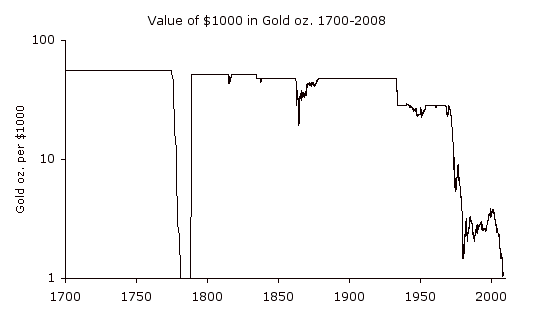
Look at this chart of the value of gold over the past 700 years:
Even if we take the effort to quantify the value of gold with an increasing grain of salt as we go back farther into history, it’s clear that it’s not been a storehouse of stable value.
Note that Robert Murphy’s chart in “defend the gold standard” is absolute fallacy, as it charts the price of gold IN DOLLARS over the past century, and of course the price of gold was TIED to the dollar for 70% of that time, so the wild fluctuations of its price are hidden by first the gold standard, then breton woods, rendering his chart meaningless.
Exactly like Murphy’s chart in the article I mentioned, yours is meaningless fallacy, and nobody with a grain of intellectual honesty should use it:
You are listing the price of gold IN DOLLARS…when dollars were fixed to the price of gold, by definition.
No matter how wildly the value of gold fluctuated from 1780-1974, its price in dollars was going to chart as a flat line, because the dollar was DEFINED as a certain weight of gold.
I would never argue that “store value” is important. However, that chart, whatever is measuring against, nonetheless shows gold having more “store value” than any fiat currency. Not only does fiat currency decline with rare interruptions, it declines unstably. Now subtract counterfeit law and time on a stopwatch how many seconds until toilet paper company stocks hit $0.
Robert Murphy is pretty much an Austrian Economist… end of story…I do not see how people could debate that… If you look at his sources in his articles he has sources from Hayek, Mises, Rothbard, Hazlitt, Bastiat… And Murphy did get asked about his definition of sound money in his book in one of the online lectures he did and he replied that when major countries were on a gold standard, gold didnt behave like it does now and the only reason why gold is booming in market value is because people are afraid of the Fed’s money printing