Indeed not “a” (single) praxeological statement, but a whole set of them. I am saying that, in order for you to interpret what “Chess is a game” means in any useful sense, you have to interpret it as at least one “If I do X, Y will result.” Probably you will interpret it as many, many such statements, or even as statements that can only be interpreted by being further broken down themselves into “If I do X, Y will result” statements.
Example: “Chess is a game.”
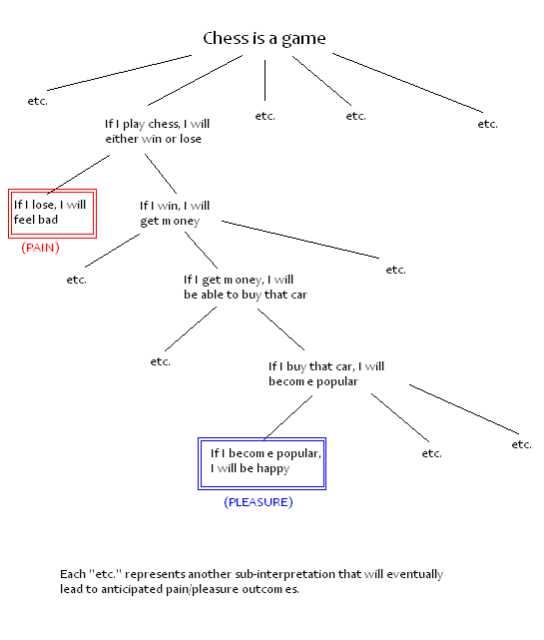
Interpretation: “If I play chess, I will either win or lose.” (This isn’t true to us, of course, but that is irrelevant: it is one interpretation an individual actor may see.)
Sub-interpretation of the interpretation: “If I lose, I will feel unpleasant.” (This is the final level of interpretation: pain and pleasure, happiness and unhappiness, satisfaction and dissatisfaction. Once I have traced a path to my anticipated pain/pleasure, I am done interpreting that aspect of the statement, as I have now decided what it really means for me.)
Another sub-interpretation of the interpretation: “If I win, I will get money.” (Remember, this is just the actor’s perception.)
Sub-interpretation of the sub-interpretation: "If I get money, I can buy that car. If I buy that car, I will become popular. If I become popular, I will be happy. " (OK, got to happiness. Interpretation (of becoming popular) complete! Interpretation of “buying that car” perhaps not complete, because I may yet think of other “If I buy that car, Y will result” conclusions that I believe will lead to respective pain and pleasure outcomes.)
Let me summarize in a diagram:
Does that make more sense?
To the side questions:
7+5=12 will be similar to the above.
“I have a square circle” could be interpreted as some actual object (say a plastic square cookie cutter with rounded corners), in which case it would be similar to the above. If it is taken to be uninterpretable it would not be a praxeological statement - you are right, strictly speaking I have to limit the OP to statements that are actually interpretable. “Square circle” is, in that case, simply not communicating anything, so I would hesitate to call it a statement, despite appearances.
“The French kind is bold” is a complex statement, that is, two statements in one: “There is a French king” and “He is bold,” each of which will be evaluated similarly to the first example.