Can anyone help me deconstruct this Statist nonsense?

Not at all. How is an economy made more prosperous by a windfall in the rebuilding and repair business? The prefix “re” is pretty descriptive. You’re basically saying “Look at all the work that has been created because of all the destruction. Look at all the stuff that needs to be rebuilt and repaired. And think about the multiplier effect…if the window is broken, that means not only does the glazer has more work, but so does the guy who makes the glazer’s tools…and the guy who does the maintenence on his truck, and the guy who makes the glass…look at all the areas we’ve ‘jumpstarted.’”

You’re forgetting the fact that all those resources would have gone somewhere else…and not only would we have had the buildings, but we’d also have whatever else was created. But instead, all those resources and man hours went into rebuilding something we already had before. This necessarily makes the economy overall poorer.

There is no “jumpstarting” going on at all.

So basically what you’re saying is that politicians can better decide what people want than the people themselves can. Actual demand isn’t sufficient. We need to have money forcibly taken from some people and handed over to other people…and not just a small amount…enough to create the illusion of demand and actually move the demand curve artificially.

You’re confusing the movement of dollars through the system with actual prosperity. Dollars simply moving around the economy is not what creates prosperity. Prosperity exists when more people are able to have more of their desires met, at a lower cost. Taking money from some people and handing it over to others does not do this in the slightest. And neither does destroying something so that resources (which would have gone to something else) have to get diverted to rebuild what was already there.

It’s funny, cause Coase and saying arguing that destruction will occur and that capital might be destroyed but that this could provide the impetus for future economic growth. You somehow think pointing out the losses of this kind of shock will bring somehow answers his point.

As I understand it, Coase’s argument is that there are multiple possible equilibria and this kind of event could be sufficient to push the economy from a less prosperous one to a more prosperous one, that seems pretty likely if you have, for example, self fulfilling prophesies regarding demand.

Why would you want to artificially increase demand? Why would you want to artificially manipulate the free market in any way? Artificially increasing demand will just lead to similar consequences to artificially lowering interest rates. There will be miscoordination throughout the economy.

My comments in bold, only about ww2:

“since the new deal and Keynesianism failed to end the great depression”

That’s patently and demonstrably not true.

So he’s going to prove the new deal ended the great depression by saying WW2 ended the great depression, after almost two decades of new deal not doing the trick..

Government spending during WW2 put people to work,

This is a basic fallacy that forgets what the wealth of a nation is. The wealth of a nation is not everyone having a job. Nor is it everyone having money in their pockets. It is the good things they have, food, clothing etc etc. So that improving an economy means increasing the amount of goods it produces. Hard to say that WW2 did that. Of course it may have produced more bombs, but that benefits only the govt, not the people. Every bomb made means an equal amount of consumer goods not made; and indeed there was a harsh shortage of everythig during WW2.

Here the propaganda clearly says “Give the govt your money, above and beyond all you are taxed. We can only make war if you do not get to enjoy in full the money we are putting in your pocket, but instead give it right back to us.”

Oddly enough, the economy will not grow if you spend more on gas and cars Keynes style, helping to win the war. Quite the opposite, says this govt poster.

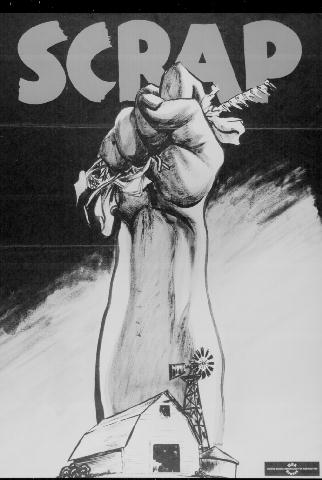
So great was the drain on available resources caused by the war that this poster had to encourage everyone to scrape the bottom of the barrel to give to the war machine.

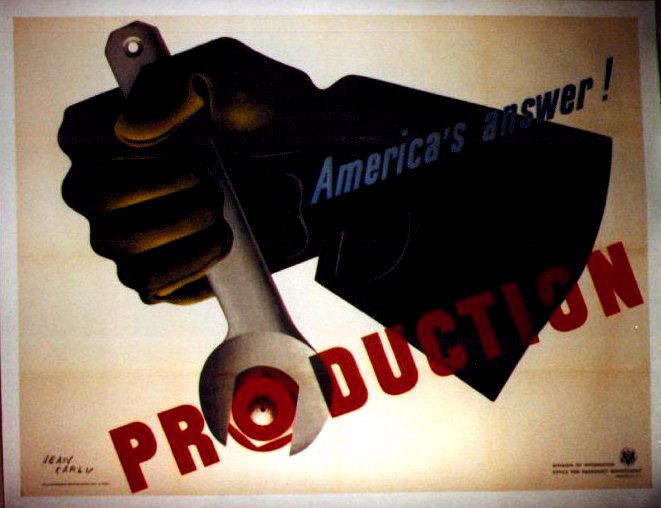
Credit cards were not invented then, or this poster would have been replaced by a picture of a credit card, with the caption, “America’s Answer: Spending.”

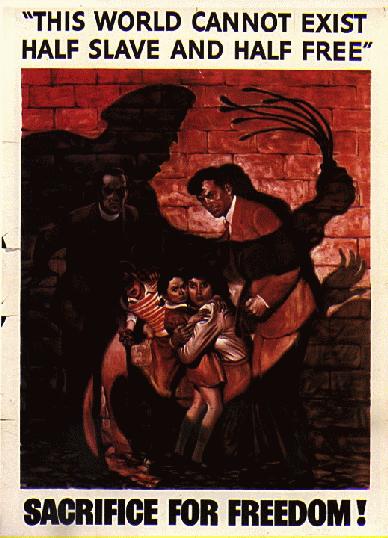
A powerful message. One wonders what the expected sacrifice is. They cannot mean soldiering, because there was a draft. You had to go out there and risk your life, like it or not. By process of elimination, the sacrifice we were exhorted to make was an economic one; to endure the poor economy war causes for the sake of the enslaved other half of the world. Clearly, this poster doesn’t understand that there was no sacrifice involved whatsoever. The war made everyone rich, gave them all jobs, put money in their pockets, stimulated private spending and investment, created demand for more products, created the middle class as we know it. So what’s the big sacrifice?

Another poster that totally doesn’t get it. It should instead have a picture of a fat man stuffing down a huge burger, captioned “Stimulate Farm production this summer. Eat a lot of food.”

This one poster alone could have lost us the war.

Instead of find time for war work, it should have said find time for extra shopping to stimulate the economy.

Instead of raising and sharing food, it should have told us to destroy our little gardens and buy food at the stores exclusively, increasing spending. And sharing food! How defeatist is that! It should have said make sure you share nothing so that your neighbor has to spend more money too.

Walk and carry packages? What kind of traitor is he? Drive everywhere and send packages by paid delivery boys. Give them jobs. Put money in their pockets. Stimulate, baby, stimulate.

Conserve everything you have? But then I will spend less, killing our economy. Did Goebells or Tojo write this treason?

Save? Save? Didn’t you read your Keynes? Saving means the death of an economy.

This poster reveals a growing concern of little chidren and their Mommies during the war, food shortages. And no wonder. The insane advice to grow your own and can your own must have devastated the food industry, which needed people to spend money on food to stimulate it.

No coincidence that the woman here is a blonde blue eyed Aryan, hand raised in the Hitler salute.

She is placing a ceiling ln her spending. Toss that woman in jail.

And she is claiming that there is such a shortage that things had to be rationed, with wage and price controls imposed. in the middle of the greatest thing that ever happened to the US economy, with 15 solid years of new deal before that. Is there no limit to Nazi brazennes?

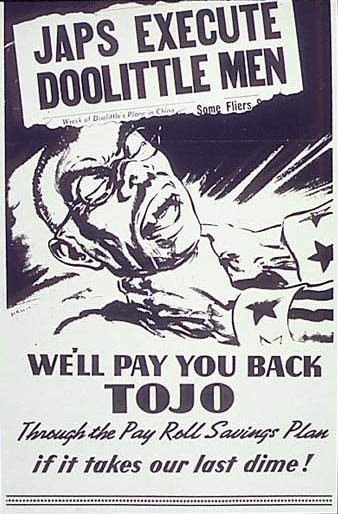
Talk about topsy turvy. The poster is saying winning the war will take away our last dime, when the exact opposite is true. The war is giving us dimes, and dollars, too, not taking them away. The war is creating the middle class as we speak, putting money in everyones pockets, giving everyone a job. Takes our last dime, indeed!
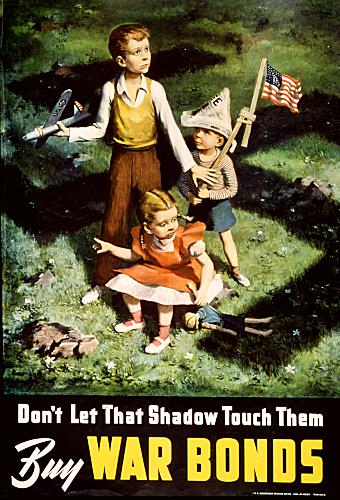
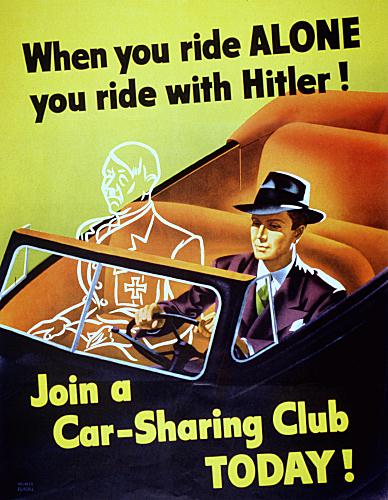
As Tom Woods has pointed out, why not simply produce battleships, sail them out to sea and scuttle them yourself without the crew on board. Is society “richer” for having done this?

Wars don’t “spur investment”; the artificial demand they create comes from the government co-opting capital, property, labour and resources into constructing and providing for the means of committing mass murder.

I swear, this is sounding like a justification the Aztecs would have used: “let’s just keep killing our own people until the gods are appeased and we can be prosperous again!”

Right, so apparently none of you understand what you’re criticizing, or else you’re happy to attack a straw man because it makes your job easier and thinking is hard (the Rothbardian approach snicker snicker).

Obviously, war and fiscal stimulus in general won’t have any positive effects on the business cycle. It can only do good during an event like the Great Depression where all this resources you’re worried about being misallocated aren’t being allocated at all, people are saving (hoarding) all their money because they have no jobs and nothing to invest in, and businesses are not investing and hiring because no one is spending any money. That’s what fiscal stimulus is for. Government provides people income, creating a demand for products, businesses rush to supply the demand now that there are willing buyers, savings and investment are reunited, and the free market can go back to allocating resources and producing wealth.

It can only do good during an event like the Great Depression where all this resources you’re worried about being misallocated aren’t being allocated at all, people are saving (hoarding) all their money because they have no jobs and nothing to invest in, and businesses are not investing and hiring because no one is spending any money.

Right, this is the key point. The economy may get locked into one equilibrium because of the self fulfilling prophesies of entrepreneurs. They expect that people won’t but their goods so they lay off workers and reduce production… and since consumption is a function of income and laying of workers reduces aggregate incomes, it’s quite easy to say what happens.

Now, I’m not saying I completely buy this argument. Point is, if you accept then you at least should agree that boosting AD is potentially a good idea in order to get the economy out of this equilibium. Whether or not I accept it, none of your arguments addressed it or anything else, there was just the usual rehashing of all the standard Austrian talking points.

I don’t buy this argument either. I’m currently doing research for a top-secret paper rebutting this argument. I’m just annoyed by how utterly lazy/dishonest many libertarians are on this subject.

So let me get this straight. You don’t buy the argument but you’re defending it anyway…because…what? You just want to have something to say? You need an argument to make?

Round and round the mulberry bush…

So, basically, you’re saying that broken windows won’t stimulate the economy unless there’s high unemployment. I guess the government of France should commence bombing of its own cities. Maybe too many people would die that way, so they could instead just demolish or burn random buildings to let their SWAT teams and fire departments get lots of practice while “stimulating” the economy back into full employment.

And, of course, the US government cannot possibly be responsible for the Great Depression even though its central bank was overseeing the economy at the time of the worst crash in recorded history. The central bank which was created to prevent the relatively minor problem of banking and financial panics instead gave us the Great Depression. Good going, geniuses.

Clayton -

First of all, I’m not an economist, so it’s not my job to know all the details. The very fact that I study this stuff extra-curricularly is a sign of curiosity and motivation, not laziness. Second of all, you’re the one who’s debating internet flunkies on a debate forum rather than citing and debunking real Austrian economists such as Bob Murphy, Jorg Guido Hulsmann or Joseph Salerno whose work has significantly updated Rothbard’s foundational but aging work on the subject which you guys seem to content yourselves with refuting.

Clayton -

  1. So “people are saving (hoarding) all their money”, on the one hand, and yet “Government provides people income”. What happened to all the money they hoarded? Why should the govt give money to a bunch of hoarders? Don’t they have enough with all their hoarded money?

[Why give him anything?]

  1. There is “nothing to invest in” with all the money they “hoarded”, on the one hand, yet when the “Government provides people income”, they suddenly know what to do with it. Their hoarded money was no good. It had to be hoarded, not spent. But the money the govt gives them will suddenly not be hoarded, it will be spent for sure. [This is even more absurd when we realize it’s the same money, see point 4].

  2. “…people are saving (hoarding) all their money,” and yet “they have no jobs”. That’s a pretty good trick. I would love to know how to save (hoard) money without a job.In my experience when you don’t have a job you have to eat into your savings, it is impossible then to hoard money and not spend. At least it was for me. My landlord and hunger pangs made sure of that.

[Hard to hoard under these circs].

  1. “That’s what fiscal stimulus is for”, to make people spend money. And yet, when you take money away from people, say a five dollar bill, [which is what the govt has to do in order to provide “fiscal stimulus”, which means simply giving that same five dollar bill back], how can they spend that five dollar bill? The govt took it away, didn’t it? Unless you mean that they will spend the money taken away from them when they get it back. But why should they? Why won’t they just put it right back into the hoard where it was before?

  2. How can there be both “no jobs” and “nothing to invest in”? Hire those jobless for cheap and make money selling your cheaper wares to the hoarders.

  3. In any case, have you read the Austrian books that discuss the absurdity both of the Keynesian statement of the problem and the Keynesian proposed solution? Can you summarize what they say, and then refute them?

John,

So let me get this straight. You don’t know about or aren’t interested in the real argument in favor of fiscal stimulus, but you attack a straw man…because…what? You’re lazy? You’re dishonest?

Clayton,

No broken window. The resources are idle.

The cause of the GD is irrelevant.

Smiling Dave,

1-2. How much money would you spend if you and a quarter of the nation were suddenly unemployed, with no reason to expect the economic conditions to change anytime soon?

  1. …Easily?

  2. Deficit spending means that government can spend without immediately taking other people’s money.

  3. That could happen. It’d be great if it did. It didn’t.

  4. That would be relevant if I were criticizing Austrian economists rather than forum posters. But I’ve read much of what Hayek has to say on the subject. I must admit I find modern Austrians to be rather dull on these and indeed pretty much all subjects.

Second of all, you’re the one who’s debating internet flunkies on a debate forum rather than citing and debunking real Austrian economists such as Bob Murphy, Jorg Guido Hulsmann or Joseph Salerno whose work has significantly updated Rothbard’s foundational but aging work on the subject which you guys seem to content yourselves with refuting.

Woah, let’s get the order of posting straight here. The OP quoted an argument that he couldn’t make fit with his ideology, so he posted it here for you guys to “deconstruct”. Coase and I sought to point out that all the posters were doing were rehashing any Austrian talking point they thought applied to the quotation in question. It’s a little disingenuous that you’d tell us to deal with the “big guns” when the only mainstream arguments brought up here are caricatures of caricatures.

(And if you think the quotation provided by the OP came from an academic economist…)

I agree with EconomistinTraining and would like to add that Mr. inTraining looks excellent in red.

Right, this is the key point. The economy may get locked into one equilibrium because of the self fulfilling prophesies of entrepreneurs.

At this point, the argument that make the most sense to me are “equilibrium never” type statements and disregarding it in favor of a market as ever changing process approach. I do not see how a final general equilibrium analysis will tell us how any inconsistency is removed. All it seems to say is that courses of action are consistent with each other, which tells me nothing useful. If anything all you can do if you are in a high position of political office is hope you choose the right path, based off of a perhaps an educated hunch, cross your fingers, and hope for the best - particularly if expectations as a whole are very obviously grim and in dire straits.

I agree with EconomistinTraining and would like to add that Mr. inTraining looks excellent in red

Something like that.

Resources are idle only because it is not profitable to employ them. Therefore, stimulus whose purpose is to employ idle resources is necessarily spending on unprofitable (money-losing) endeavors. That is logically equivalent to tossing bricks through windows.

Clayton -

Except that prices generally rise. The same money buys less now than it did before government stimulus. Oops.