I smell another Venus/Zeitgeist scout – boldly venturing into enemy (capitalist) territory, Undercover Brother style. Yawn.
“I honestly can’t tell if this is a legitimate post or not.”
He is posting a serious question and he’s being polite.
Original poster, I’m glad you posted here. We need more people who DO NOT know about free markets to post here and learn. As I did and continue to do. We have great posters here like Clayton, who can get into the nity grity and educate you. All for free. And much quicker than the time it takes for any school.
And once you get converted over…which you will, you’ll spread the message for us with more passion than any of the others who are not new to this.
EDIT:
We don’t this forum to turn into something like democraticunderground.com That place literally feels like a communist country. If they even suspect you of thinking the wrong way, you will get banned and they’ll even go so far as to delete all of your post as if you never existed. There is no real discussion that takes place there. It is a police state nightmare. This is one of the only forums where libs and free market people and anyone else can speak to each other freely. Which is perfectly in tune with lew rockwell folk message…freedom.
“Why work hard when your father’s money is making money for you?”
What does this have to do with the free market hurting you? Or desruction as you said in your title?
Am I supposed to believe that government employees are magically exempt from the profit motive?
On a more abstract level, it is important to remember that the pursuit of self-interest (what we really mean when we speak of “profit motive”) is present in all human action. This is a definitional matter - even an ascetic who lives a spare and self-effacing life is pursuing what he perceives to be his highest interest - enlightenment or transcendence or whatever.
The profit motive isn’t just an idea. It’s a bit of a misnomer to call it “capitalism” like we have “nihilism” or “Arminianism” as if it’s just some kind of ideology which has taken hold of the world. Capitalism is first and foremost a descriptive theory of the world-as-it-is. In particular, since the Industrial Revolution the largest historical puzzle facing the economist is two-fold. First, why did people suddenly start to become so wealthy and why did technological and economic advances become so rapid around 250 years ago? Second, what took humanity so long to reach this stage?
The answers lie in understanding the role that proeprty rights play in enabling the processes of specialization, division-of-labor and what Austrians call “lengthening of the time-structure of production” a cryptic phrase that simply means we break down the task of manufacturing into smaller and smaller pieces not within firms but within the market itself. Smaller and smaller improvements are made by producers before they pass on their output to the next producer.
Well, this goes back to a proper understanding of two concepts: uncertainty and calculation.
In the first place, uncertainty is a problem that afflicts all men alike - the regulator faces as much uncertainty as the regulated. Hence, what is the correct course of action can often only be seen after the fact, if at all. The economy is essentially a process of blind search where entrepreneurs are the individuals who take on the risk of trying new combinations in the search parameters (starting new businesses, expanding investment in existing businesses or shifting investment out of a business).
In the second place, all humans engage in calculation. The caricature of the unwashed masses as blind dolts who stumble about their daily lives goaded by one animal impulse after another is just that, a caricature. The fact is that the regulated are every bit as capable of calculation as the would-be regulator. If the job of the regulator is to “foresee bad consequences and halt activities which result in those bad consequences before they are tried”, then the regulatee is just as capable of this kind of foresight. The key is strict, unlimited, individual liability for all persons at all times no matter their occupation. All individuals should be liable for any tort they commit and this liability must be unlimited because the damage that can be done is potentially unlimited. If this condition holds, then the question of foreseeing bad outcomes is reduced to the self-interest of the individual who will calculate the potential consequences of his actions. “It is cheap to dump my toxic chemicals into this creek. However, if I am discovered, then the people who live downstream and are harmed by my toxic efflluent will be able to sue not just my company but me personally and my entire wealth will be at risk. Perhaps I had better think twice about this.”
Do you see why unlimited, individual liability is so crucial? But the government’s system of business law works precisely to limit this. Many types of decisions made by CEOs and board members cannot come back on them, it is only the corporation which can be sued. This is the true reason for “corporate personhood.” In Britain they are actually fairly honest about the whole thing… LLC stands for “Limited Liability Corporation” and its express purpose is to limit the liability of the owners/operators of the corporation. So, the government unwittingly plays a role in enabling the very kinds of things that leftists are frequently alarmed about - destruction of the environment, trodding over the rights of the poor, and so on.
Finally, a closing note on this idea of having something other than the profit motive. It is often said that the government doesn’t have a profit motive like private businesses do. To the extent that this is true, the reason why is rarely, if ever, mentioned. The King (to put it in more basic language) has no profit motive precisely because he can take whatever he needs whenever he needs it. The government does not have to worry about profits because it can take whatever it needs in taxes at any time and it never hesitates to do so. Look at the second World War… there were rationing controls on almost every consumer good, taxes were stifling, government spending accounted for the majority of the entire gross domestic product of the US. So, the absence of profit-motive is due to an even greater evil, the evil of arbitrary seizure. Wal-Mart turns a profit and it benefits from a lot of bad legislation in the process that gives it unfair advantages vis-a-vis a small businessman. But Wal-Mart can’t just kick my front door in and take whatever it wants. In the limit, the government always reserves exactly this right (they’ll say “it’s an emergency” of course but that’s just a formality).
Clayton -
Look OP, you are right, capitalism does have its problems. It does cause social injustice through wealth concentration. But we have regulations to battle with this. Progressive income taxation, high corporate taxes to ensure the big guy doesnt get more than his share, market oversight to ensure no exploitative behavior by enterprises. With these measures, we can get good results like Scandinavian countries with low Gini index aka high social justice and humane society with the best elements of both market and state regulation.
A lot of misesians dont want to admit this, hence the over the corner, sometimes bitter remarks in the “scandinavian myth” thread, but when it comes down to reality, the policies work and the result is what people expect from them, as is visible from voter preferences.
No one is stopping him from posting anything. No one even attacked him. All I did was say I couldn’t tell if it was a legitimate post. I didn’t even attack anything that was said there. All said was I couldn’t tell if it was a legitimate post. I’m sorry that he got overly defensive and came back and me like I was some kind of ignorant antagonizer. I’m sorry that you think my simply pointing out that I couldn’t tell if a post is legitimate constitutes treading toward democraticunderground territory, but I’ll note that I was nothing but polite myself…including in response to his snipy retort.
Look through the forum history and you’ll find quite a few newbs I’ve welcomed and helped quite considerably. Sometimes even when no one else would.
I don’t think any lectures are in order here.
On another note, it looks like more people than just the OP could use this (in particular the how-to-quote section):
New member? READ THIS!
The problem with this whole line of thinking is that it leaves the concept of government as a territorial monopolist of law and security completely exogenous. It’s not even up for review or debate. What if the very nature of government is itself the problem? What if that is the source of most of our social ills? Since it’s not even under discussion, it cannot be subjected to critique.
Clayton -
Somehow I don’t think this is meant in the “yes, the world is not perfect, Earth will never be Nirvana” sense in which it resides.
“Corporate taxes ensure ‘the big guy’ [who?] doesn’t get more than his share”? What is “his share”? Who decides that?
oy vey. How many pages in that thread and we’re still getting “in reality, statism works”? For anyone interested in literature and media on this, see the Mises Wiki on Sweden.
- Of course it’s not an argument against using finite resources. We must use them intelligently though. We burn millions of barrels of oil every year, just in the USA, simply getting harvested food from the farms to your supermarket. I thought economy was supposed to mean efficient…this is the opposite of efficient. Oil has so many uses in our modern day, that we cannot continue to just burn it up getting from point A to point B every day; we will be in for a rude awakening one day if this does not change.
You seem to be focused on oil a lot, and this paragraph really has ALL sorts of problems. Firsrly, Using them “intelligently” means absolutely nothing. It may be “intelligent” to burn up everything next year. It may be “intelligent” to not use it at all. It all depends on the goals of various individuals acting in society, and what other means they have available. Secondly, yes, natural crude oil is a very easy to handle, energy dense, and useful. One of these uses is as a compact, easy to handle, energy dense fuel. Just because they’re very useful in, say, manufacturing pharmeceuticals or plastic, doesn’t mean that fossil-fuel derived plastics 100 years from now are worth more than a truckload of milk driven across the country today. You can still make petroleuom products for a wide variety of uses, just not from fossil sources. It’s all about energy useage and transfer.
Fossil fuels represent a large, extremely rich source of easily accessible energy. We’ve used that to develop societies with lots and lots of surplus resources that can sustain a wide variety of labor and capital. This much larger stock of useful capital and labor is precisely what will enable us to develop additional, renewable or replacement sources of energy. There will be transition periods, but oil production is not going to fall off of a cliff, and oil demand is not going to continue to climb in the face of rising prices. Peak Oil graphs make the frankly naive assumption that demand is going to continue to rise at a steady rate versus decreasing supply, when there are alternative energy sources available.
The fact that we don’t know precisely what the total stock of accessible fossil fuels on Earth are is just as irrelevent as not knowing what the total stock of copper is, or not knowing how much wheat will be harvested next year. The point is that fluctuations year-over-year will be gradual, alternatives are available, and people attempt to account for uncertainty and risk.
On the subject of inheritance, I take Ayn Rand’s position: in a market economy, wealth tends to change hands to those who are most capable of wielding it, and so no matter how much you inherit, if you don’t use it wisely in the long run you will lose it. It might be useful to consult some data on the United States.
Inheritance hasn’t formed a very large percentage of the net wealth of the rich historically. According to the Fed, from 1989 to 2001, there “was a precipitous drop in the share of recipients [of wealth transfers] among the highest income group, from 48 to 36 percent, and for the top one percent of the wealth distribution, from 57 to 44 percent”. Surprisingly, “wealth transfers as a share of household net worth tends to decline with both income and wealth.” In 1998, the present value of wealth transfers amounted to 17 percent of the net worth for the highest income class.
We might note, as Thomas Sowell writes in Economic Facts and Fallacies, that many of those in the top quintile of income earners do, in fact, work more.
The US Treasury has done a number of studies on historical income mobility. Many of them have reached the same conclusion: as long as you were not in the extreme top or extreme bottom, your chances of moving between income brackets remained fairly good (though obviously not ideal).
The gyrations of income mobility seem to apply to millionares as well. According to the Tax Foundation, only 15% of millionaires remain so for more than a year.
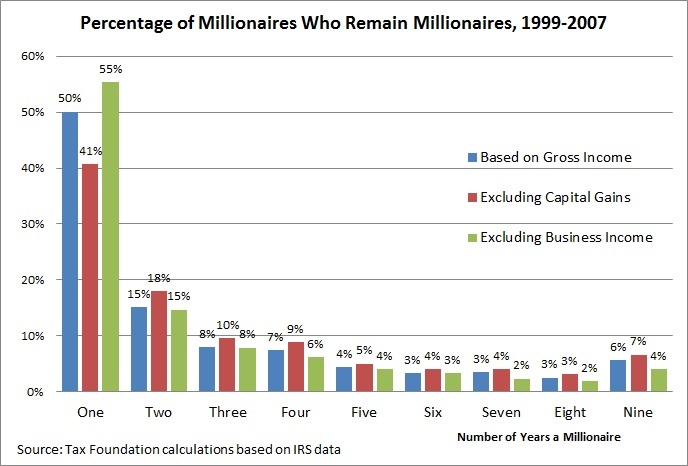
I’m not trying to defend the rich here or say every single one of them deserves to be where they’re currently at; I’m just saying reality is always a little bit more complicated than the “RICH GET RICHER POOR GET POORER HURRR” caricature you get all the time from the media and from left-wing propagandists.
To all posters on this thread:
Thank you for all your input. I definitely learned more about the broad subject of capitalism and most importantly, how it’s been skewed so much over the decades, that it’s hard to distinguish true capitalism from the trash system we have today. The discussion has already made me think of some more topics to thread in the coming weeks. Oh, and thanks for the link to the noob guide John! Special thanks to Clayton for his insightful and thorough replies.
Have a great evening!
Another recommendation:
Beginners’ video list
debt-based monetary systems combined with free-market capitalism
Uh…
I find it much easier to quote people point-by-point alternatively. For an entire post within one bracket the conventional method works. The question is, is it so terrible to quote unconventionally when addressing point-by-point?
Yes. It’s aesthetically unpleasing and many times confusing to a point that I find myself not even bothering to attempt to read posts that aren’t quoted in one of the two normal formats (i.e. html blockquote or indenting).
I address point by point virtually all the time. I use the blockquote and proper spacing to make the post as graphically pleasing as possible. Have a look at how this is done in this post, and the rest of that thread. Try to imagine how that discussion would have looked if the parties did not quote properly like that. It would have been virtually unreadable.
Before I post some more, I must say that this thread has been hands down the best thread I’ve ever read on any forum ever. So many economic fallacies are busted in clear, concise, and cutting words that this is sending my logic circuits buzzing at 110%. This thread should be stickied for future generations and be a required read in schools (hurr, hurr, I know free schools wouldn’t be required to do anything).
- On the issue of inheritance - Assume that the money inherited was obtained in a legitimate, free market way (otherwise, it would be a failure of the justice system, not the rest of the market).
I will begin by quoting Smiling Dave on the topic of money and wealth:
How does one make money? By working. In other words, you only have money if you have first produced something worthwhile, which is what working is . After you have done your share, being productive, then you get money. The money in your wallet allows you to go out there and reap the rewards of your productivity, by consuming what you want.
The point of this obvious little exposition is that before you spent any money, you have contributed to the wealth of the nation by producing something. Otherwise you wouldn’t have the money to spend.
In short, having a dollar in your wallet is at once a Certificate of Productivity [a proof that you actually contributed to the nation’s wealth], and a License to Consume [which is why we want money in the first place, to spend it]. Your consumption will not reduce the wealth of the nation, because you have already increased the wealth [by working for the money] before you ever took any wealth for yourself [by spending the money].
Taking this essential fact, we look at people who earn their money with their toil. These people are then capable of exchanging certificates of production for actual goods. Because they made their money through voluntary, mutually-beneficial trades, their money is, so to speak, “socially just” (to entertain the notion).
Now, what happens when money is inherited? Is production harmed and society made worse off? Note that inheritance of money is postponement of consumption. The original owner decided to not engage in voluntary trade with others to “cash in” his money for real goods. When money is passed down, it is this certificate of production that is passed down. When this is cashed in by the inheritor for real goods, he is accepting a gift from his father/mother who decided to not accept a good from society so that his son could. The cycle of the money is, so to speak, made “complete” in the sense that the certificate of exchange guaranteed to coordination of production and consumption - the father produced and saved to make his son better off and the son reaped the benefits of his father’s help to society.
Has the son made society worse off? Not at all, for the father had produced for society already. Just because the son did not make his money directly does not mean that he makes society worse off. Money, after all, exists not to reward the virtuous but to coordinate production and consumption. The money he returned to the “system” is an overdue acceptance of the real goods for which the money is a placeholder.
When a son accepts a crazy amount of money, he does not make anyone else poorer off. The father-son system is closed, and the transfer of money neither created nor destroyed wealth for the rest of society.
Furthermore, examine what the son does when he “loses” his money. He spends it on jewelry, cars, houses, and casinos. The cars are likely created by a company which also creates non-luxury cars, and in this way the purchases of the wealthy (likely way above the cost of production of the car) help to decrease the cost of a car to a poor person, for a company can now defray the cost of producing other cars with the extra money gained from the luxury car. Don’t forget that people actually work at the car factory and get paid as well. So the money of the rich man also goes there. When he gets a house built, he is also paying construction workers. When he squanders money at the casino this provides a way for the janitors at the casino to make a living, and for the people who make the chips. If the casino makes a lot of money, it stores this money in a bank, which then loans out the money to companies which create jobs. When the rich man buys jewelry, he indirectly provides a wage for people who work in the mines. Yes, the money of the rich man is dispersed, but where to? It does not merely disappear. It goes somewhere to aid in coordinating the production and consumption of other goods.
- On the issue of oil - Assume our reserves have some hard limit which will be reached 100 years from now (I believe that Clayton works in this field and can attest to the fact that we have more oil reserves than we know). Of course, the end would not come abruptly and cause chaos in the world. We would have a considerable cushion period in which prices would obviously rise and result in the increase of production of alternative energy.
Furthermore, consider the alternative - the government decides that only 60% of our yearly energy may be acquired from oil. This will not result in the cessation of the use of oil as energy. It would merely delay the end. So if your contention is that oil would be used up - it would be used up anyway eventually. If you mean to say that government intervention would ease the transition from oil to other sources of energy, note that the distortion of market forces would redirect much of our resources from projects the markets deem efficient to the purpose of finding alternative under false (government constraints). This means that developing countries (if you think that some world government should implement this universally) would be greatly hurt as they try to find ways to not use the cheap energy. Furthermore, resources that the first world would have spent in improving the third world would now be redirected due to distortion of market forces.
Oil has allowed our standards of living to increase significantly and has freed up our resources for more important purposes because it appears to be an economically-favorable way of acquiring energy. Is your problem with climate change? That is an entirely different discussion.
Another major problem - “everyone wants more stuff.” Does that not concern anyone on here? When is enough enough? We already have 7 billion people on this planet of finite resources, with nearly half of the people suffering from a lack of fresh potable water and steady food supplies. Yet some people are able to afford obscene luxury, like billion dollar, 27-story homes…make sense much?
Yes, this makes a lot of sense (when the profits are made in a legitimate, free market way). Why? Here’s why:
People want more stuff. Yes. Can they have more stuff? They might, through the market. Of course, due to the scarcity of goods, the market is able to ration the goods, and in this way works within the constraint of scarcity.
The people who can afford crazy homes do so because they contributed to society - remember the certificates discussed above. They have put their labor into society as a voluntary exchange. They now can build themselves homes. And once more, the money they use to build the home goes to the construction company, the company which acquires the raw materials, the people who plan houses, those who certify them, etc.
Free markets have done a remarkable job of voluntarily slowing the population growth of the world. This is an amazing emergent property of the market. Just when we thought that Malthus might have been right, we see that population in the West barely inches up with time. The fertility of the US is in fact below replacement fertility, meaning that if this keeps up for a long enough time, the population of the US (without any immigration) would being to decline (immigrant fertility upon arrival is higher, yet in the second generation it decreases very much).
Sadly, I am not as eloquent as some of the other posters on here, but I hope I contributed a tiny amount of truth to the discussion.
Vive,
There’s so much Anarchism that keeps getting attributed to Marx. “The passion for destruction is a creative passion,” says Bakunin in 1842, 6 years before Marx wrote the Communist Manifesto. Not attacking you. I’ve just started realizing how much Marxism is only accidentally Marxist.