CEO Pay vs. Average Worker Pay

Hi,

I was introduced to free market economics through Ron Paul which then led me to Austrian Economics. I have a question in regard to pay structure for CEOs and I was hoping someone would help me with this question.

I believe in the free markets and that wages should be dictated by the free market. However, how does the free market solve the growing gap between CEO pay and average worker pay, when the market (companies) decide to only pay their workers 40K a year. Since the 1970’s, average worker salaries have not increased while CEO pay has increased 10 fold.

I believe there’s something morally wrong when a CEO is paid $50 million dollars but then fires 1,000 workers due to the “economy” without cutting his own salary. In a free market, shouldn’t wages for workers rise with productivity (wealth should be shared to some degree)? McDonald’s for instance pays their workers minimum wage but these same worker’s have helped (quality service) McDonald’s become the #1 fast food chain. Shouldn’t these worker’s receive additional compensation since the company has become so profitable or does management only receive additional compensation.

In America it seems like the latter; company’s generate huge profits but the average worker never sees a difference in wages whereas management receives huge salary increases. Is this how the free market works for labor and wages? Also, would it be against free market principles to institute a CEO to average worker pay ratio, say 40 to 1 (pre-1970s) since now its 400 to 1. I would really appreciate any input.

Thanks

Of course it is morally wrong.

Something like this can only happen in a country where there is socialism for a few and capitalism for many.

“However, how does the free market solve the growing gap between CEO pay and average worker pay”

This isn’t a problem. Some people are worth more to their respective employers than others. It’s an economic fact.

“I believe there’s something morally wrong when a CEO is paid $50 million dollars but then fires 1,000 workers due to the “economy” without cutting his own salary.”

A CEO’s salary is not determined solely at his discretion. The Board of Directors and the stockholders in general are the ultimate decision makers. If a CEO is paid 50 million dollars and the people who own the company think that he or she is worth it - who are you to tell them they are wrong? They are purchasing this person’s services - they will pay a price the market sets for those services. On a similar vain, would you limit the amount of money made by the highest paid sports stars? Personally I would never pay them that much… but someone thinks they are worth it. Who am I to tell them how much they pay their employees?

“In a free market, shouldn’t wages for workers rise with productivity (wealth should be shared to some degree)? McDonald’s for instance pays their workers minimum wage but these same worker’s have helped (quality service) McDonald’s become the #1 fast food chain. Shouldn’t these worker’s receive additional compensation since the company has become so profitable or does management only receive additional compensation”

In a free market, wealth is created and real wages usually do rise. You are confusing the cause with the effect here. The REASON McDonald’s is so sucessful is because they created a simple business model in which inexpensive labor is utilized to produce a low-cost product for the customer. The Labor isn’t low cost because of how well McDonald’s uses it, it’s low cost because that’s the market price for the labor. Incidentally, forcing the wages up for these people would make them poorer on average. They would not be worth as much to the company at the new price, and predicably some of them would be laid off. Not only that, but the price of McDonald’s food would rise, affecting EVERYONE in a negative fashion.

“In America it seems like the latter; company’s generate huge profits but the average worker never sees a difference in wages whereas management receives huge salary increases. Is this how the free market works for labor and wages?”

You are making a very, very wrong assumption. America does not have a free market. Not even close. Real wages fall in this country for 1,000 reasons… inflation, taxes, and other government schemes paramount among them. In a free market, increasing prosperity would result in greater capital accumulation and an increased demand for labor. Real wages would rise. Your comment that management receives huge salary increases is irrelevant - it may or may not be true. But even if it is, that only means such employees are becoming more valuable to their employers. There is nothing wrong with that.

“Also, would it be against free market principles to institute a CEO to average worker pay ratio, say 40 to 1 (pre-1970s) since now its 400 to 1. I would really appreciate any input.”

Yes, it would be. How will companies compete for the best CEO talent if their wages are limited in this way? That’s right, they can’t. Which means CEO skills would be less profitable, less people would train to be CEO… and there would be a shortage of effective CEO’s. That doesn’t sound good for the prosperity of businesses - businesses who need to stay in business if they are going to pay wages!

Thanks
Workers are paid based on their marginal productivity - in other words, how much they contribute to the value of the products they produce. A person who manages an entire firm, like a CEO, has a much, much greater marginal productivity than a worker who works on an assembly-line. Also, contrary to popular belief, wages have risen over 30% for the poor when factored for technological advancement: see this.

CEOs essentially pick the Board of Directors. If the CEO doesn’t like a member of the Board of Directors, then that director is typically not re-nominated.

The problem is that large corporations receive massive direct and indirect State subsidies.

Even though GM is incredibly inefficient, nobody has started a competing car manufacturing business. Why not? The reason is that the auto industry is heavily regulated. There are lots of regulatory hoops for getting a new car approved as “street legal”. This is effectively a tax on small car manufacturers. Suppose it costs you $10M to comply with the regulation, no matter how many cars you make. If you make 100,000 cars, then the cost of the regulation is $100 per car. If you make only 100 cars, then the regulation makes your business unprofitable.

Also, real interest rates are negative. GM receives a subsidy equaly to the difference between the interest rate it actually pays on its debt and the true inflation rate.

Via limited liability incorporation, the management of GM has a free put option to declare bankruptcy and cheat its creditors. Therefore, GM must be bailed out. Otherwise, GM’s creditors are stuck. Limited liability incorporation is a huge benefit to nearly insolvent or insolvent businesses, who can merely declare bankruptcy and default on their debts.

The CEO of a large corporation is not chose by a true free market process, but rather by a process of nepotism capitalism. Connections are more important than actual ability.

As another example, consider FRE and FNM. FRE and FNM have special perks, because their debt is backed by the Federal government. FRE and FNM may borrow at a cheaper rate than anyone else, and use the profits to invest in mortgages. Even if I believed I could organize a better mortgage financing business than FRE and FNM, I couldn’t compete with them because my debt isn’t backed by the Federal government. The CEO of FRE and FNM is merely collecting economic rent, rather than being a brilliant risk-taker.

what?!? they have no competitors?!>there are no car munafacturing businesses outside of their monopoly?!?

How?

If people think they are being paid too little, they should work for the person who will pay them more. If no one is willing to pay more, why do they feel they deserve more?

More companies= more ceo’s each making less. Fewer companies = fewer companies each making more.

An industry can employ the same number of factory workers whether its comprised of 1 company or 100 companies, but the number of CEOs is dependent on the number of firms.

Stockholders receive the profit. Stockholders choose to pay CEOs a lot because they believe it to be a wise expenditure.

Not besides Ford and Chrysler in the States, both of which are also state-backed. Outside of the US, the major auto companies are even more socialized.

well then, perhaps i agree.

aside from their competitors they have no competitors.

i hope you brought your sense of humour online with you today [:P]

[:)]

Since I keep on bungling the point: the auto industry is cartelized by the state, through statist unions and bailouts. They rely on politics rather than the market to make their money.

true dat

First of all, Joel, I feel it’s important to establish that we haven’t seen or had “free markets” for over 100 years. With gradualism it’s difficult to establish when the free market ended and socialism began. We can take the ordination of “The Fed” and the graduated “income” tax almost as an end to gradualism and the start of acceleration into a socialistic economy. These boosts of expansionism resulted in The Great Depression and now the more severe “bubble” of an economy manipulated and controlled by big government.

So the question: is CEO salary of 50 million “morally wrong”?

No – not if you consider the “50 million CEO” is no doubt a master at extracting huge contracts, “stimuli”, laws forcing small business competitors out of business (ever tried to buy beef from a local, free range and organic farmer/butcherer lately? Or raw milk from a local dairyman?), and other government enacted “favors” from those gangsters with big smiles (politicians). That’s why he’s paid the 50 million. He (or she) knows whom to sleep with, when. And how. And how to manipulate markets.

And he/she is well worth the 50 million he is paid. It is GOVERNMENT, and its involvement with corporations – and its wars, and its intervention into the affairs of other nations, and its manipulation of “money” and markets, virtually thieving all the precious metal resource from the “voters” – its Government that is morally wrong. Government “regulation” ALWAYS has the opposite effect from its stated purpose.

Ron Paul knew this, however. He was very reluctant to “run” for Emperor in this political climate. He’s no fool. But he was virtually carried along by enthusiastic supporters like you and my son, Dave.

http://keaglefamily.com/ronpaul.html

Dave, of course, couldn’t understand why I was so willing to support him and Christa in their exuberance for “the campaign”, but refused to register and vote. Another subject for a different thread.

Dr. Paul understood that “government” from the top down, the two government operated (and allowed) political “parties” (“third” parties are allowed for show only – another thing Dr. Paul fully understood), and all the lap-dog media that promote leviathan worship – government was frightened to death of his message.

Slogans of liberty and freedom, yes.

Liberty and freedom, no.

In a free market there wouldn’t be the imbalances you describe above. A good CEO (or his equivalent in a non-corporate-world environment) would still elicit a good salary; else he would join another firm for a higher salary. Same for the worker. He/she would be free to seek out employers who would pay value for value. He/she wouldn’t be forced by labor union mentality to be a “slacker”.

“The workman is worthy of his hire”.

Regards,

Geo. Keagle

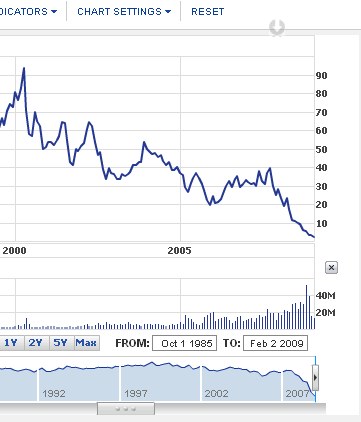
GM stock : april 2000 $93, today $2.2 – that’s more than 97% down. Do the CEOs who ran the company (into the ground) deserve to be richly paid ? If not, maybe there’s something wrong with the way they get paid…

thats for the shareholders to decide isnt it?

I guess. Still, I don’t see why shareholders would pay to have their company destroyed – which apparently they did. Or perhaps something else is going on.

they made a bad decision. people make mistakes. sometimes macdonalds will hire the wrong person to flip burgers and need to let them go. but the guy still gets to have earned his money whilst he was there. and might not be able to count on a great reference.

in cases where the failures are maybe less dramatic, and yet are similarly in a context of wider economic catastrophe it can be argued that perhaps the company suffered relatively less (i.e. that inferior management would have caused greater losses ) (this is an argument i would only use very sparingly)

Joel,

This is an excellent article about CEO bonus pay, private jets, high salaries, ect… http://mises.org/daily/3330

I found it to be very enlightening.

Looking at wealth differences between classes in society is a pointless exercise based upon envy. Any policies made based on something coming from envy will only cause poverty and make all people poorer.

The limiting of CEO pay is a great example. Technically this is a crappy idea as you are making a policy without knowledge of what each individual CEO does and without the real value of the CEO.

The free market is the only human system that gives these super rich CEOs an incentive to supply goods to all people including poor ones as even the poor ones can vote on the success of any supplier with their purchasing choices. Furthermore, the free market is the only human system that crushes companies for poor performance and rewards companies for satisfying consumers without regard to emotional concepts like CEO-worker pay differential. The free market does this without envy, why can’t you?

I believe the envy is justified for the simple reason that this society is not truly a free market one. It is an imitation of one. Our government acts as a patsy for entrenched business interests to encumber small business rivals. Big businesses are able to thwart away competition from small businesses by sitting on patents, encouraging bureaucracy for emerging technologies and employing legal maneuvers that can crush innovators even when they knowingly steal from them. What this means is that improvements that should have entered the market and improved society long ago now have to overcome the hurdles of older businesses that are still squeezing the worth out of obsolete tech. Then you have the double whammy of banking interests acting out of the pocket of these corporate megaliths making it hard to even get a loan to begin with. So you get the situation such as with the electric car where innovation comes from a few noble hobbyists using their spare change to try to make a workable product.

What this means for the average American is that whole new industries are encumbered from developing which keeps many jobs from ever existing and keeps the status quo in line. This allows businesses to simply cut corners on their stale monopoly while the public accrues the penalties. In the case of the electric car, the public is starved of a cleaner form of transportation, new mechanic jobs, new teaching jobs, a new parts industry and further research and development. On top of that society is forced to bear the burden of air and water pollution leading to all sorts of health issues on a population and taxpayers forced to foot the bill.

But beyond the issue of job creation and destruction lies the issue of technological displacement of the average worker. This has been slowly occurring over the years and will come to a point where the average person will have access to mass knowledge via the Internet, yet little access to entry level positions since fewer people will be needed to do things like run a store (RFID), mow a lawn (robots) or cure a cold (nanobots). On top of that certain items could finally become abundant and lose their artificially inflated price such as with food and clothes. As this change occurs I doubt many will have a choice but to start providing services for practically free, leading to a society no longer under pressure to compete for basic goods such as food, clothes and electricity. Immigration will slow since there will be no jobs available to go to and the technological innovations will be available in their home countries. Crime will also simmer down since the economic incentives will diminish. If we can produce large pre-fab homes that can be machined by robots then the whole real estate industry may collapse. Either that or we’ll have a nation of college educated waiters with nothing but revolution on their minds and a lot of info online on how to build bombs.

the same old tired argument. will people ever learn that the corporatism we have in america is not the same as the free market? we wouldn’t have these giant corporations if it weren’t for government artificially limiting competition.