Some issues i would like to hear an Austrian opinion about:
Without state intervention (or strong labour unions), how can it be avoided that the income of top managers becomes obscenely high while the income of all others is declining?
Would you advocate to hold the CEOs of failing companies responsible for their mistakes and dispossess them when appropriate (e.g. CEOs of AIG, GM, Lehman etc.)?
Competition. Look at the salaries of CEOs in unregulated, internationally competitive industries. All the obscene profits are in pharmaceuticals and the military industrial complex.
People are responsible for their own actions. Period.
under free markets the phenomenon of rising real wages for ceo’s and falling real wages for employees is really quite impossible. If a factory increases it’s output it increases its profits while increasing wages since wages now exchange for more things.
No since a free market would handle a situation like this much better than a state could. I could imagine the CEOs becoming more corrupt and slower to meet consumer demands under state management.
Managers, CEOs, etc.. are just hired employees no different then the receptionist or mail room guy. Their wages are determined by their marginal value productivity just like any other wage rate on the market.
Most people confuse the CEOs with the owners and entrepreneurs. The owners are all those who have provided the capital for the firm. The share/stock holders or any other private investors.
Imagine a free-market where nominal wages were allowed to fall to their market price. This effectively would create full employment, as everyone willing and able to work would find a job, because the employer could employ them at the wage specified by the amount of money chasing labor and the supply of labor itself. Given high nominal wages today, there would probably be a decrease in wages in most industries. But, at full employment there are two phenomenon which gives way to higher wage rates:
Competition for labor. If there is full employment, then new firms entering the market will have to offer higher wages to attract these workers. Naturally, this will cut into their marginal revenue per capita and it will distribute more of the profit to the workers. During the 1920s, workers’ wages increased at a higher rate than entrepreneurs’ profits.
Capital accumulation leads to investment, which leads to higher productivity. The fastest growth in wages would be real wages, meaning as goods become cheaper the purchasing power of the same nominal wage rate will increase. This is why in a free-market there would be steady long-term deflation, if we assume that the supply of money remains constant.
State intervention has only caused the rich to become richer, and the poor to become poorer. Minimum wage has not kept up with inflation, largely caused due to all this massive welfare and warfare spending.
Their companies should be allowed to fail and redistributed through the free-market (i.e. others buying up healthy assets).
As Snowflake eluded to these apparently ‘obscene’ salaries to which you refer tend to occur in the most regulated industries.
Strong labor unions which focus on worker salaries and benefits instead of productivity combined with high gov’t regulation tend to create uncompetitive zombie companies, e.g. GM.
Gunverment regulation, despite the best of intentions, usually results in more of a partnership between several big businesses and the polytrixters, each serving the other while stifling competition and innovation.
Your #1 seems like a rehash of Ricardo’s “iron law of wages.” Ricardo basically argued that wages will always return to basic sustenance levels, in order to keep the workers alive enough to work and earn profits. The fact of the matter is, though, that the more profitable businesses become in real terms as the economy grows, the more they’ll compete for workers from other firms, and the more they’ll have to increase wages/salaries/benefits and improve working conditions (e.g. less hours for higher pay, better workplace safety, etc.).
As for the whole executive-disposition shenanigans, it’s best if the government leaves this alone. It should be up to the shareholders of these companies to decide what happens with the CEOs. As for the bailouts, the government should get out of those equity positions ASAP. And even if the government doesn’t decide to get out of the bailouts soon, it should at least not prevent private shareholders from controlling the CEOs. Obviously, profit-motivated investors will be better at controlling their companies than a corrupt government.
agreed, the question is, what should happen to the CEOs of above companies? Should they be able to keep the millions they made while running the companies in the ground?
What? Where did you get god from? I’m saying that if you do something bad you should be held accountable for that… it doesn’t matter if you’re in a corporation with collective ownership or not. If you decide to unilaterally do something bad, you get punished for it. Similarly, if the shareholders all voted to do something bad, they should be punished for it.
So you all agree that the sky rocketing income for CEOs occurs primarily in state controlled businesses.
If this is so how do you explain the income of the CEO of e.g. AMD. The company is running huge deficits yet the CEO earns millions per year. (the same argument could be made for half of the bank, pharma, car, computer, fashion industry etc.
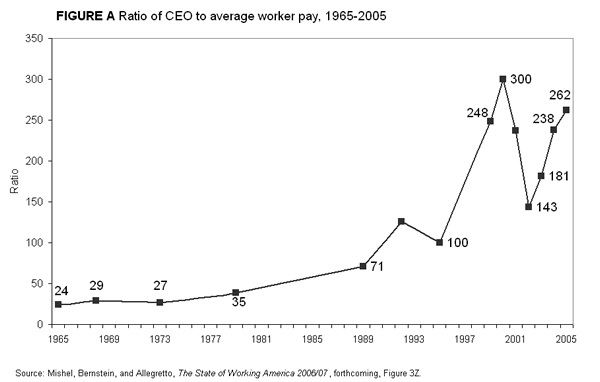
Also how do you explain the chart below showing the income ratio between an average employee and the CEOs and the fat that the income of the average worker has been decreasing since the mid 70s while the top managers get more and more money(http://www.epi.org/economic_snapshots/entry/webfeatures_snapshots_20060621/).
Lastly, your theory sounds nice and might work in a world where you have small companies competing with each other. Ideally in this world the CEOs coincide with the people who founded the companies and who invested their own capital and heart and soul into the companies. In the real world however, you have multi billion dollar international conglomerates. These companies are run by a clique of top managers who don’t care what happens to the company in the long run or its workers as long as they get their bonuses. The worst thing that can happen to them is that the company goes down in which case the take the golden parachute out.
sounds good … so what should happen to the wall street bank managers who are responsible for the current disaster? I’m not aware that the heads of lehman brothers had to pay back the money they made over the last 8 years.
Most here would say not necessarily, since the corporation is a product of the state. In a free society, the CEO’s wealth would be exposed to liability. As such, s/he would be liable to creditors for the losses.
fair enough … but how do you explain that the wages of the top managers increased tremendously over the last 40 years while the income of the employees stayed constant or decreased?
The CEO should be held liable to his creditors, and so in the case of bankruptcy would have to distribute his earnings to satisfy all outstanding debt. This is one of the reasons why inside-trading is so important; it allows the general public to unveil the real value of a company much sooner than they would otherwise.
Like I alluded to, this a product of the welfare state. It is a product of insatiable inflation (making everyone poor equally as fast, but those with less money are hurt much more) and welfare which curtails investment, employment and production.
This sounds like an appeal to emotion, of some sort. Everybody is interested in long-term income. If an entrepreneur can get away with fraud due to the loop-holes in State legislation, the free-market is not at fault.
Personally? By colluding with the federal government they are aggressors. It would be one thing if they had used goernment powers for social good, but instead used them for personal gain. Confiscate all their wealth until damages are repayed.
so why doesn’t it work? I am not seeing law suits against anyone of the wall street crowd.
is that so? in the real world it rather seems they continue moving to the most undeveloped nation in order to be able to produce for minum wages and lowest environmental standards while pushing the cheaply produced goods back into the domestic market.
I agree that what you are saying might work in areas where you need highly skilled and well educated workers but it obviously doesn’t work for all those areas where no particular education is required.