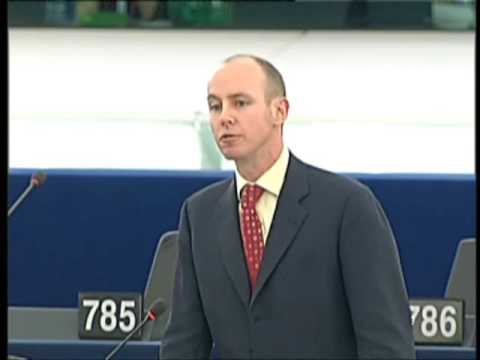
So I was at the Oxford Union today, in the Gladstone Room, as there was an OUCA (Oxford University Conservative Association) / Freedom Association “event” which provided free alcohol, nice surroundings, and a speech by Daniel Hannan, and I thought it would be fun.
The speech was standard fare. Well I say that; he’s an excellent speaker as I’m sure you know from having seen his speech on youtube. He provided some excellent examples of the insane expenses claims that it is standard for MEPs (Members of the European Parliament) to make. For example, the standardised payment they get for their weekly journey to Brussels is set at the level of (now listen to this) first class on the most expensive form of transport… plus twenty percent! This means that if MEPs drive or get Ryanair, they can cream around €1,000 over and above their salary. Added to this is the “general expenses” payment, totally unaudited and generally paid directly into the current account of MEPs (around €4,000 a month). Now this isn’t to pay for offices (two are provided), staff (provided), computers, furniture or anything (all provided). This is just an extra payment to MEPs, already rather impressively reimbursed.
He moved on to talk about how the current expenses scandals in the UK shouldn’t undermine our faith in representative democratic government. And then he said a lot of good stuff about decentralisation, where possible to the individual.
Anyway, what I really meant to post about were the discussions I had with my (best?) friend, and some Libertarian Society members I met there. These were centred on the issue of basis for morality, and along with Martin Cox, a voluntarist (his description of himself - I’d call him a minarchist) tutor at the University, I was attacked for holding an overly rigid version of rights-based morality. There are two issues I’d like to discuss.
(a) Does the fact that all moral systems are grounded essentially on faith mean they are basically worthless?
(b) Given that we may never know the future (at all, don’t give me bullshit about being able to predict with some level of certainty) can we ever (i) react to threats of aggression; (ii) react to aggression we believe to be ongoing? Is the pure “turn the other cheek” pacifist position the only consistent position with libertarian ethics based on self-ownership?
Very cool you met Daniel Hannan. He’s fairly unique in that he is a Tory with principles.
I have to think about your questions, but offhand I wanted to say that I don’t think an anti-state postion as more than a preference is possible without a rigid version of rights based morality. In other words, anything flexible would undermine the premise that the state is immoral.
when do human being introduce morality into their conversations…
I claim its when they want to influence people to act differently, without coercing them/being violent, without seeking sympathy (at least not directly), without appealing to the self interest of the listener (at least not directly) etc.
now, nihilists can consistently be anarchist, and supporters of capitalism, though without claiming that they are this because those things are ‘morally right’ just because they prefer them, and they recognise particular benefits of them. I think training in economics gets people close to this.
now, not everyone you meet will be a nihilist , some people believe moral claims are important, and then morality can be a tool for you to try to influence them. if you can make a consistent argument in moral terms that the people who can be influenced by moral talk can understand… it will be a way to promote liberty. though its certainly not the only way.
about b) if you adopt a radically skeptical position about the limits to human knowledge and the recklessness of assumption, you cannot even be confident that you areturning the other cheek when it comes down to you deciding to do that…
When acting interpersonally, we have to assume certain principles which you may consider to be faith, things like “we exist” and “there is a physical reality independent of our own sensual impressions left to discover”.
However, when creating third-party machinery, we may collect information from our environment which was not falsified by our own predispositions. Then, we can still have a debate about the validity of the data gathering process or potential measurement errors, but the process has left the realm of “faith” I’d say.
Actually the belief in my own existence is not based on faith =] But skeptics maybe need faith in order to believe that they exist ?
Well, I don’t see why physics or materialism should get a free pass ? I say it’s also based on faith. I don’t, but if one is going to be a consistent skeptic…or maybe skepticism doesn’t need to be consistent ? Who knows ? Or who could know ?
If you mean interpretation or belief by faith, then I’d say a String Theorist sees strings. A particle theorist sees particles/waves. I’ve heard some scientists argue string theorists aren’t even really doing science since they can’t experiment their pursuance, but string theorist argue their math and hypothesis are building up to foreseeable times when they can experiment so somebody has to put forth the effort to get there someday. There’s assumptions and likings going on for the students when it comes to joining fields that are still debating each other in science. There’s some kind of leap to what field to pursue when the facts haven’t been able to dismiss arguing fields in science. I had a very smart Astronomy professor going for her Ph.D. researching Gravitational Lens. She taught how Astronomy and thus physics has assumptions and those assumptions are not dismissed everyday but they are not proved either.
I don’t think all moral systems are necessarily faith-based. It is possible to reason about morality: for example, we know that a moral system saying “everyone has a right to kill everyone else” is wrong because for you to kill someone else would violate their right to kill you. The goal of the libertarian theorist is to use similar reasoning to figure out moral principles that can be applied to practical situations (e.g., property rights, contracts, etc.).
As for the claim that moral statements are worthless, this position is contradictory because it is itself a moral statement. Although it seems at first to be nothing more than a “meta-moral” statement (i.e., a statement about moral statements), the claim is implicit within it that people ought to behave in accordance with the fact that moral statements are worthless, which brings it back into the realm of moral statements.
I think NirgrahamUK has the right idea. Although empirical statements are always subject to uncertainty, at some point we must assume that the most likely observation of reality is true. Otherwise, we become utterly incapable of making any kind of statements about the world. With such radical skepticism, neither could we say that someone who didn’t turn the other cheek has done anything wrong. And any line of reasoning that would mandate pacifism for victims would also mandate pacifism for aggressors, so, again, for consistency’s sake we must assume that it is possible to know things about the physical universe.
One might say the same about science or belief in the existence of a real world and so on, if they wish to be consistently sceptical…
Define “know”. You make it seem as though you cannot even know the air you breathe from one second to the next will turn from clean to venomous. Of course, you do not in practise operate with such scepticism and you have good reason to believe (based on inductive inferences) that it’s very unlikely to take such a turn. Knowledge is shorthand for justified, true belief. If you really know nothing about the future how do you even know that that claim (that you can never know the future) will be true in a few seconds and how are you warranted in holding it? It’s a self-refuting position. I mean my point is you can be pretty certain about some things, and completely agnostic about others (what will the price elasticities of potatoes be in a week’s time in London, for instance), and Austrian econ certainly doesn’t commit one to the idea that the future is wholly unknowable. Seeing a person point a gun at you is where you make a judgement call, and if it turns out to be wrong you may have to bear the brunt of it.
I did think justified true belief, but then there was a counter-example (identical twin brothers death thing, or something like that).
I’m stuck.
Because while it’s “unreasonable” to conclude that we have no evidence the sun will rise tomorrow, that the air will continue to be air, that the rules of physics will continue to hold, I can see non-arbitrary line between that and concluding that any relationships can be extrapolated into the future.
As a reprinted Charley Reese article on LRC recently proposed,
And finally, a politically incorrect word of advice passed along to me years ago by a veteran cop: If you have to shoot somebody, make sure the judge will hear only your version of what happened. In other words, kill; otherwise, your assailant will probably sue you.
If you’re in a room full of libertarians and even compared to them it seems you can’t have a normal conversation you must be seriously lacking in social skills.
If we follow materialist nihilism’s propositions to its logical ends, then no, I can’t prove to you irrefutably that we are but esthetic particle heaps without a final definition of right or wrong.
But I don’t have to. With Gödel’s incompleteness theorem, Bayesian reasoning and Popper’s critical rationalism, I’m still able to determine that when it comes to materialism, the odds are stacked against its critics.
I’m also able to state that a society based on individual and property rights is more likely to create a peaceful and prospering order than one without these. Ain’t it beautiful?
Yes, that’s what science is all about. Nothing has an absolute status, and instead of assigning “right” and “wrong” to certain theories, they are combined or judged according to their probability.