Christian Libertiarianism

Is the NAP around there? Than who cares of what flavor is one’s belief?

While it’s certainly within the boundaries of NAP for Mr. Lind to believe just about anything he wants, it’s also within the boundaries of the same principle for me to consider his belief points (item 3 in particular, which I’m hoping he will be following up on as promised) incredibly conceited and in no way able to stand up to normal scrutiny. If I might expand some on my initial post, it seems less likely to me that these points are made as serious conversation for non-Chrstian libertarians and more as a means for the original poster to attempt to find other Christians within this community in order to expand on their circle of peers. He openly stated for us that he’s hoping to meet other Christian libertarians, after all. It would have been more polite in this case to simply ask if there were any Christian libertarians on the board and discuss how they choose to reconcile their faith with their politics, but I suppose that’s spilt milk by now.

From my own perspective this entire notion of Christian libertarianism however, strikes me as an example of a broader trend towards “Christianizing” various subjects as to make them relevant amongst what is admittedly still a very sizable peer group in the world. Were I a Christian myself though, I might consider this a self-defeating tactic on the grounds that it may lead to isolation of the notion of Christianity into a more insular subject, and no ideology can survive apart from its detractors and those still on the fence. That said the ultimate fate of Christianity is of little concern to me, so I’d neither rush to defend it nor hurry it along to ruin personally. That’s up to those in the thick of it to decide for themselves.

I’ve never understood why people pu these little prefixes or suffixes in front and back of anarcho or libertianism. It is what it is so there isn’t a need to put something in front or back of those words. I guess it’s so people can say I’m this and that. Which is fine, but I don’t see a need in it. That’s just me, though.

Hi Goddard,

Good comments. A little background about me…I was both an atheist and a libertarian long before I became a Christian. I am very much committed to the principles of libertarianism, and have long been fascinated by the idea of a truly free market society.

One of the biggest problems in the philosophy of anarcho-libertarianism (the true free market society), is how such a society can maintain order and justice without government intervention in the market place.

More than anything, my purpose for posting is to show how the Christian faith, competing in such a free market, truly can bring about the most order and justice in such a society…this was the claim of item 3 (and item 5).

My main follow up to these items, was largely based upon scripture (in keeping with the purpose of my post), and was in my reply to Jay above.

My intended audience is, actually, everyone…not just Christians. I truly believe the Christian faith alone can make a pure free market society succeed.

Hi Merlin and Eric,

The problem with evolutionary philosophies of mind and decision making is that such philosophies apply recursively to your own minds. ALL evolutionary accounts of mind ultimately posit molecular self replicating and computing machinery as the ultimate source and origin of the human mind and culture. In short, Eric and Merlin, to quote Francis Crick from the Astonishing Hypothesis…both of you are “NO more than the behavior of a vast assembly of nerve cells”. In other words…you Eric and you Merlin…meaning your minds or “self awareness”, don’t actually exist…you just think you do. Basically, this makes each of you a walking self contradiction. Further, if mind does not exist independent of the algorithmic processes running on such an assembly of electrochemical switches, then neither do higher order concepts such as truth or false hood, right or wrong.

In short, an assembly of switches has NO method of assessing the truth or false hood of a proposition, much less whether something is morally right or wrong. Switches simply function in the way they were designed. It is a mind EXTERNAL to such machinery that assigns meaning to the state of an assembly of switches.

Mises does an EXCELLENT job of explaining why a materialistic account of mind cannot be correct (Note: This quote is from Mises’ book, “The Ultimate Foundation of Economic Science”.

If the emergence of every idea is to be dealt with as one deals

with the emergence of all other natural events, it is no longer

permissible to distinguish between true and false propositions.

Then the theorems of Descartes are neither better nor worse than

the bungling of Peter, a dull candidate for a degree, in his examination

paper. The material factors cannot err. They have produced

in the man Descartes co-ordinate geometry and in the man

Peter something that his teacher, not enlightened by the gospel

of materialism, considers as nonsense. But what entitles this

teacher to sit in judgment upon nature? Who are the materialist

philosophers to condemn what the material factors have produced

in the bodies of the “idealistic” philosophers.

This is much easier to see in human designed computing machinery (non biolocial assemblies of interconnected switches). See my article on why minds, not machines, make decisions at http://www.searchingforspirit.org/WhyMindsnotMachinesMakeDecisions/tabid/65/Default.aspx

The upshot of all this is that mind is indeed metaphysical or spiritual, not material, and as such lends much more credence to a Christian foundation for anarcho libertarianism than an atheistic or evolutionary one.

Christians are not alone in the view…as I just pointed out, Mises himself held to a non-matieral view of mind, as did Rothbard. See Rothbard’s powerful paper, “the Mantle of Science” on Mises.org at http://mises.org/rothbard/mantle.asp

Mises’ treatise on a non-material mind in his book can be found at http://mises.org/books/ufofes/ . The quote I used above can be found at http://mises.org/books/ufofes/ch1~7.aspx

  • Chris

Chris I will not reply there because I am not in the least interested in religious debates and also because it’s pointless debating something you do not wish to go away for other reasons.

Merlin,

I understand your desire not to engage on Christian doctrinal issues but in his previous post Chris merely forwards an argument against a materialist view of the mind. Surely the nature of the mind is fair game for debate? Even though he has a temporariy prior commitment to Christian theism which clearly influences his ideas this is in no way different to some one who has a temporaly prior commitment to naturalism. Essentially what you are saying is that theists are irrational and cannot be debated with. If that’s the case then libertarianism has little hope given a world wide view.

That’s not at all what I meant, and I’m sorry if I expressed my view in a confusing manner.

My idea is not that the debate, be it religious, is ‘irrational’ or somehow unworthy. I was just expressing my personal preference not to pick up the debate due to lack of interest, not lack of merit on the topic. The topic is very interesting in general, although I tend to suspect arguments of logical impossibility whereby one logically denies what clearly exists physically (as in: you cannot logically state that the thought is the result of bio-chemical reactions. I am stating that and I exist ).

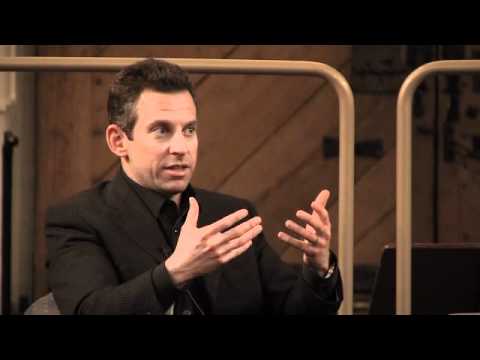
Sam Harris fails to recognize natural rights or property rights as a way to approach morality from a scientific perspective. I think that is due to his lack of knowledge regarding natural rights more than his choice to disregard it. I think he makes some fair points about the biblical approach to morality. What do the religious think about Sam Harris? My old christian teacher from school would say that he is the anti-Christ.

One thing I do like about this sort of meeting or public speaking, is that everyone is so civilized, no one is singing or dancing or bowing or shouting crazy things.

I like Sam Harris, although I do disagree with his stances on terrorism and do not like the way he uses some of his examples to make a point. I think it is about time we had an “extremist atheist” who attacks moderates a like.

Thanks for clearing that up Merlin.

Jesus Christ is an Anarchist is my favorite paper on this subject. I urge any Christian Libertarian to read it.

All Science teaches us about morality is that bad morals tend to be weeded out of societies out of interest of self-preservation. It can not teach us what we ought to do or what ideal morals are, it can only try to show us how the morals we happen to have come to the forefront.

There is always the problem when morels are based on a magic book, that is the moderates and atheists turn their backs on religion and in effect turn their backs on what is considered morels.

Artificial. As opposed to “natural”, means created or produced by man. California Casualty Indemnity Exchange v. Industrial Accident Commission of California, 13 Cal.2d 529, 90 P.2d 289 Created by art, or by law; existing only by force of…[human] law. Humanly contrived. ~ Black’s Law Dictionary, Sixth Edition (c.1991), page 113

″Natural law is that body of rules which Man is able to discover by the use of his reason.″ ~ Hugo Grotius

“A mature adult is supposed to know the difference between the real world and the games people play, between the natural and the artificial. He or she is supposed to be able to keep such things in perspective.” ~ Frank van Dun, Ph.D., Dr.Jur. - Senior lecturer Philosophy of Law.

What one creates, one controls, and since Natural Persons, i.e. men and women, are not “formed by human laws”, they are therefore, not subject to “human laws”. It is obvious, (to me at least), that I did not form myself, just as governments did not form themselves, therefore neither or us may create “our own law”, we are both subject to the law of our creator. So, it took no stretch of the imagination to realize that if Natural Persons are formed by nature then they are subject to the Law of Nature, the Natural Law

“A philosopher can choose to disbelieve in Newton’s laws, but this will not enable him to fly. He can disbelieve in natural law, but political and social institutions built on false law will fail, just as a bridge built on false physical law will fall…” http://jim.com/rights.html

Regardless of what the natural man may design, God has instructed all men through His Spirit to “judge all things by His Word.” And:

“To the law and to the testimony: if they speak not according to this word, it is because there is no light in them.” Isaiah 8:20

We know that man’s laws and governments act beyond their humble task; it has little to do with law and much to do with religion–Mammon and Hedonism. What one worships, one imitates, and one’s law is that imitation. Given enough time, all systems of man’s law self-destructs in a fit of tyranny. God’s Law is Truth and Eternal, so when the Truth provokes all of us, and it does, be diligent and remain grounded in the Word of God. All your life you have probably been told what you are allowed to know, and we have all been guided down the primrose path of half-truths which are lies. Maybe you have or have not really considered all things–why we exist; what our purpose is; what is real and what is not? Would you like to know the Truth of these things?

It is said, “Ignorance of the Law is no excuse.” That does not refer to the over 60 million laws of men on the books in America, but it refers to God’s Law. Our Heavenly Father, the Creator of all, has written His Law not only in Scripture through His prophets and apostles, but also on every man’s heart; that is why you ultimately know what is just, what is right, what is good and what is evil. That is why we are warned that:

"For the wrath of God is revealed from heaven against all ungodliness and unrighteousness of men, who hold the truth in unrighteousness;

Because that which may be known of God is manifest in them; for God hath shewed it unto them.

For the invisible things of Him from the creation of the world are clearly seen, being understood by the things that are made, even His eternal power and Godhead; so that they are without excuse:

Because that, when they knew God, they glorified Him not as God, neither were thankful; but became vain in their imaginations, and their foolish heart was darkened.

Professing themselves to be wise, they became fools,

And changed the glory of the uncorruptible God into an image made like to corruptible man, and to birds, and fourfooted beasts, and creeping things." Romans 1:18-23

The Truth that He has written on all of our hearts is the inherent gift to man from our Heavenly Father. But, through the spirit of the world, those truths become perverted when one takes his eyes off of God’s Truth.

So, in all of the issues in your life, you have the choice to be diligent, to believe, to trust, and to walk according to the ways of God, in faith! Or, through the help of many around us who serve the prince of this world, there is the choice to be influenced to turn your back on God through reason and compromise following men and their false images.

Throughout history, the spirit of the world has woven an intricate web around the disobedient and ignorant, influencing them by their temporal surroundings and lusts of the flesh to be “recreated” in the image of man. In Matthew 15:3, Jesus warned us of how man’s traditions, i.e. denominations, family traditions, etc., nullify the Word of God, “my parents are I grew up a and I’ll always be a” Too many will continue to cling feverishly and relentlessly to a tradition rather than obey the Word of God. Our Lord said, “Because strait is the gate, and narrow is the way, which leadeth unto life, and few there be that find it.” (Matthew 7:14). And:

“Love not the world, neither the things that are in the world. If any man love the world, the love of the Father is not in him. For all that is in the world, the lust of the flesh, and the lust of the eyes, and the pride of life, is not of the Father, but is of the world. And the world passeth away, and the lust thereof: but he that doeth the will of God abideth for ever.” 1 John 2:15-17

As seekers of the Truth, we must be cognizant of how powerfully blinding traditions can be, in that they can rob one of the Truth. In other words, many “Christians” say in their hearts, “Don’t confuse me with the Truth because God’s Grace is sufficientmy mind is already made upand besides that, God knows my heart” In Truth, what they are admitting: "I don’t care what the Word of God says, I know my pastor, teacher, parents, loved ones, peers, media, government, schools, doctors, and lawyers, are all correct in their understanding and beliefs, and they would never lie to me.

“Our legislators are not sufficiently apprized of the rightful limits of their power; that their true office is to declare and enforce only our natural rights . . . and to take none of them from us. No man has a natural right to commit aggression on the equal rights of another; and this is all from which the laws ought to restrain him . . . and the idea is quite unfounded, that on entering into society we give up any natural right.” ~ Thomas Jefferson

In The New History of America, the case of Cruden v. Neale, where the court states a principle of natural law so clear that it cannot be twisted by any lawyer, that man is only bound by the laws of nature. Here is what the court stated:

“…That the majority shall prevail is a rule posterior to the formation of government, and results from it. IT IS NOT A RULE BINDING UPON MANKIND IN THEIR NATURAL STATE. THERE, EVERY MAN IS INDEPENDENT OF ALL LAWS, EXCEPT THOSE PRESCRIBED BY NATURE.. He is not bound by any institutions formed by his fellowmen without his consent.” ~ CRUDEN v. NEALE, 2 N.C. 338 (1796) 2 S.E. 70 Excerpted from an article entitled HOW “CITIZENS” ARE TRANSFORMED INTO “PERSONS” found HERE>
http://famguardian.org/Subjects/Taxe…tToPersons.htm
For His chosen people, in the promised land, what sort of government did God establish ? An-archon. No government, no king, no president, no prime (and no prime) minister; only the commandments of God (as constitution) and judges for disputes.

For 400 years the Hebrews lived in this agricultural society; then they became somewhat insane and asked God to give them a king (and it was downhill ever since)

Mr. Lind,

To be sure, it can be said that a religiously backed or motivated organization is capable of providing goods or services of value into the greater economy. It can also be said however, that there is a marked difference between being useful and being necessary. From a purely conditional standpoint, we understand that the essential component of an anarchist society is the absence of an entrenched aggressive element. How exactly this aggressive element is to be marginalized in society is of less certain terms, but to imply as you have that the Christian faith alone is capable of achieving this objective would be to disregard the numerous non-religious efforts made to explain to us via the science of human interaction how aggression can be curbed through the realization of superior non-aggressive options.

Furthermore, I do believe that taking such a position as earnestly as some here have is done with some amount of hubris, for this is certainly neglecting the many people that such a claim would be in opposition to. You are certainly opposed by the Christian Socialists, who have interpreted the same source material as you to an entirely different end, and are as logically and emotionally committed to their conclusion as you are to yours. You have the many other religions of the world to consider, and I’m sure that any libertarian practioners thereof would seek to contest your claims of your one true and only way, itself but a single interpretation of a disparate collection of works in a sea of hundreds, if not thousands, within but a single broad supergroup of Christianity. itself within the confines of just the Abrahamic relgions. You have the suspicion of persons such as myself, who assign no special place to Christianity and will neither act in favor or in opposition to it on a matter of principle, only through what I reason to be the case.

To say so bluntly that yours is the one and only means of achieving a goal of a truly free society in light of all this, from where I’m standing comes off as an arrogant act, especially in the absence of sufficient evidence to support your claim. I would remind you in such a scenario, that like all such debates the burden of proof falls upon you to verify your claims with evidence. Do not expect me to prove or disprove them for you.

In a world that worships Lucifer, the Christian should take his allies as he finds them and not bicker about vain metaphors. I will remind you that you do not know the name of this God you are advocating. How do you know it’s not the Deceiver?

If one obeys God because what He commands is good, then one might as well do it for that reason alone, and not use His name as a cheap slogan to add a vacuous sense of piety to one’s proposals.

You are wrong and here’s why:

“Good” is subjective, you have to argue morality from an arbitrary, but specific, framework. If you have no framework, you can not debate morality.

1: “I will do such and such because it is good, and you will not do such and such because it is bad.”

2: “What is good and bad?”

1: “Whatever feels good to me is good, whatever feels bad to me is bad.”

2: “I feel differently than you.”

commence violence

Because we Christians use the bible as a framework, we can debate amongst ourselves what is right or wrong based on the bible. Can we have a rational debate between a Christian framework and nihilistic sado-masochistic viewpoint? No.

Less obviously, there is no rational discussion to be had between a Christian and an Atheist, concerning morality, unless some common ground has been arbitrarily found. Even if that is the case, then that common ground was only happen-stance and neither party can hope to be persuasive unless the Atheist argues from a Christian framework or a Christian tries to argue from an Atheist framework (Which is nigh on laughable, not because he is diametrically opposed, but because Atheism carries no logical framework with it.).

We evoke “God”, not to evoke a sense of piety, but because it carries along with it a framework in the bible, and lets the other side know where we’re coming from.

Less obviously, there is no rational discussion to be had between a Christian and an Atheist, concerning morality, unless some common ground has been arbitrarily found. Even if that is the case, then that common ground was only happen-stance and neither party can hope to be persuasive unless the Atheist argues from a Christian framework or a Christian tries to argue from an Atheist framework (Which is nigh on laughable, not because he is diametrically opposed, but because Atheism carries no logical framework with it.).

As someone nominally on the atheist side of this discussion perhaps I should feel offended at your assertation that atheism has no logical framework. On the contrary, from a pure religious standpoint it was very much a logic-based decision for me to profess no faith, on the grounds that I have not been presented a compelling case for the validity of any particular religion or deity, nor is it considered prudent to default towards faith in a subject which stands to be investigated further, therefore untill such should happen that changes this scenario, for lack of evidence I should not profess belief. You’re welcome to disagree with this, but that would be claiming I have a bad logical framework rather than none at all; quite different.

From a moral standpoint, you are correct to state that there is a subjective nature to morality, due to how each person has their own preferences for what they do and do not desire and there exists room for conflict due to these differing viewpoints. Quite unlike your example implying this must inherently lead to violence however, someone of a more libertarian standpoint would consider the certain predictable foundations of human action as part of a framework upon which we build the non-aggression principle as a rudimentary foundation for the use of property rights to determine fair use of oneself and one’s resources and resolve conflicts in a non-aggressive way. This doesn’t tell us what is good or bad beyond aggression, but certainly it is a framework that can be built upon towards this direction that is not beholden to any particular religion.

Also, a bit off this subject but if you honestly believe that you can’t have a rational debate with a nihilistic sado-masochist, I’d have to imagine you haven’t met that many nihilistic sado-masochists, because from how that’s properly defined I’m not really seeing what’s stopping you from finding someone you could sit down with there. Just saying.

“…no rational discussion to be had between a Christian and an Atheist, concerning morality…”

Also, you shouldn’t feel offended since “[I am] correct to state that there is a subjective nature to morality…”

When a Christian comes to a discussion concerning morality it comes with a convoluted plethora of information garnered over millenia, but when an Atheist comes to a discussion concerning morality he/she is practically a blank slate. One doesn’t know if the Atheist is going to be humanistic, nihilistic, or just downright unintelligable. Obviously the debate is off to a rocky start, and it can only get mutually rewarding when they find common ground in arbitrarily held values. (Like valuing life/property/reward for work/time/truth or whatever it happens to be.)

That is all well and good if both parties have agreed to the non-aggression principle, but there will always be certain people that don’t believe in or care about the non-aggression principle, and even in a libertarian society they would necessarily be coerced into behaving.

You’re right though, the coercion doesn’t necessarily have to be violent.

However, this underscores, rather than refutes, what I have said previously. If a Christian is debating morality with an Atheist, it is only by happenstance that they both agree to the non-aggression principle, and any debate between the two can only be logical in so far as both parties remain within the non-aggression principle.
Therefore, there is very little debate to be had, one can only hope to iron out inconsistencies in their already preconcieved framework, and they both leave believing in the same principles they happened to believe in before.

Concerning morality.

Good is a word. The good and evil type of good is subjective only to a certain extent. Now if you ask someone their favorite colour, now that is completely subjective. But the nature of good is not completely subjective, it does not take a genius or a God to tell you that the worst kind of evil (that i won’t bother specifying) is evil, nor does it take a genius or a God to tell you what is the most beautiful kind of good. That being said, i think that the bible gives a poor framework for morality. I think that we can invent a better framework for morality than the bible, one that is more clear, more concise and definitely more good. A great foundation for this better framework is property rights and natural rights. If you look at the 10 commandments, firstly to base your morality on 10 little commandments is insufficient and does not allow for the potential of morality to meet its potentiality. Secondly, I would ask you to tell me which commandments would not be covered by private property rights?

If there is no rational discussion to be had between an atheist and a christian that is only because Christianity is irrational. I have had many long in depth discussions about morality with christians and athetists. Most atheists will have no choice but to base their sense of morality in one belief system or another, because they would have been taught or conditioned with that belief system during their life. That should not prevent rational discussion of morality and I realy fail to see why people can not find any logical basis for morality. If there was no bible then man would be completely immoral, without the bible then man would be without any sense of morality?

It is 100% subjective. A person is brainwashed as a child into believing in certain values that are usually conducive to society. Go against the grain, and you’ll get tore up, the logic for it is an afterthought.
You can not prove that life is valuable, you can’t prove that property is valuable (especially not other peoples property), you can’t prove truth is valuable, etc.

I think watermelon is nasty.

I think you’re wrong.

People tell me lots of things, there is a huge difference between telling me something and proving it to me. I could tell you that killing human beings is a beautiful moral imperitive and come up with a lengthy rationalization of why that is.

Even without a bible people would still rationalize on why we should get along, and then we would still fight because resources are scarce, we are imperfect, morality is arbitrary, we are expendable, and we serve no obvious purpose in the universe.

If I choose to be a Christian in a world that was built for conflict, what authority do you have to say I’m wrong?

Actually, all Christian morality is suppose to follow from two commandments:
“‘Love the Lord your God with all your heart and with all your soul and with all your strength and with all your mind’; and, ‘Love your neighbor as yourself.’” Luke 10:27
Telling me it’s insufficient is just like telling me cupcakes are too small.

Why?