http://www.youtube.com/watch?v=gaS-vwZ77x8
6:02
Can anyone debunk this?
The US had several Panics while on the Gold Standard prior to 1929 and never had experienced anything like the Depression. The closest to the Depression was the Recession of 1920 to 1921 in the aftermath of the human disaster of WW1. This little incident was almost as bad as 1929 yet the USA recovered in under 2 years to go into the Roaring 20s.
What these videos don’t talk about is that the USA had periods on and off the Gold Standard when economy was much smaller, less diverse and had worse communication systems and yet with all of that the country still never experienced anything like the Depression.
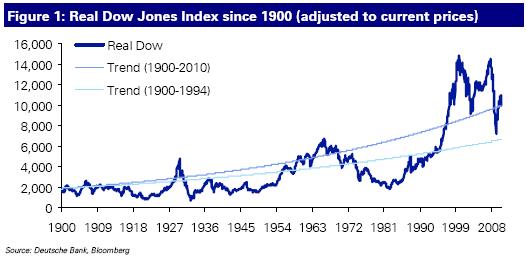
Keep in mind that the Depression went from Oct 1929 to Nov 1953 (24 years) when the Dow Jones finally reached its 1929 high. Consider how poorly that is when the USA created vast amounts of currency during WW2.
This post deserves more answers.
I know one person who can:
Inflation doesn’t “grow” the economy, but it can yield, for most, a satisfactory redistribution of the ‘weights’ of the patterns. Meaning that more money will go to different places. Schiff is right when he says ‘legitimate growth’ or ‘production’ are limited in the U.S. due to the colossal amount of foreign produced goods consumed here (imports). But inflation will ‘grow’ the economy in the sense that it changes the patterns of consumption (and their proportions) which, in a world where the U.S. produced anything, cause more production.
Keynesianism made more sense in a not-quite-so globalized economy. But the planners don’t have any other universal justification for social engineering and credit monopolization.
I understand, yet it doesn’t really clarify why countries that threw away the gold standard did better. Sure, it might have changed consumption patterns but is that enough to increase overall performance?
Well, it does explain why inflationary countries got out of the depression quicker…They printed money; they increased velocity; they shifted patterns to a quicker “cycle” than they otherwise would have formed.
Keep in mind that the Depression went from Oct 1929 to Nov 1953 (24 years) when the Dow Jones finally reached its 1929 high. Consider how poorly that is when the USA created vast amounts of currency during WW2.
Just out of interest, why do you define the depression in relation to the DJ as opposed to other markers? And doing so, what is your explanation for the period between the mid-60’s and the mid-90’s when there was an even longer period of apparent depression?
It was a short term fix. Look at where we are now with fiat money.
My reasoning is two fold:
The start of the Depression was a drop in the Dow Jones from its 1929 high not when the interventions of Hoover and FDR sent the markets down even further and completely disrupted the economy. If the drop identified the start then reaching that level should also signify the end. Otherwise you could have any even/statistic be the end which seemed to me to be inconsistent.
This Dow Jones is the best measure of private savings and private equity I know of, if you have another that is more accurate then please suggest it.
I do not believe that 1946 or when ever employment picked up is a reliable indicator of the end of the Depression as the govenrment was in the process of relinquishing control of the economy.
There’s no doubt that the inter-war gold-standard was the primary cause of the great depression and abandoning it was the correct move. The problem, of course, is that what took its place turned out to be even worse.
Schiff is right when he says ‘legitimate growth’ or ‘production’ are limited in the U.S. due to the colossal amount of foreign produced goods consumed here (imports).
So, should the citizens of San Diego stop importing much of their goods from other parts of the United States? Should people gradually become more autarkic? I’ve never been impressed by Shiff’s argument against the export of manufacturing.
Could he mean some goods (manufacturing capital) but not others?
Umm, if people are in SD are importing things from the other parts of the U.S., this is domestic. Schiff and I explicitly state foreign imports as the cause of the weakening of domestic production.
Mercantilism has its plusses in a pragmatic statist world.
The term “domestic” is used arbitrarily. I could, if I wanted, draw a border around San Diego and proclaim everything outside of it “foreign,” but this doesn’t change the fundamental fact of the benefits of a growing division of labor. And, domestic production hasn’t “weakened;” it has ceased to grow as quickly as the service sector, but neither does this imply a “weakening” economy (i.e. that a growing service sector at the expense of employing the same amount of people in manufacturing will weaken the economy).
Oh, good more libertarian subjectivism. Nothing redundant about claiming the same things over and over and over and over and over and over and over again waiting for someone to verify that you are the smartest one in the room.
First of all genius boy, “domestic” is used to refer to nation-states…it is not arbitrary in our terms of discussion.
How can you tell if “domestic” is arbitrary?
Oh, and here we admit that there is a decline in growth (which is the definition of weakening according to the state; recession) and it does (according to that pesky definition) imply a weakening economy (according to the state).
We are all familiar with the usual libertarian arguments against such statistical measurments…no need to point them out.
Frankly, I understand why mainstream people hiss at libertarian argument strategies. Claiming everything is subjective or arbitrary…
Aristophanes,
There’s no reason to get flustered for being challenged on a public forum.
Regarding the arbitrariness of “domestic,” you missed the point. If it’s good for society to expand the division of labor throughout the territorial expanse of the United States, then it’s arbitrary to just claim that expanding it to China is bad. The fact that these two territories have different governments is not reason enough to argue that globalizing the division of labor is bad; i.e. that we are worse off because of it. In other words, if it’s good for the division of labor to grow beyond municipal and state borders, it’s not inherently bad for the division of labor to grow beyond national borders. In fact, national borders are arbitrary in that they’re political demarcations.
Oh, and here we admit that there is a decline in growth (which is the definition of weakening according to the state; recession) and it does (according to that pesky definition) imply a weakening economy (according to the state).
But, the economy isn’t in a recession due to the lack of manufacturing jobs; it’s in a recession because of a previous bout of malinvestment, a moribund banking sector that hasn’t delevaraged sufficiently, and bad public policy. We could employ all of the United States’ workers in the non-manufacturing sector if we exported our manufacturing, and this wouldn’t lead to a loss of wealth or productivity — it would, in fact, make us wealthier.
Instead of railing at me for “repeating libertarian arguments,” why don’t you provide an actual argument of your own?
hahaha
No, I didn’t. I said that the ‘libertarian usual’ is not sufficient to stifle the acceptance of the other parameters discussed. (Borders, Nationalism)
Zero Sum? It is absolutley NOT arbitrary if their growth comes at our loss. Is that not possible with credit expansion taking over the channels of distribution in that arbitrary geographic location where a particular language, currency, and judicial system operate?
It it was arbitrary, then people would have no problem moving between the locations if they choose to follow their trade around to its most profitable location. But, unfortunately, culture, language, tradition, etc. all prevent most people from moving in between polarized societies en masse. So borders are not arbitrary. They are statist, but they have a life of their own beyond their simple enforcement.
Or, if we pretend that nationalism is a thing that prevails over the ‘assumption of arbitrary borders’ (as reality posits), then we can say that it is bad when production jobs leave one non-arbitrary geographic location to go to another non-arbitrary geographic location.
I notice you use the word “inherently” to descibe the “bad” consequences of an expanding division of labor*.* That couldn’t possibly be because there are “superficial” “bad” consequences that relate to the topic of the OP? i.e., national borders
Also, when you have said that the division of labor expands you neatly gloss over the contraction of the division of labor that happens in the U.S. (you know that totally arbitrary geographic location that totally arbitrarily has a much higher standard of living than some of the other totally arbitrary geographic locations and their centuries of culture and history and even present day traditions).
You also might want to consider the contraction of the division of labor in Europe when the U.S. started to draw immigrants. Your logic says that it meant no difference to Europe that masses of people wanted out…it is absurd. It meant no difference to Egypt that their Jewish labor force wanted to expand beyond the national borders…
But, you do repeat the same idiotic juvenile libertarian “subjective interpretation” BS. “We don’t have to think very hard about borders because they are immoral. Who cares if they exist and have for all of history? They don’t need to be accounted for in social theory because they are immoral.” I used to think the people on these boards were smart, but now I think they are like parrots. Whether you like it or not, you have to deal with statist problems.
I didn’t tell you this would happen some day. I forecasted it.