Depression of 1920 Revisited

A former libertarian on YouTube has made a brief video critiquing the libertarian narrative of the depression of 1920:

http://www.youtube.com/watch?v=x7yME2CUVmo

Since he mostly lists facts and it’s hard to argue against facts when you can’t ascertain their veracity, I’d like to ask the more knowledgeable users here what they think of the video.

Note that he also believes we should esablish government panels of psychologists to tell people how to act and feel…

Let’s disregard Spawk’s views on psychology for a moment and focus on that particular issue.

The libertarian narrative? I thought it was an Austrian narrative?

  1. I don’t have a huge amount of data to compare what he’s saying to, so I have a hard time proving or disproving the facts which he is using. I feel like he at least has to be leaving some facts out, or else the normal libertarian assertion that the recession “was as bad” was truly the result of poor scholarship and those who have made these claims should be ashamed of completing poor work. I’d also argue that Spawk is one of the most intelligent users on youtube.

  2. He seems to make generally very good points, although he commits two fallacies, the first is assuming that there’s simply an easy way to view recessions/depressions or when they have ended, I’d argue that they’re naturally biased towards reflecting Keynesian views, and he also fails to relate to how he believes that the recession actually went or how it recovered

  3. He admits himself that the government stimulus that was used was not much, the public spending wasn’t enough to make an impact and there wasn’t a huge change in interest rates, I’ve also heard it said before that the fed had very little power over interest rates as it does now during the time of the recession, so it doesn’t really compute how it is that the government spending ended the entire recession and it would seem that that there was some serious free market forces bringing a natural recovery.

  4. He fails to make too many arguments relying upon logic and focuses far too much upon data points, which in the end make was he’s saying relatively unconvincing. You get back into the theoretical aspects of what is going on once again, and it’s very hard to deny the Austrian aspects of the argument.

For more info on this,

see here

(in particular the links listed at the bottom.)

Going to respond to each major point individually (lengthy response).

“GNP must fall 10% for it to even be classified as a depression.”

False. A depression is not a severe recession. In fact, the term “depression” is void of any meaning in economics today. Periods of economic contraction, often associated with financial crises, were first called “panics” and then “depressions” and now they’re referred to as “recessions.” The latter is defined as two or more consecutive periods of negative growth.

“Modern estimates claim that GNP fell by 2-3%”

First, this estimate varies depending on the source. The U.S. Department of Commerce claims that GNP fell by 9% during the first year. More importantly, however, is the method used by various econometricians in measuring the severity of historical economic contractions. Information for this period is relatively scarce and economic historians employ varying methods, i.e., focus on different variables (changes in GNP is merely one factor).

In many areas, the first year of that depression is as bad or even worse than the first year of the great depression (which is the claim made by Austrian Economists):

  • 13-15% deflation; wholesale prices fell by around 40% (highest rate of deflation ever recorded)
  • Unemployment rose, by some measures, to 12% (What Austrians tend to focus on)
  • Industrial investment and production collapsed by 30% (What Austrians tend to focus on)
  • Asset prices fell by some 50%
  • Businesses that managed to avoid bankruptcy saw a 75% average fall in profit.

“Unemployment rose to around 10% but these number are inflated by the fact that in 1920 the civilian labor force grew by 4.3%”

This is irrelevant. Population growth and entry into the labor force do not yield involuntary unemployment. In fact, it stimulates the demand for labor by increasing the marginal productivity of capital. If a relationship between these two variables exists then we should see the rate of involuntary unemployment rise simultaneously with population growth and/or periods of heightened immigration.

We see no such relationship.

“The recession was not short by modern standards (i.e., since the introduction of Keynesian counter-cyclical policies).”

Well first, Keynesian counter-cyclical policies (increasing aggregate demand through government expenditure while simultaneously engaging in expansionary monetary policy) were used during the great depression, which lasted for over a decade. Keynesians, for whatever reason, tend to ignore this fact.

Next, the argument is that Keynesian (as well as pure monetarist) counter-cyclical policies merely delay and exacerbate the necessary correction. We saw that the Keynesian policies pursued in the 50’s and 60’s lead to the stagflation crisis (simultaneous double-digit unemployment and inflation) which crippled the American and English economies and ultimately spelled the death of traditional neo-Keynesianism.

We also see that Bush and Greenspan’s counter-cyclical policies (a) lead to the accumulation of massive malinvestment in various industries, first in tech and then ultimately in real-estate and finance, which lead to this calamity today. And finally, we also see that the Keynesian counter-cyclical remedies employed today have been entirely ineffective by all objective measures.

“Keynesian policies ironically ended this economic contraction by lowering the discount rate and engaging in expansionary fiscal policy.”

Lowering the discount rate (expansionary monetary policy) is neither unique to, nor is it what defines Keynesian counter-cyclical policy. In fact, it was proposed before Keynes by various Chicago economists, most notably I. Fisher (still supported by monetarists and New-Keynesians today). What is characteristically Keynesian is the belief that aggregate demand must be stimulated by expansionary fiscal policy along with monetary policy.

By all measures, and especially when compared to the type of fiscal policy employed today, the Harding administration engaged in an absolutely insignificant amount of fiscal expenditure. In fact Hoover’s fiscal policy was far more expansionary than that of Harding.

Finally, and this is absolutely key, the FED did not have the power to alter or manipulate the over-night interbank rate (federal funds rate) which is a far more potent tool of monetary policy. The reason why we hear little of the discount rate today (the rate at which member banks borrow funds from the FED) is because they have this tool (federal funds) available to them.

Lowering the federal funds rate literally means giving banks funds and lowering the rate they pay on deposits (steepening the yield curve) as opposed to merely lowering the rate that member banks borrow from the central bank.

“Cutting government spending contributed to deflation”

Government expenditure has absolutely no effect on the general price level, which is just a ratio between the quantity of money supplied/demanded at any given point and the quantity of goods supplied at any given point. Money that the government confiscates from the private sector and then spends will re-enter circulation. Likewise, if the government never confiscates money in the first place, then the sums will remain in circulation. In other words, it’s just a transfer (redistributive); it doesn’t actually change any aggregate/stock.

Conclusion: In short, this individual ignored important facts and variables (the collapse in industrial production and investment, for example), tried to obfuscate certain facts by adding additional superfluous variables (such as attempting to dismiss the rise in unemployment to a growing labor force), and cherry-picked sources that support his argument while simultaneously ignoring those that do not (The 10% unemployment figure and the 9% fall in GNP).

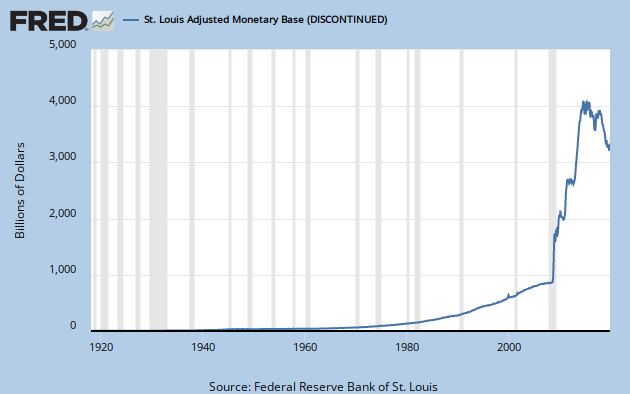
Took a gander at some of the recommended threads and the federal reserve calculates the money supply like this

And I think to myself that this doesn’t fit with anyone’s explanation. The money supply continually increases at a very high rate as a recession breaks out and then it starts to decrease dramatically and the economy recovers… Something here that does not compute. I also don’t understand the relationship between the supposed interest rates of this time and what is happening to the money supply, unless what is happening is that inflation from the war hand’ t fully taken its toll and then the market here is taking a hell of a long time to actually expand the money supply.

Go for it.

Good stuff Esuric. I’d also note that economists as a whole are not even close to coming up with a definition of “depression,” and so when they study the subject at all they tend to measure in terms of simple peaks and troughs in economic activity for the sake of avoiding disputes over semantics. As well, as Esuric said, there’s a real paucity of good macroeconomic data before WWII and thus a lot of debate about the length and severity of historical recessions.

To take one example, Christina Romer (1999) has done some work remeasuring changes in output and recession durations, showing that the NBER data is quite flawed. According to her, the 1920-21 debacle resulted in one of the largest losses in output in recorded history, second only to the Depression years (p. 32), yet it only lasted 14 months, compared to the 44+ month ordeal of the Great Depression (p. 31). This is short for a recession of that magnitude.

And yes, it’s long in comparison to the average length of post-WWII recessions (10.7 months), but it’s also long in comparison to pre-Fed recessions (9.7 months), all of which were milder in terms of output loss. (Note that Romer doesn’t include any contractions past 1990, including the most recent financial crash.)

Also of note is that the Fed kept the discount rate jacked up at 7% for most of the duration of the recession, only lowering it noticeably after it had ended (late March 1921, according to Romer, late July according to other estimates). The monetary base shows a huge contraction. And the Harding government ran a nominal budget surplus (in the 1921 fiscal year, so July 21, 1920 to June 30, 1921) of $509 million.

EDIT: I’m taken aback at how selective this guy is. He cites Vernon Smith (1991) on the deflation. Yet he’s apparently unaware that Smith does away with his own argument that the deflation was caused by aggregate supply shocks, noting that the 4.1% increase in the labour force occured from mid-1919 to mid-1920 (there is no monthly data), not during the recession years (start of February 1920 to end of March/July 1921) (p. 2), and that even excluding farm prices the deflation of 1920-21 was still abnormally large even compared to the Great Depression (p. 3).

Esuric,

I thought that the federal reserve has always had power over the three “textbook” ways in which it controls the money supply: Federal funds rate, the discount rate, and required reserves.

The fed has no direct control over the federal funds, merely an indirect influence through open market operations where it influences the rate, which is something I thought that it always had in is options set. Do you have a source which I could borrow to back up the claim that the fed had no influence over the rate during this time?

Can you explain this a little more? Isn’t the federal funds rate the rate at which member banks can take out loans from the Fed?

In case this isn’t obvious, I am the maker of the video.

" False. A depression is not a severe recession. In fact, the term “depression” is void of any meaning in economics today. "

I will link an article from the economist that vindicates my view that many economists use 10% falls in GNP as a demarcation for depressions.
http://www.economist.com/node/12852043?story_id=12852043

“First, this estimate varies depending on the source. The U.S. Department of Commerce claims that GNP fell by 9% during the first year. More importantly, however, is the method used by various econometricians in measuring the severity of historical economic contractions. Information for this period is relatively scarce and economic historians employ varying methods, i.e., focus on different variables (changes in GNP is merely one factor).”

The paper that I linked on the GNP number discusses other numbers used included those by the department of commerce. Your claim that there are multiple indicators of the severity of a contraction is true. This is why I looked at unemployment, deflation, and GNP instead of just one.

You bring up a host of indicators, some of which I addressed (unemployment and deflation), and some of which I did not. The atmosphere was bad for business, and your numbers do indicate that the recession may have been more severe than I suggested. However, it was obviously not comparable to the great depression as some austrians like to claim. I don’t think its initial period was that much more severe than other previous recessions either.

"This is irrelevant. Population growth and entry into the labor force do not yield involuntary unemployment. "

Of course it doesn’t. I explicitly state that this is not what we would normally count as cyclical unemployment. What it will do, however, is great an enormous (temporary) surge in frictional unemployment.

“Well first, Keynesian counter-cyclical policies (increasing aggregate demand through government expenditure while simultaneously engaging in expansionary monetary policy) were used during the great depression, which lasted for over a decade. Keynesians, for whatever reason, tend to ignore this fact.”

This is a fairly complicated topic so I will have to be over simplistic here. The idea that FDR followed Keynesian policies is one that can be easily challenged. Firstly, we can see that FDR obviously engaged in many policies which were not keynesian. IE crop burning. Secondly, we need to take into account the psychological affect of FDR’s action. The attitude that the public perceived in FDR scared the investment community. They feared that some kind of socialism of nationalization of industry was coming. This is largely why investment fell into the negatives, and why the private sector wasn’t able to pick up demand until after world war two and the dismantling of some of FDR’s programs, aswell as the death of the man himself and a change in perceived path foward taken by the government. To put this is keyneisan terms: FDR negatively impacted investors animal spirits. His perceived intentions greatly increased uncertainty and this caused an approximation of a liquidity trap (In the modern sense).

There is also the matter of how much spending was needed. I am confused by your claims about Keynesians not addressing this. What I just gave was an explanation flavored in post keynesianism. But the standard reply (which is also partly true) is this: FDR didn’t spend nearly enough. The collapse was huge and it took spending the size of world war two to get us out.

As for monetary policy it was not keynesian. One may argue about the intent. They may have had keynesian intent. But they certainly did follow through on those intents successfully. As I’m sure you know, the money supply collapsed during the great depression. That should have been avoided. Could the federal reserve have stopped it? I doubt it. It was more a psychological matter than any thing and we lacked institutions like the FDIC. But the money supply being able to collapse like that was not consistent with keynesianism. But then, what exactly is keyneisan monetary theory? This will vary greatly depending

“We saw that the Keynesian policies pursued in the 50’s and 60’s lead to the stagflation crisis (simultaneous double-digit unemployment and inflation) which crippled the American and English economies and ultimately spelled the death of traditional neo-Keynesianism.”

I would say that that had more to due with negative aggregate supply shocks and badly planned government micro intervention. Neo keynesianism was discredited, but many newer versions of the phillips curve remain. But this is because they made a bad prediction, not because following their policies caused the error in the prediction. Granted, the seriously misguided monetary policy of hte time (which keynes would have abhorred) made things worse.

“We also see that Bush and Greenspan’s counter-cyclical policies (a) lead to the accumulation of massive malinvestment in various industries, first in tech and then ultimately in real-estate and finance, which lead to this calamity today. And finally, we also see that the Keynesian counter-cyclical remedies employed today have been entirely ineffective by all objective measures.”

You aren’t making any argument here and I am tired of perusing lines of discourse that aren’t directly relevant to my video. The entire history of cycles in the US is not the subject of my video. 1920-1921 is.

"Lowering the discount rate (expansionary monetary policy) is neither unique to, nor is it what defines Keynesian counter-cyclical policy. "

I don’t think I ever said the policies enacted were very keynesian. If I did could you point me to it?

“By all measures, and especially when compared to the type of fiscal policy employed today, the Harding administration engaged in an absolutely insignificant amount of fiscal expenditure. In fact Hoover’s fiscal policy was far more expansionary than that of Harding.”

I did not claim that Harding’s efforts were large. Infact, I explicitly said other wise.

“Finally, and this is absolutely key, the FED did not have the power to alter or manipulate the over-night interbank rate (federal funds rate) which is a far more potent tool of monetary policy. The reason why we hear little of the discount rate today (the rate at which member banks borrow funds from the FED) is because they have this tool (federal funds) available to them.”

I explain, in my video, why the discount window was more important back then.

“Government expenditure has absolutely no effect on the general price level, which is just a ratio between the quantity of money supplied/demanded at any given point and the quantity of goods supplied at any given point. Money that the government confiscates from the private sector and then spends will re-enter circulation. Likewise, if the government never confiscates money in the first place, then the sums will remain in circulation. In other words, it’s just a transfer (redistributive); it doesn’t actually change any aggregate/stock.”

This is mistaken on so many levels. Firstly, it seems to assume say’s law in its most vulgar form. Secondly, it equates a decrease in spending with a decrease in taxes. That is not how the government works. Harding did lower taxes but not until the end fo the recession. What he, and wilson, did prior to that was mostly just to cut spending cuases a surplus.

I am going to skip over thigns that I adressed in the previous comment.

“To take one example, Christina Romer (1999) has done some work remeasuring changes in output and recession durations, showing that the NBER data is quite flawed. According to her, the 1920-21 debacle resulted in one of the largest losses in output in recorded history, second only to the Depression years (p. 32), yet it only lasted 14 months, compared to the 44+ month ordeal of the Great Depression (p. 31). This is short for a recession of that magnitude. “

This data is interesting. Romer is measuring output loss by measuring losses in industrial production. But by Romer’s own other numbers this is clearly not a good indicator of GNP. Given this in conjunction with my comments in the video on unemployment and deflation I would say that the indicators of how server this recession was are mixed. I should also mention that we have conflicting data on the length of the recession. The source I link in the video states that it was 18 months long.

“Also of note is that the Fed kept the discount rate jacked up at 7% for most of the duration of the recession, only lowering it noticeably after it had ended (late March 1921, according to Romer, late July according to other estimates). “

The Smith article that you link and that I sourced puts the TROUGH of the recession at July 1921. You can also see that stock prices don’t start to recover until late 1921. (http://en.wikipedia.org/wiki/File:Dow_1918-1922.jpg )

“noting that the 4.1% increase in the labour force occured from mid-1919 to mid-1920 (there is no monthly data), not during the recession years (start of February 1920 to end of March/July 1921) (p. 2), and that even excluding farm prices the deflation of 1920-21 was still abnormally large even compared to the Great Depression (p. 3). “

February 1920 comes after mid-1920. Given the lack of monthly data the monthly distributions can not be known. Given this the idea that this labor increase caused a spike in frictional unemployment is still very plausible. Of course the deflation was large even given the change in farm prices. You are acting as if I attributed all of it to farm prices, which I clearly did not.

The FED first engaged in open market operations in 1922.

http://www.minneapolisfed.org/publications_papers/pub_display.cfm?id=3826

Hi there.

But it’s not meant to be. That’s the whole point. It’s supposed to be a macroeconomic indicator in addition to GNP to give us a more accurate picture about how severe the recession was. As Romer says,

She also comments on GNP series:

The point is, we don’t have much data on this period compared to the post-WWII age, whatever data we do have is hotly debated, and so it seems to me that if we want to construct an accurate picture of the past we should rely on several figures not just one. I brought up Romer (1999) just as an example, there are plenty of others. So in at least a few respects (output, deflation, etc.) we can suggest that this recession approached serious severity.

I know we have conflicting sources, that was also the point. You used the NBER’s dates. Romer’s new dates are based on industrial production, which yield peaks and troughs broadly similar to the NBER data but less inconsistent. These suggest the recession was 4 months shorter than originally supposed.

I think you’re being shifty here. Smith (1991) suggests that the recovery was in July 1921. If this is true, this means that, based on your own source, the recession was already mostly over with when the Fed lowered the discount rate to 6.5% in May. (Based on Romer, the recession was in fact entirely over by then.) Yet to avoid this implication you instead decide to look at stock prices, which you rejected as a reliable indicator in the comments of your own video (for reasons I agree with): “the stock market was not nearly as good of an indicator of general economic preformance in 1920 as it was by 1929 and so this entire line of argument is fairly uncompelling.” Indeed.

Huh? No it doesn’t. Mid-1920 in the data Smith uses is June/July.

Maybe, but as I said, that friction (mid-1919 - mid 1920) did not coincide for the most part during the period we’re discussing (early 1920 - mid-1921) so I can’t see how it’s relevant.

I didn’t mean to come across as if that was what I was saying. What I was saying was that two of the factors you attributed the deflation to (labour/ag supply shocks) explain almost nothing. This deflation was still abnormal and sharp despite them.

"“But it’s not meant to be. That’s the whole point. It’s supposed to be a macroeconomic indicator in addition to GNP to give us a more accurate picture about how severe the recession was.”

I know, that is why I stated that the indicators were mixed. I was just clarifying because the term “output” threw me off. I normally associate it, when it is un specified, with general output measurements like GNP.

“So in at least a few respects (output, deflation, etc.) we can suggest that this recession approached serious severity.”

In terms of output yes, but I am still skeptical of the deflation claim. To be sure, deflation was not small. But as large it was, when taking into account aggregate supply movements in agricultural and labor, I do not know. Smith states that it would still be large with out the affect of agriculture but he also has a very flawed method by which he disregards agriculture. He looks at the GNP minus agriculture. But this totally ignores how deflation in sector of hte economy can affect the rest of the economy. His treatment of labor is similarly flawed. The labor spike took place into mid 1920, after the recession started. Of course, frictional unemployment takes time to dissipate and so this alone could have affected the unemployment numbers. On top of this the frictional unemployment could have easily transitioned into involuntary unemployment is the recession had a large affect on investor confidence. As I said, I am sure that it was not small. But, as you probably know, several Austrians don’t just claim that this recession was not small, they claim that its beginning was more costly than the great depressions. I don’t think that this is substantiated by the data.

“These suggest the recession was 4 months shorter than originally supposed.”

I don’t think industrial output tells us a whole lot about the rest of the economy.

"I think you’re being shifty here. Smith (1991) suggests that the recovery was in July 1921. If this is true, this means that, based on your own source, the recession was already mostly over with when the Fed lowered the discount rate to 6.5% in May. "

One of us is misreading Smith. He states (all on page 1):

“The National Bureau of Economic Research dates the 1920-21 recession from a general business peak in January 1920 to a trough in July 1921”

" By the year’s end, industrial production had fallen 25.6 percent below its January 1920 peak and bottomed out at 32.6 percent below its January 1920 level in July 1921, the general business trough."

This is why I stated "The Smith article that you link and that I sourced puts the TROUGH of the recession at July 1921. "

That the trough was in July does not at all mean that the economy recovered in july. It just means that the economy hit bottom in July. At the most the recovery BEGAN in july. This would fit very nicely with the Fed lowering the discount rate a few months prior.

“Yet to avoid this implication you instead decide to look at stock prices, which you rejected as a reliable indicator in the comments of your own video (for reasons I agree with):”

What I rejected was the idea that it was nearly as good of an indicator as things like GNP. It is, indeed, not a very good indicator, and I would not offer it alone. I offered in in conjunction with Smith. I hope this alleviates your suspicions of shifty behavior.

" Huh? No it doesn’t."

Yes, that was a typo on my part lol. I meant to say that mid 1920 comes after February 1920. This means that we were still sending people into the labor force once the recession began.

“What I was saying was that two of the factors you attributed the deflation to (labor/ag supply shocks) explain almost nothing.”

To reiterate, I am skeptical of the claim that the deflation was greater than the great depression once aggregate supply shocks are accounted for. I don’t think the data that I have thus far viewed substantiates the claim.

I don’t see how. As far as I can tell Smith deals with that counterargument in the article.

In other words, what you are saying is that there was a recession severe enough that soldiers from WWI remained unemployed for well more than a year after they were demobilized. I admit, this may be true and the data could go either way, but I fail to see how this contradicts the Austrian account.

Who are these “several Austrians”?

By the same token, neither does GNP for the reasons Christina Romer brought up.

If you only rely on GNP, of course.

You are trying to attribute the recovery to a puny lowering of the discount rate in May. This is extraordinarily strenuous, since there’s reason to think the recession was already over with by then. The more significant lowering happened in November, and 2/3 sources say the recovery was already complete by then.

. The money supply continually increases at a very high rate as a recession breaks out and then it starts to decrease dramatically and the economy recovers…

Have you accounted for time lag? It takes a while for the newly printed money to be malinvested, then more time for the malinvestments to start hurting the economy. Decrease in the money suppply is, the way I understand it, and I’m ready to be enlightened, not a factor in recovery. Main thing is not to keep pumping more in to keep the zombie companies created by the boom on life support. Stopping that will let them die and the resources they gobbled will be used productively.