But what if participants all agree that gains (even if subjective) could have been better given a different, realizable outcome?
Money talks , bullshit walks!
Prisoners talk, none of them walks.
“Prisoners talk, none of them walks.”
If drivers could telepathically communicate and coordinate, they could all synchronously press the gas and breaks at the same time making traffic jams and delays practically impossible (up to the physical limit of the area of the given road divided by the total area of the sum of the cars).
Differential reaction time between drivers is basically your prisoners dilemma. So I guess we have a market failure! We need government to coordinate the road. Nationalize the roads!
Under your definition, is there any human action that’s not coercive?
How could the government eliminate the delays? It already owns the roads.
That’s why there are delays.
How could the government elimate food lines and delays? It owned food production.
http://englishrussia.com/index.php/2008/01/14/lines-lines-lines/
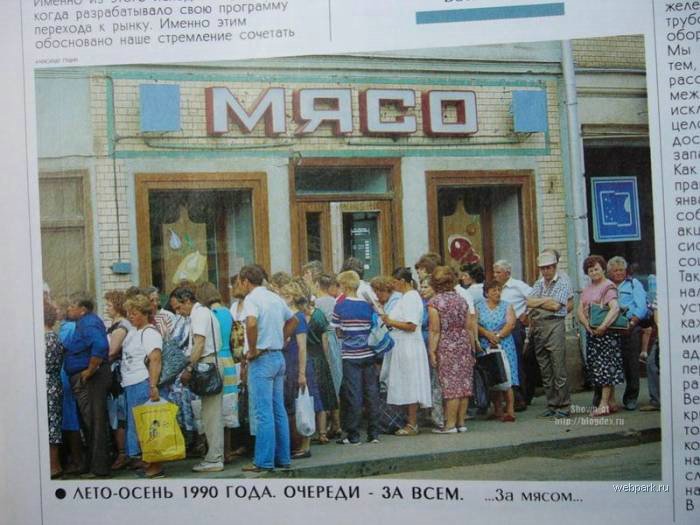
People who are arguing with Neoclassical about state efficacy in alleviating alleged market failures must have missed the posts where he clearly explains that he isn’t doing that at all…
This definition of market failure makes basically everything a market failure, and so is still nonsensical (or at least pointless).
“If only they had all stood together in our spear line, they wouldn’t have lost so many people.”
“If only they had pooled our capital, they could have produced more cheaply, made more profit, and supplied more to willing buyers.”
“If only they hadn’t have spent a decade on a dead end research path, they might have created better inventions to improve lives more.”
“If only they hadn’t have ratted each other out, they wouldn’t have gone to prison.”
None of these are damning to the market as a process. They are only damning to the individual actions taken by participants in the market.
The spear line is a great example of fabricating “market failures” by redefining rationality. It is only individually rational to run if you can guarantee that others will stay to fight. Since you can only guarantee that others will stay to fight by having a trained force that won’t have people break, it is not rational to run; running alone and living isn’t an available option. You may be one that dies for not breaking, but the only other available option is to run with the rest of your untrained force and have a higher chance of dying. The rational decision is to stay with your trained force and have a lower risk of death. That some armies would still break and run to their own deaths only shows that they had limited knowledge of the options and no “entrepreneur” (if you want to call State generals that in this case) had yet stepped in to fix the issue for people by properly training the army.
“How could the government eliminate the delays? It already owns the roads.”
Exactly.
Zavoi: “Under your definition, is there any human action that’s not coercive?”
Sure, such as sitting here typing. However, I don’t think it’s controversial that law enforcement is coercive. I’m not sure your intent here. I don’t mean NAP-violating (nor do I mean NAP-non-violating). I mean coercive in the everyday sense of “forceful and possibly violent” (leaving aside whether such force or violence is “justified”).
Like Walter Block, I believe public roads actually experience a shortage, leading to “traffic jams” for the most part. Hence, there is a greater need for tolling, etc.
But you are all missing Friedman’s point: even assuming public roads, there is a better outcome than what results from individual decision-making; that is, individual rationality does not lead to group rationality.
Sure, I agree with that. Or at least that individual rationality does not have to lead to group rationality. However, that isn’t a market failure. Every case of what you are calling market failure is an opportunity for an entrepreneur to alleviate something that is bothering the group by coordinating the individuals. For his efforts, he makes a profit.
If this bit here I quoted is the summation of your position, I think you need a term other than market failure to describe it.
Totally different question.
Neoclassical: do you believe in ‘society’s failure’? If so: can you give me a definition of it and a example to apply it too?
The free market is simply the process whereby civil society makes voluntary exchanges. Market failure is society failure.
Again nonesense sorry. If everyone had agreed on a superior method of employing resources then those methods would have been employed in the first place by people individually choosing them. Since people didn’t choose those alternative means however we could never argue that they thought it was superior. Human action has revealed people’s preferences, and they lie in conflict with your own. Thats your problem, not ours.
We shouldn’t. But the communist that made it up certainly thought he should.
Biased Physicist: “The laws of physics do not make monopole magnets. Ah, I shall call this Physics Failure.”
“We shouldn’t. But the communist that made it up certainly thought he should”
What can you do when you have economist after economist insisting that there are market failures. From light towers, to dams, to money, all the way to health insurance. It never ends.
Have you heard about the Canadian census discussion? Recently a Canadian economist declared that markets fail in information, because markets can’t provide businesses with the information census can (our long form census asks things like, how do you get to work, do you drive or do you sit on the passenger seat!) It’s kind of like saying the markets can’t provide for goblins, they have failed!
It’s one thing to distinguish between actual violence and non-actual violence*: e.g., respectively, a store owner being shot by a robber for resisting, versus the store owner handing over the money without resisting. This distinction is useful for economic theory and is non-normative.
*Interpret this as “non-(actual violence)” rather than “(non-actual) violence”.
For the most part, both law enforcement and you sitting there typing fall in the category of “non-actual violence,” but you say that one is coercive and the other is not. This presupposes a definition of what an “ordinary” sphere of action is for each person – we can see this from the fact that it’s possible to create a parallel argument that both actions are coercive:
- The enforcement of the common law is coercive, because I would like to steal stuff from people, but I am prevented from doing so.
- You sitting there typing is coercive, because I would like to live in a world where you’re not sitting there typing, but I am prevented from doing so.
The only way to break the symmetry – the only way we can say that X is not coercive – is if we say that “living in a world where you’re not doing X” is not “really” an action. But on what non-arbitrary basis can we make this distinction?
The reason why I’m harping on the precise definition of “coercion” is because I’m wondering how there can be coercion without it being ipso facto government (albeit on a small scale).
Zavoi, that’s an interesting point and I suppose you’re right. All action is coercive. Even one’s very existence is coercive. Just like the concept of liberty, the concept of coercion vs. non-coercion breaks down outside the statist context (and perhaps even within it).
My point in saying that even common law or natural order is coercive was to say that we cannot avoid coercion just because the state is gone. I think what you’ve done here is make a more thoroughgoing point along the same same lines. To wit, we cannot avoid coercion. It is a continuum if anything. We can just eliminate a major cause of coercion so that we are more free than before.
In fact to me I don’t really see the point in always focusing on freedom, or the coercion actually happening to oneself. There are many other factors affecting human happiness. For me, the patents and regulations of the state preventing new technologies from arising is more onerous than anything else. Although this is caused by coercion, I don’t feel (at this moment) any great coercion or interference in my own immediate personal affairs from the state, so that is not a huge issue for me. I actually care more about the state intervening in others’ affairs more than my own. Some people just want to be left alone entirely and that is the big thing they care about, but for me I’d much rather suffer through taxes and TSA checkpoints than have to wait forever for new technologies like visual cortex scanning.
In other words, it seems the reason to eliminate the state is so that one can be, in sum total, more happy, fulfilled, etc. I hope this isn’t getting too far off track from what you intended.