Does General Welfare give citizens a lot less incentive to work or produce capital? I’m unsure what to think of this, because my mother is a single parent, and has supported us mostly off of General Welfare and Child Support before she got a job. She had no more then an associates degree in College, so it was hard to find a good income.
The most basic argument against welfare is that a family that survives under welfare has less incentive to increased productivity. It no longer becomes a question of survival vs. death, since the State eliminates the most dangerous threat to a lack of productivity. On the other hand, every individual is different, and so this in no way is a rule. But, it generally remains true. In the case of your mother, it is possible (although, obviously I do not know better than you, so I could be completely off the market) that welfare made it less necessary for her to further her education to get a higher paying job.
The issue was, she couldn’t be a full time student because she has two other kids to look after. I’m 18, but my two younger siblings aren’t, and at the time one of them was still in Elementary School.
She had a job as an assistant to students with major physical and mental disabilties, but she lost that job to volunteers. She now works as a cashier at a Grocery Store, and even then our budget is still a nightmare sometimes because of her getting her hours cut, and the prices going up.
With the recession, things just get a lot worse.
The problem with where I live, is that its almost IMPOSSIBLE to find work no matter how hard you try. I’ve experienced this myself, I’ve applied, and shown up at that Grocery store several times and not once have they considered me for an interview. I’ve had a job set up at the Gas Station, to work a night shift, but the hiring freeze here screwed me over.
I applied at a local restraunt where mostly wealthy people dine. I don’t know why I didn’t get the job, but 2-3 days later the person told me that they had filled up, when they said all of their employees had left for college.
I went into Wal-Mart in this area, only to find out they were only hiring people for temporary work, and that they would take the very best from there into the store. I didn’t even give that one a chance it was only to be temporary for store renovation. I needed a STABLE job.
Then I went to Gamestop, i had an interview, and I got a call back saying I didn’t get the job since they extended the offer to someone more qualified.
It isn’t always that it gives less incentive to work, its just that for some people, like me its really hard to find a stable job and an income to support yourself. For others, its nearly impossible to make it on Blue Collar jobs no matter how hard they work.
I don’t know what to think about Minimum Wage and the Job Market, because Business’ obviously won’t lower their standards to higher more employees. Even if they do, they get away with giving you a lower then average payment which you would be unable to live off of.
In refute though, I can easily blame The Income Tax, Medicare, Social Security Tax on paychecks as well as illegal immigrants, minimum wage laws, and affimative action.
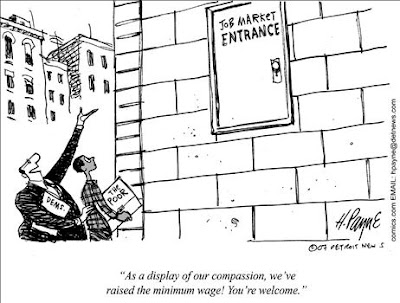
While there is truth to what you say, we can sit and bitch about how the minimum wage laws make it difficult all we want. The fact is, I need a job, and its likely the Obama Administration wont change the policy. Or rather, its unlikely they will be removed any time without liberal propaganda pointing the finger at you for “Not caring about helping people” and being heartless with evil intentions.
Well, talking about your mother, she had to overcome two different things. First of all may have been less incentive to find work. I am sure it goes without saying, that if she did not have the welfare, she would have gotten a job, no matter what it paid.
But the second problem was her inability to find good paying work. This problem was also caused by the state. Licensing laws are very harmful to the poor and unskilled. She could not just open up a medical practice, for example. There are also the zoning laws and regulations. She probably could not just open up a bakery from her house and start selling stuff. The government does a lot of things to make market entry way more difficult than it should be.
Doesn’t it make sense to require a license to open up your own medical practice? We gotta make sure the lives of our people are well taken care of.
No. Why should I not be able to go to an unlicensed doctor?
There is no reason to believe that licensing ensures people are well taken care of.
Licensing ensures that service will be worse and more expensive for the simple fact it constricts supply.
I was sure that licensing is recognizing that the person has a high enough education to qualify for that job. Like, you wouldn’t want someone running a medical practice with no more then a High School degree.
And if that man had been the apprentice of a doctor for years?
Thats different, but wheres the proof that he was?
What do you mean, “our people”?
And I certainly would not visit an unlicensed, uncertified doctor. I’d imagine there would be some kind of mainstream, trusted certifying agency that issued certificates to doctors deemed worthy. Consumers would likely want that so they know who is reliable or not.
Again, why should I not have the choice to do business with someone that is not licensed?
People used them all the time before there were licensing laws, and they did just fine.
Then explain to me why they were put in place.
How about you tell me why I should not be able to use someone’s services that are not licensed? I am not the one willing to harm people here, you are.
What happens when you restrict supply? And who benefits the most from that?
They were put into place by a cartel of doctors wanting to artificially prop up their incomes by using force to prevent peaceful trades between patients and who they deemed non-doctors.
Remember that most economic models work on the margin, and may not affect every individual in the same way, even in the same circumstances.
Generally, US welfare programs benefit unwed mothers with children, and so there has been an corresponding increase in the same. If there was no welfare opportunity, your mother might have looked for other, more productive, options. Perhaps not. Some people value productivity and work much higher than leisure, and so, on the margin, the relative quantity of welfare was sufficient but not detrimental to a productive family unit. If this was true for your mother, then the current rate of welfare support may have had no material impact on her productivity choices. She was simply not on the margin.
Conversely, some people value leisure and security more than productivity and consumption at the rates offered by welfare, and thus might opt for welfare, whereas without it, they would have chosen productive ends for their time.
Additionally, we must look at the opportunity costs of running a welfare system – in this case massive dislocations of resources. For instance, cost of living might be cheaper, relative wages higher, barriers to work lower, or charitable programs more charitable, without the distortions introduced by these programs.
Depending on the kind of person you deal with, it does.
A member of my family (unfortunately) is a very good example for that. First, she did not work much and her husband earned the money. Then her husband had an accident and was disabled thereafter, thus she got money from the state for caring for him, he got pension, she got some unemployment payments, everything was fine. Then my grandma, who was living in the same house, got a stroke and went to an old people home, and my grandpa is almost blind, so she got even more money for caring for them and could live well. Plus, she could spend all of my grandparents savings. She didn’t really care to get a job because everything was turning out so well.
Now, the issue is that she didn’t really care for her relatives, so my disabled uncle started to behave weird so she sent him to a hospital and he refused to come back. My grandma was in a home anyway and she scared of my grandpa, too, so now she does not get any money anymore and suddenly, oh miracle, she starts looking for a job again.
Another cousin is the same, her parents and grandparents always gave her money and financed her failure to finish an apprenticeship because she’s lazy for ages, and if they don’t stop, she won’t work. This is, of course, privately funded, but with her mindset, the same would happen if it was the state giving her welfare.
So, while there is a number of people who really want to work but cannot, there is also a number of people who don’t go to work as long as they get enough money from the state, and the more welfare the state offers, the greater the number of the latter people is. In Germany, a large network of people is talking about a basic income, varying from 500 to 1500 euro per person no matter their status. I do not want to know what desastrous effects this would have on the economy.