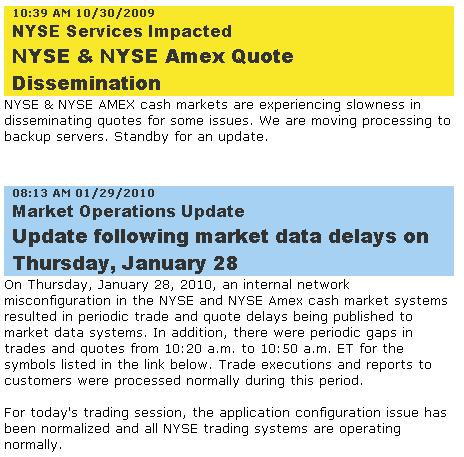
I’m leaving this as an open discussion because I’m working on some preliminary study for this topic as a potential masters thesis. Anyways, the reason why I ask this question is due to the two flash crashes in the last two years I’ve read about. The first happening in May of 2010 and the most recent one happening this July. I find the flash crashes troubling because in both instances it was due to the algorithms utilized to trade which caused them and not due to direct human intervention. For me, this made me realize that there was something missing from the use of algorithms and computers in trading: the ability to measure economic value of the goods traded.
It may seem trivial to some that one could easily assume if some good has a price, that it must have a constant economic value, but that isn’t true if one considers the fact that goods are always purchased/sold on the margins of the benefits in buying/selling them. And it is this particular issue of marginal utility that can’t be captured in a price. There are other ways to measure the good excluding its price. What this means for designing algorithms is that there is no easy way (or perhaps no way at all) to form non-arbitrary parameters from which we can create the algorithms themselves.
Algorithms in this context require a definite set of problems that are uniform in nature with an equally definite set of solutions to the problems which are also uniform. One cannot create an algorithm that gives solutions which are wrong (this contradicts the definition of an algorithm). Nor can one create an algorithm which has variable steps (they must be finite). Nor can the algorithm run for an indefinite amount of time (it must have some finite upper limit to its runtime). This means there’s two possibilities for the problems regarding high-frequency trading at present: the algorithms are not solving problems regarding the trading of goods (they’re arbitrary in their calculations) or they fail to capture the parameters of the trades they’re issuing (they’re incomplete in their calculations). In either case, I think there are terrible flaws in the use of computers in absence of human beings when it comes to trading goods (beyond automation of human issued trades).
The things I’m missing to make this a strong argument is a theoretical background from both economics and computer science (I have the latter down from researching effective methods and the Church-Turing thesis) and some empirical research to back up the theoretical background (I’m writing up some random scala programs to capture market data from firms known to regularly utilize HFT). If anyone here has any ideas where to look in terms of the economic theory for this, please post what you know or any good journal papers I can dig up at my university library. Thanks in advance.