Envisioning the future

I found this visually inspiring:
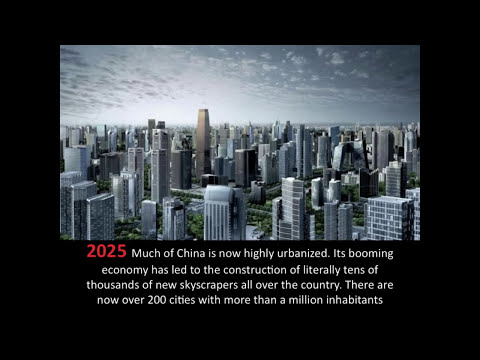
Content-wise, it’s only so-so… it takes extreme AGW as gospel truth and focuses primarily on technological progress and gets some of that wrong, too. But I thought it would make a good lead for my post.

Politics

The major political unions (EU, American Union and the Asiatic and African) will not fall apart per se but will face increasingly uphill going as responsible countries tire of bailing out irresponsible countries and as marginally irresponsible countries learn that it pays to be really irresponsible. Formal political unification will continue to elude the globalists.

Social

The West continues trying to export its social ideas (women’s rights, gay rights, abortion rights, children’s rights, etc. etc.) onto an increasingly deaf global audience. A global backlash sees non-Western countries returning to “traditional/conservative” ideas from their part of the world. This deafness is being driven primarily by the worldwide resentment towards the US/UN global military stance.

Military

The US military is an obvious fiscal target. Either there will be war in 2013 or the US military’s international footprint will be drastically scaled back. A general shift towards special forces continues to make regular armies and navies less and less relevant as the prospect of sweeping, territorial war - fought with the total economic output of nations - simply dwindles away.

Financial

Here, the Establishment will continue to make serious headway. Tax codes will continue to be unified and regularized with across-the-globe cooperation in catching “tax cheats” and shutting down “tax havens” continuing full force. Alternative currencies will continue to be subjugated by whatever means necessary as the dollar, Euro, Yen, etc. march into the future as the unified monies which are eventually supposed to bring about political union.

Privacy

Privacy will continue to decrease. The Establishment is absolutely on track to realize its dream of a global, fully digital financial system where the central financial authority has complete, instantaneous visibility of every transaction made anywhere in the world in any currency.

Drones, indiscriminate backscatter peeping, routine searches, etc. will only increase. There is little, if any, will in the general public to bring a halt to - or even slow - these developments.

Police

Police power will continue to gain ground in the short-run as the “diversification” of the United States continues to drive the desensitization in the US towards police brutality that is characteristic of the rest of the world. In the medium-run, this trend will abate and reverse (worldwide) as video-cellphones + Internet make “citizen journalism” documenting police brutality a new sport/challenge among young people all around the globe.

The drug war will continue to fracture at the seams as enforcement becomes increasingly militarized (the shock-front of militarization now being led by the war on terror) while popular support for stiff penalties for users and small-time dealers continues to weaken.

Medicine

New developments in regenerative medicine will make current, drug-based medicine as obsolete as the typerwriter after the invention of the Personal Computer. This will cause a massive shake-up in the nationalized health industries of the West as the drug giants find the rug pulled out from under their feet. The incubator-to-nursing-home model of bureaucratized health management will leave the old dinosaurs feeling exposed as individuals simply short-circuit the entire system by spending on gene therapy and regenerative procedures that permanently improve their quality of life without the use of drugs.

Technology

Computer technology will continue to improve rapidly with a shift from “office products” to mobile devices and personalization. In particular, flat-screens are going to give way to touch-screens just as CRTs (remember those?) gave way to flat-screens before them. This will fundamentally alter the graphical interface to the user (no more mouse). In addition, the keyboard is going to go away and highly-accurate voice-recognition software will directly take down dictation while a touch-screen keyboard will still be available for passwords or too-weird-to-pronounce words/names/symbols.

Biotech will continue to advance at an amazing pace. The shifts in regenerative medicine will turn out to be more disruptive in terms of their practical impact on human well-being than all advances since the Industrial Revolution combined.

Interest in space exploration will actually begin to dwindle as NASA and private space companies find, more and more, that space just doesn’t make any sense economically. This prediction is hugely controversial but I believe that the next 3-4 decades will bear me out. I’ll short your Ansari X-prize-based stocks in a heartbeat.

At some point, the Internet is going to shift from being “read-only” to being “read-write-and-execute”. There are some fundamental shifts that have to occur before this takes place, but my prediction is this is the long-run direction.

IP

The RIAA/MPAA will continue dreaming up new and more shocking schemes to “take over the Internet” and they will continue to fail. At some point, they’re going to ask the government to launch a “war on piracy” (or maybe they already have) but - unlike the war on drugs and war on terror - this one will be a complete flop and even the stupid American public won’t put up with it.

This trend will begin driving a fracture in the entire media complex as IP-based industries begin to find that formerly reliable IP-enforcement mechanisms (copyright, patent, even NDAAs) begin to be flaunted even by brick-and-mortar companies that can be sued. The “but everybody else is doing it” defense will be trotted out in court and will win sometimes and lose other times with the net effect being a general collapse in traditional IP industries.

Liberty/Free markets

Liberty will continue to grow - the growth markets will turn out to not be the US or the West but the formerly communist and up-and-coming ex-3rd world countries whose citizens have stopped listening to Western preachiness and start asking themselves whether hard work and individual freedom really aren’t the universal recipe to rapid economic success.

In the West, red-tape-fascism will only increase with no end in sight. Jaywalk-and-go-to-jail is the future here. This is one reason I think that translating liberty into languages other than English is crucial. There is no future for liberty in the English-speaking world, at least, not for a long time to come.

OK, that’s it, I’m done channeling my inner Celente.

Clayton -

the future will entail a bigger government and a second revolution of our time.

It is then that we may see liberty.

I desperately hope it can be bloodless this time around.

Clayton -

Worst-case scenario: World War III is launched and it ends with the extinction of Homo sapiens in a nuclear holocaust.

Best-case scenario: a successful liberty-minded political/social revolution takes place over the whole world.

Unfortunately, I think the worst-case scenario is more likely than the best-case scenario.

Idk, I prefer my analysis: things will be essentially the same for a long time. Some will be slightly better, some slightly worse. A new war here and there, but no major new global catastrophes unless the near and middle east surprise us with something drastic and the us and china take opposing sides.

The economy will be significantly better according to popular economic indicators in 2.5 years, inflation will be at 3.3% at that time, yet the housing market will not have rebounded very much.

A new, populist cause will arise in about 7-12 years for the left, and the right will continue drifting towards the left. The Ron Paul base, unless someone can harness it soon, will become tired and apathetic, perhaps laying dormant for someone principled to reawaken it in 15 years.

Enivornmental legislation will be pased but not anytime soon. In 5-7 years the government will continue more seriously restricting interactions with the environment and since all the regulations will be piecemeal and overseen by too many departments, they will create a heavier burden on business that will consolidate power into larger businesses. Eventually, possibly under the guise of increased efficiency, they will pass a larger bill gaining new power to regulate businss interaction with the environment. Maybe it will be a carbon tax, maybe tradeable pollution permits, maybe something related to the new populist cause mtioned above. In either case, expect a large new environmental bill at the latest in 15 - 20 years.

The Fed will continue to be controlled by loose monetary policy, though interparty bickering will always prevent “the necessary amount of deficit spending” as seen by Keynesian thinkers. Steve Keen will not have gained significant influence in the US.

Unions will not gain new powers. In 5-9 years they might even see even more decrease in membership.

I was going to suggest that 9-11 alarmism would have to be replaced by some new threat from abroad so that the government would be able to gain new powrs to snoop around, but 9-11 seems to very much still be on people’s minds, so they might hold off on that for another 6-11 years.

The government will maybe attempt to break up major telecommunications companies. I give it a 30% chance that they try. Google will continue to be a majorpowerhouse for at least 4-6 more years. I do not foresee my huge new competition against them. They would likely buy up any successful new technologies.

No major new changes in the politics of the music industry.

Th postal service will continue to hobble around for another 5-9 years, when they might finally realize their uselessness and be cut back by 20-40%. They might also get a revamped business model to offer some other related services. This could be in conjunction with the government beginning to offer Internet services to catch up to South Korea (unless private providers adequately bridge the gap themselves) - while this issue is merely mentioned now, some politicia could get it in his head that he could run a successful campaign off of this. A national high-speed rail project will be proposed 7-11 years from now. It might initially get rejected, but it would be taken up again 4 or 5 years later.

The UN will continue to be irrelevant.

The Greek crisis will turn into a prolonged recession. Top Euro countries will continue to do decently well. Eastern European countries will post moderate growth. The Arab Spring will simmer down. There will be no new developments in Africa lest some valuable new resources are discovered or some major philanthopic organization decides to work with some country to bring it a more stable free market.

Cina will continue to “grow” for another 7-13 years. If it implements more market reforms, they might continue for another 15-17 years. However, the miscalcuation and bubbles will come home to roost and there will be some major crisis in China.

Russia will remain Russia. For a long time. As in I don’t foresee any major change. Do a linear extrapolation of its past 5 years into the future for another 20-25 years.

Private companies will be making space more accessible, but don’t expect any major development until 5-8 years from now. After this, over a period of 10 years, there will be significant improvements in th field that will make going to spake much cheaper. Maybe a price reduction of about 20-30%. A country or two might, 9 - 14 years from now decide to start some exciting new space project. If successful, it will sadly restore faith in government and increase its power.

No flying cars anytime soon. Sorry.

Major discoveries in the treatment of AIDS 7-11 years from now. Major cancer breakthroughs 10-15 years from now. In the meantime, more bacteria become resistant. Maybe the government will grab more power not through a foreign threat as mentioned above but with a health scare - a virus which requires quaratines and mandatory vaccinations of adults. Yet this will not happen in the near future. Maybe 20-24 years from now.

Government overreach into healthcare will advance, but not without limit. We will not have a Canada style system. It will be just market-oriented enough to beble to blame inefficiencies of the free market.

Brazil’s growth will be slowed by more regulations.

Y’on crack?

I second Jargon’s inquiry. Pray tell, whence your inexplicable economic optimism??

Clayton -

Capitalism generally outpaces government. Except for hyperinflation and depressions, but in the long run it wins (for now).

Also, it seems like 2.5 years is enough time for GDP growth to pick up.

I would like to share your optimism but I do believe that capitalism is under a systematic, organized assault from a large section of the Establishment and that we entered the most organized phase of this assault after 9/11 and the housing collapse. Their object (world taxing authority) seems to have eluded them but I’m far from having a rosy outlook. Each time they’ve failed to bring about a world government, their answer has been to launch another global war.

Clayton -

Remember, central banking and the modern total warfare state reduced this:

To this:

But why? Why did this happen? There is actually a pattern to the destruction of Europe. The centers of middle class industrial growth were the hardest hit. This was by design. Remember the logic of total war? “We have to bomb the factories because that is where their bombers are being manufactured to bomb us.” Dresden, Warsaw, Hamburg, Cologne - these were thriving metropolitan centers of middle class growth and it was smashed by indiscriminate bombing and fire-bombing.

This tells me that it is actually these which are the greatest weapons of mass destruction ever devised:

The people who wield these weapons are “scorched earth” mentality - if they can’t own it, nobody can.

Clayton -

Just to clarify, you’re talking about organized religion and central banking, correct?

Terrafugia, anyone?

The Vatican and the Fed, specifically. They are part of a much larger network and there are copycat systems but these are the Michael Jordans of economic devastation and war. Of course, the killers in the “defense” industries of each respective nation do the actual dirty work of applying millions of tons of explosives to hapless innocents but such mass murder would not even be thinkable without the machinations and legitimizations of the drab men of the cloth and their buddies, the money changers. I guess I shouldn’t leave out the courts while we’re at it, but they’re virtual a department of the Vatican anyway.

Clayton -

Love the thread,

I’m highly pessimistic at this point about the future. But in terms of using it to guide my daily financial decisions, I’m struggling to make those changes.

Be that as it may, we all know that certain bubbles are forming in the system as the natural negative feedback loops (loan defaults at the private level) are prevented from having their natural effect, and those affects are amassed as sovereign debt.

But that’s not all, we have aging stressed infrastructure in the US (power grid, roads, airlines, oil->gasoline industry, etc.). We’ve built cities in locations where there’s little room for error. New Orleans gets flooded by a large scale hurricane. A drought could potentially destroy the cities in the Southwestern US (Desert Areas) and the Midwest, because there’s not enough naturally occuring water to meed demands.

Now these are just a few of the natural and technological systems that are under stress. Nevermind the social and economic stresses placed on us through various socialist initiatives. Drug War, Immigration issues, Welfare, Government run health care, etc.

Nassim Taleb, coined the term anti-fragility as the opposite of fragile. A fragile system is one where random disproportionate (improbable but not impossible) shocks to the system, called Black Swans, have a destructive effect. A robust system, is one in which these same events have little or no effect on the system. An anti-fragile system is one in which these same events have a positive effect on the system.

Now in nature and life, we have a lot of examples of anti-fragile systems. But in our socio-economic institutions we’ve created an enourmous amount of fragility because we focus on the normal behavior of the systems, without adequately appreciating the improbable but possible large shocks. Hurricane Katrina is one of those. The current Drought in the midwest might be one of those.

In addition to this idea, he pointed out something else, about the sheer impossibility of predicting (with any significant level of specificity) the future. Partly because of these Black Swans. But even more so, the sheer volume of data necessary to predict out into the future grows exponentially as you move farther and farther forward.

So, we may be able to predict for example, that the sovereign debt bubble will burst, but how and just how severe it will be remains to be seen. When it happens and how it cascades is unknown. The other huge unknown is how rapidly we will adjust and adapt to those changes.

Here are some things to think about.

How rapidly can we put an alternative currency in place (non-government based) when the dollar hyper-inflates?

If we have a cascading power failure in the US/Canada East Coast, how long would it take to bring everything back online? How quickly will we run out of food and water?

What happens if the GPS system goes down due to the enormous sunspot activity coming out of the Sun over the next 1.5-2 years?

What happens if the drought raises the cost of bread/grain/corn/meat prices substantially this fall?

There is so much so fragile in our system right now. We don’t have enough redundancy in the underlying tech/processes currently in place for power, food, finances, communications. And on top of it, we’ve created enormous bureaucratic red tape, that makes it hard for private individuals and companies to rapidly adapt to them.

Why am I pessimistic? Cause all of our socio-economic macro systems are setup upside down, they’re all fragile, so fragile they’ll not just break, they’ll shatter.

Why am I optimistic? Because at the fundamental level, we all know and understand the basic mechanics of freedom and austrian economics (praxeology) because they’re built into us. At the micro-level, we’re fundamentally (biologically) anti-fragile. Stresses (within tolerances) cause us to get stronger, healthier, etc. In our knowledge, logic and small-scale social interactions the same is true (for the majority of us, but not all). The stresses we encounter in our local environment encourage adaptation and cooperation.

So, what’s going to happen? We can’t predict the weather 6 hours from now, with much certainty. I’ve watched six hour radar maps every summer for the past 3 years whenever we expected afternoon thunderstorms locally. We have no clue what the future holds.

The only thing we can do, is try to build some level of resilience (anti-fragility) into our personal lives (micro) and continue to educate and advocate reductions in government which will allow the naturally anti-fragile market to continue to generate more and more anti-fragile solutions to our larger scale risks.

In the end, we’re all on the Titanic. I don’t know what you’re doing, but I need to quit playing shuffleboard and get back to my cabin and build that life-raft for my family of 4 out of the curtains and my mattress… Why didn’t I purchase a suite?!

Clayton,

Why do you think that organized religion has any real power in the modern age? Central banks, most likely, or at least they’re tools used in this war, but why religion except in how it directly relates to the state?

But where is any to be found? In the US, home of the command-corporate economy?

Exactly. Have you not noticed the central bank balance sheet expansion and the total reliance of stock markets on credit flows? I don’t understand how you are an enthusiast of austrian economics yet somehow think we are out of the woods for immediate future.

Maybe there are numbers out there suggesting growth. With all the credit creation used to sustain things it might not be surprising, though the Fed is quickly being backed into a corner by a faltering stock market. Then again, record numbers of BLS statistics and otherwise are being revised at record numbers. Example, courtesy of Zerohedge.

Where is Wheylous and what have you done with him? “Getting away with it” is not in the cards for us or the bankers.

LOLing @ the Vatican vilification. I didn’t know Dan Browne posted here.

Glad you asked. I’m coming to the view that religion (whether organized or otherwise) is actually the single most powerful attribute of the social order and this is why religion is the first thing that is monopolized by the State. Religion - considered as a complex of ideas/beliefs/attitudes - is the “cosmology” that ties everything else together. It is at once the memetic metabolism of the mind as well as the memetic immune system. It determines what gets believed and, just as important, what never even gets a hearing.

Of course, I don’t need to explain the role of monopolized religion in baptizing the murder of the State.

The power of religion is as real today as it ever was. What has changed is the stance of the State with respect to its need for religion. Namely, with the advent of the “secular/englightened” era, the State supposes that it no longer needs to monopolize religion and can, instead, subsist on its own manufactured moral legitimacy. The total state is attempting to monopolize everything else rather than simply monopolizing religion, law and the military as in the olden days. This is the Egyptian model of government.

Every feature of the social order is a reflection of some feature of the human being (most notably, the brain). We have cars because we can’t run at 60 mph but our brains and hands can devise mechanisms (cars) that can. We have books because our brains can only hold a limited amount of symbolic information, while our hands (again) are capable of scrawling marks that “extend the memory” into inanimate objects. And so on. Religion, like any other feature of the social order, is a reflection of human nature. These features will never go away no matter how “enlightened” etc. we become. In the power struggle between our sacred and secular rulers that has been raging since at least the time of Martin Luther, the secular powers seem to have gotten the upper hand but - in the long run - they are destined to lose. The Vatican understands this and they can wait for as long as it takes for things to come around to their natural order.

In the meantime, we are being subverted by concocted religious bullshit. This is “made-up religion” - democracy is man’s new Savior, the world’s problems are the result of a deficiency of charitable donation, the State does not lie and has your best interests at heart, etc. In times past, people were extremely skeptical of made-up religion precisely because they understood that human nature is basically a constant - at least within the span of a human lifetime. But we have allowed the focus of our religious cosmology to be shifted away from the human being as the end of all cosmological study to the Universe instead. I believe this shift was made possible by the obsession of monotheists with the Absolute.

Combined with the advent of the Industrial Revolution and the truly remarkable strides that we have made in locomotive and informational technologies, this shift has resulted in a transformation of the memetic landscape with profound effects on the individual human being. This is most notable in the AGW debate - people are concerned about “the Earth” - not even as a vehicle of human life but for the Earth’s sake. We need to save Earth for the Earth’s sake. Try going back 500 or 600 years in time and explaining this to a medieval merchant in downtown Florence. In this contrast, you can see how the memetic structure for collectivism has been constructed piecewise - mostly haphazardly - over centuries to the point that it has deeply subverted human nature on such basic points as survival, use/alteration of the environment, and so on.

This goes back to my views on The Big Lie. The corrupt religion-mongers (not all within any religion are corrupt) have been very cynical in their application of The Big Lie to advance their interests and the interests of their religious organizations. When you look at the history of Christianity, you see it is filled to the brim with forgeries, redactions, intentional mistranslation, copy/paste errors, and historical whoppers of the grandest magnitude - children’s fairy tales, cultural myths passed off as literal, historical events. Yet all delivered with a straight face and don’t forget that God is watching you when the offering plate passes by. The secular powers have always been propagandists but theirs has always been of the more tactical variety - “we invaded Ruritania to prevent the evil mongrel horde of bloodthirsty Ruritanians from invading our Fatherland, burning our villages, raping our women, etc. etc.” Lately, the secular rulers have seized on The Big Lie as their own modus operandi. The idea is that - by wielding The Big Lie themselves - they no longer have any need to share power with the sacred rulers. It’s working so far.

Clayton -

I don’t get the joke -

Austrians have predicted hyperinflation for a while now without anything to show for it.