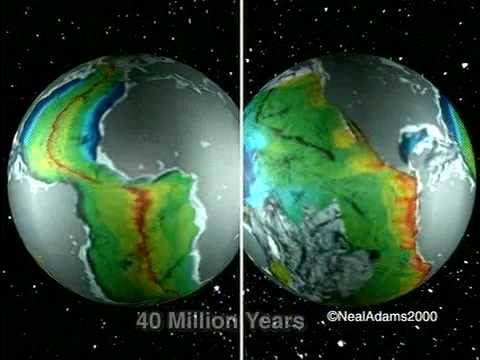
This theory is about the origin of the planet. This is completely unrelated to economics but I thought you might find it interesting. Neal adams read a book about the theory and he has sinced made a few videos about the information.
I’ve heard it before. Form my amateurish point of view, I don’t see how it can hold much water. For one, could the solar system have retained its balance with all of the planets constantly growing? I doubt it.
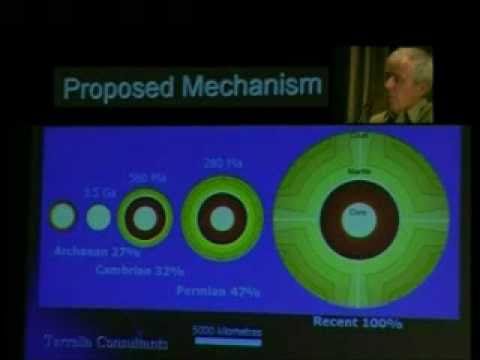
There are different theories about the mass gain aspect. The one i thought makes the most sense was a form of photosynthesis. The same type of mechanisms that cause a tree to gain mass, cause the entire planet to gain mass. The suns energy gets transferred in to more matter by a process unknown to us within the earth. But Neal Adams thinks that there is a plasma layer near the core. But he also says that matter does not exist, that gravity does not exist. He thinks that it is just em and electrons are being drawn to the em and this is what causes gravity and the appearance of matter. But i am not too in to the physics of it. I just find the geological aspect quite interesting. Some other theories are that it is getting less dense or “air pockets” are forming within the earth.
But I also heard that before tectonic plates/continental drift theory become mainstream and accepted, growing or expanding earth hypothesis was the most widely accepted theory. But i can not be sure of that.
The plasma cosmology guys suggest that there are constantly plasma flows into the Earth (and other planets and the Sun, etc.) from space. Plasma is matter, so that would mean a constant influx of new matter into the Earth. Adams seems to get really fuzzy on the particle-physics stuff.
I have also held reservations myself about the positron asymmetry. It seems to me like we’re generalizing from our tiny bubble in the Universe (we see lots of electrons around us but not lots of positrons, therefore the Universe is filled with electrons but not positrons) and I’m inclined to believe that positrons and electrons must exist in equal numbers in the Universe until I see reason why I should believe otherwise.
I think that gravity may be a figment of our imagination. Gravity is currently a purely phenomenological force, that is, we see its effects but we really do not know what it is. It’s like a “gravity-of-the-gaps”. Gravity exists wherever we cannot otherwise explain the motion of particles or other objects. Gravity is Gm1m2/r^2 because we see that an object of mass m1 and an object of mass m2 at a distance of r^2 revolve about each other in an elliptical equation described by G/r^2 * m1*m2. That’s a purely phenomenological theory, it has no causal component to it. That doesn’t make it a bad theory, it just makes it a very tentative theory.
At every step in the history of science, the Universe has turned out to be stranger than it was even possible to imagine within the confines of mainstream orthodoxy. The fact that you cannot fit a growing Earth into current scientific orthodoxy doesn’t really mean anything to me. That doesn’t mean every crackpot theory is right but it does mean that every right theory originally appears to be crackpottery. If Adams is right that you can shrink the Earth and it is that good of a fit, then it’s basically a no-brainer to say that the Earth has grown. What implications that has for the careers of established Ph.D’s with tenure at major universities is of no interest to me.
I’m also pretty much in the plasma cosmology camp. To me, these two theories seem to be a potentially good fit. In plasma cosmology, the planets are electrically connected to their stars; stars are electrically connected to each other and the cores of their galaxies; galaxies are electrically connected to each other as clusters, and so on. Plasma is the medium which carries the electric charge between the heavenly bodies and plasma is matter - it has mass. Hence, charge exchange implies mass exchange. No need to try to reform particle physics beyond noting that the role of gravity in particle physics should be held suspect since gravity originates in the “cold, dead universe” of Newtonian mechanics.
But I also heard that before techtonic plates theory become mainstream and accepted, growing or exapnding earth hypothesis was the most widely accepted theory. But i can not be sure of that.
Before plate tectonics came around, there were numerous theories that attempted to explain what was observed in the geologic record. When the theory was finally vindicated, it was rapidly accepted across pretty much the entire field of geology, because it was so obviously right, and explained observed phenomena with supporting historical evidence.
The preceeding theories all remind me of the old ideas of how the planets might move in a geocentric system. Epicycles and whatnot. When the truth was finally realized, the system instantly became more predictive, and much more elegant:
Adams’ particle physics is pretty obviously bullshit. He should stick to the geology. He hand-waves on how the positron “subtly attracts” these prime-matter particles and sticking them together by fiat is just a violation of the 2nd law of thermodynamics (things don’t clump together for no reason).
Plasma, on the other hand, behaves very much like like these supposed prime-matter particles. It is electrically neutral but it contains equal amounts of both positive and negative ions which can be separated in the presence of an EM field thereby becoming separate, charged plasmas which then exert their own EM fields. That doesn’t help us with particle physics because plasma is just made of conventional particles and cannot, therefore, explain those particles. However, since the question at hand (growing Earth) does not concern particles themselves but how a large body made of conventional particles (planet) can grow over time, we do not need to invent exotic theories of particle physics to answer that question. The Earth has a charge and attracts plasma of the opposite charge from space. The Earth, as a matter of fact, experiences continual inflows of plasma from space (visible in the Aurora Borealis).
The universe is infinitely old, there was no Big Bang.
We can only see a tiny portion of the universe. We do not know its extents. It may be infinite in size.
The particle view of physics is a misleading anthropomorphism resulting from looking at macroscopic objects which appear to be massy, solid and, as they are divided smaller and smaller, point-like. Speaking of something as a “particle” should be understood as simply a way to think of the behavior of the physical world in a very tiny region of space.
At its most fundamental level, the Universe is not amenable to particle or wave analogies which accounts for the difficulty of comprehending wave-particle duality of quantum particles. A wave requires a medium but at the most fundamental level - the stuff that everything is made of - you cannot appeal to a medium since the medium itself would have to be made of something else.
We should speak of the Universe at scales which we can observe but not envision as law-like. The boundary of the physical universe in the small is the exhaustion of law-like behavior. That is, when we can no longer distinguish the outcome of physical experiments from randomness, we have reached the apparent boundary of the physical universe in the small (I believe this is the so-called “quantum foam” or “quantum randomness”).
Coincidental relations between mathematics and physics should be a red flag that something very fundamental is happening. It is a mistake to say that “the Universe is Number” as the Pythagoreans did. However, the behavior of the Universe is, in many instances, indistinguishable from that of a mathematical object (for example, the relationship between gauge theory and the Standard Model). If no further complexity can be found in the behavior of the Universe, then we are justified in treating it as if it were Number.
I am in disagreement with scientific orthodoxy on almost every single one of these points.
I’ve been studying Pythagorean philosophy for awhile. Sound (Harmonic vibrations) is what pushes matter together. Empty space is where the vibrations are strongest. and it pushes matter together into specfic areas. So planets, Earth, are the result of very specific harmonies that harmonize AS the pattern of our solar system. And to think of the kind of harmonies that Iwhatever needs to be producing to make the universe assemble the way it does is incredible. The pythagoreans, i believe, had the saying “The universe was sung into existence.”
Everything totally is number. Specific ones too and the derivations of it. Pythagoras ,and many, many other antiquity based mystery religions, had about as close of knowledge of the true nature of reality than anyone ever has.
Without sound and vibration existence is relegated to just the x axis. Unperceiveable One tone gives us 2 dimensions and harmonies bring us the third dimension.
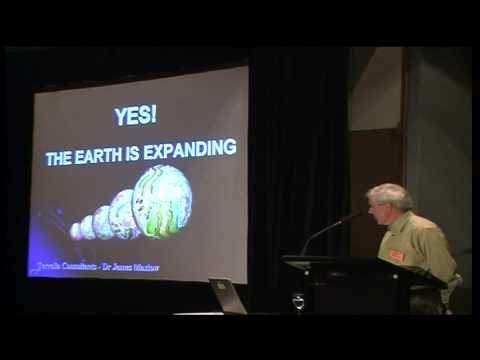
2:54-4:02 in James Mazlow’s speech is very helpful for saving time that could have been wasted watching the rest. He’ll save the part where he explains his notion until after an exercise in trying to fit “coincidences” to it. Most hacks make you wait longer to catch them.
Leedskalnin contended that current EM theory is a bit off base and outlines some simple experiments to illustrate his theory of positive and negative unipole magnets as the base of matter.