How Do Austrians Explain the Post-WW2 Economy?

Hi all,

I was wondering, have any Austrian economists done any work on trying to explain why there wasn’t a crash after WW2? If you think about it, all the building blocks are there for a second Great Depression. First, during the War, the Federal Reserve increased the monetary base on such scale that it made look like they were asleep during the 1920s (when expansionary monetary policy supposedly set the stage for the first Great Depression).
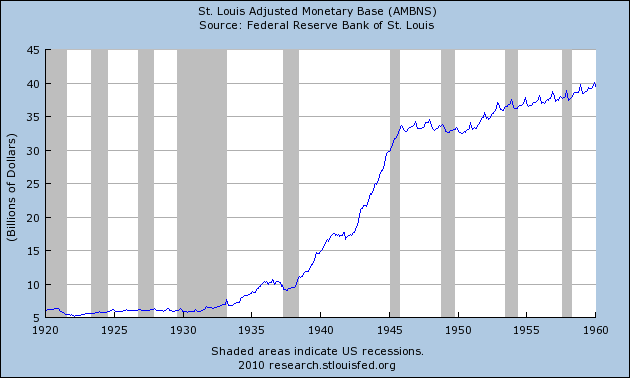
Second, the Federal Reserve went beyond manipulating the money supply and used coercion to directly alter the capital structure of the economy. New factories were built for the express purpose of building fighter planes and munitions. Old factories that once produced consumer goods were converted to producing supplies and equipment for a fighting army.

And of course, let’s not forget about the men who could have learning/refining skills and getting job experience that instead were off fighting the enemy. Those that didn’t come back maimed or dead came back with 4 years of their lives wasted on destruction.

So why, after all this, did the economy not fall into a Second Great Depression in the late 1940s after the war had ended and a capital structure altered to support a war effort had to suddenly support a civilian economy? Certainly, there was a brief recession immediately after the war, but compared to the 1930s it was a cake walk.

This is hard for me to understand. Monetary expansion in the 1920s supposedly distorted the capital structure so much that the economy crashed and unemployment rose to the double digits. But, then, an even greater monetary expansion and government coercion in the 1940s distorts the capital structure so much that the economy unemployment moves to the single digits after demobilization??

Not to say things in the post-WW2 era were perfect, but there is a suspicious lack of a monumental economic crash here.

I tried googling but couldn’t find any articles on the subject from an Austrian perspective (may have been the search strings I was using). So if anyone could point me to some sources, I would greatly appreciate it.
There was a massive liquidation of government spending after the end of the war, which freed up a lot of capital for other production. Since the labor unions had been liquidated during the war to release manpower for the army, there was no obstacle to a very sudden and rapid recovery of all industries.

And that’s what happened. There was a sudden depression, but it was too short to notice.

But I thought Austrians stressed that capital was heterogeneous. Just because the government isn’t using this factory for bombs anymore doesn’t mean an entrepreneur could easily use it to make cars or that entrepreneurs would have any use for it all.

Indeed, I thought the fact that you can’t easily convert capital from one use to another was the main reason recovery so difficult in the 1930s with labor unions being at most a secondary reason.

It seems to me the problems of a misaligned capital structure would be more exaggerated here than they were in the 1920s, so I don’t see why the war wasn’t followed by a Second Great Depression.

You can’t easily convert it to automobile production without additional investment, which is why capital liquidation is essential. This did not happen in the 1930’s.

Tom Woods on the topic:

Article he mentions “The great depression of 1946”

I think your faulty line of reasoning is right here in the question.

The former economies of the former Soviet Union and the Eastern block had practically no boom/bust cycles either, thus, some people wrongly concluded that they enjoyed greater economic stability.

The solution to your problem is the same as for the former socialist economies. They were already in a permanent stage of a slump due to the controlled economy. There were no entrepreneur**s to make the mistakes caused by artificial low interest rates. There were no entrepreneurs at all that could invest the capital in accordance to the needs of the consumers. There was no boom/bust precisely because they were in a permanent slump that they could never recover from.

A similar situation occurred during WWII. The economy was already in misalignment due to the heavily controlled economy during the war. What more, the US has not even recovered from the great depression. The economy was already in a slump. The new money went to finance the war and all those industries that supported the war. That is, by definition, a misalignment of the structure of production from what the free market would have dictated if not for government spending. Once the war was over, all of these misalignments were in fact corrected.

DD5,

I was not aware that lending to private businesses was suspended during world war 2. You quite likely are right, but do you have any sources to verify that?

Anyways, even if that is the case, then we are still left with the government making malinvestments. It built factories, bases, many things that simply were not needed after the war ended. And if there were no private loans, who was replacing non-war related capital that existed before 1941.

And I don’t think your post answers the question of why correcting these malinvestments didn’t cause a PROLOGNED recession as unneeded capital sat idle like it did in the 1930s. How did the economy in the late 1940s do such a good job of shedding bad capital and transitioning to a more appropriate capital structure?

It did cause a recession, a very severe one. However, it was so short-lived that anyone hardly noticed.

Maybe you should consider reading Robert Higgs, according to him from the end of WWII to 1946 “the largest single-year drop of income in American History.” Here is a video as well.

Sorry, you must have caught me mid-edit. I am asking why it didn’t cause a prolonged recession like it did in the 1930s. The fact that it was short-lived (especially compared to the Great Depression) is what is so amazing.

Giant Joe, I skimmed the article (I am at work so can’t fully read it until tonight), but it looks like he focuses exclusively on the drop in measured GDPwhen he is describing how “great” the recession if 1946 was (and even then he notes the decline was smaller than it was in the Great Depression). However, GDP is a single number that aggregates away much information (maybe the drop in GDP has more to do with government spending taking a dive during demobilization than it does with falling private output), so that shouldn’t be the only metric for a recession.

If you look at unemployment, Tom Wood’s reports that unemployment after the war was in the low single digits. However, during the great depression, it rose to almost 20%. This seems like an interesting point and a VERY interesting contrast.

But like I said, I only skimmed the article and I will look more tonight. So I will shut my trap until I do that. :slight_smile:

The “prolonged” recession is always the result of government policy that delays the corrections. It was precisely the absent of such policies at the end of the war that made the transition much smoother and quicker. It was pointed out above by Angurse, in reference to the Higgs article,about the sharp drop in wages after the war. The fact that unemployment didn’t also soar was precisely because wages were allowed to drop.

It’s really not that extraordinary. After the war there was no organized political constituency that could lobby for protectionism, as everything had been subjected to the wartime government. The government was thus able to drop all price controls as it slashed government spending. Demobilized soldiers returned home and lived off their savings for a few months while the industries retooled for peacetime production.

DD5,

This is my last post then I gotta get to work. lol

I am not sure what you are describing is actually essential to ABCT. If you read Roger Garrison for example he can explain ABCT without any mention of wage flexibility. In his description, it is the misalignment of capital resources and the fact that those resources cannot be realigned easily that make the recession prolonged.

For example, many people on this board describe the current recession using ABCT. Butwhat government policies are preventing wages from falling now? If you’re going to say unions, you should really reconsider. If you look at the sectors experiencing the most unemployment they are not ones dominated by unions. How many unions are there for financial analysts for example? investment bankers? residential construction workers? architects?

Anyways, i gotta run! BBL

Government policies are preventing capital market liquidation right now, as well as increasing government labor employment.

Minimum wage laws.

Since companies have a much tougher time lowering an employees wage, due to government regulations such as minimum wage laws, the employee is laid off instead.

Giant Joe,

Well, I finally read Vedder and Gallaway’s article and I don’t think it directly answers my quesiton. And on more careful viewing it looks like I misread the article when I first skimmed it. Thankfully, on page 5 the authors state that they conclude that were “NO depression in 1946 nor anything resembling one” and that aggregate data need to be viewed with a skeptical eye (that means you guys quoting stats on GNP dropping as evidence of a depression during this period, you need to read this article). I’m in total agreement with them there and this matches the points I was making earlier.
http://mises.org/journals/rae/pdf/R52_1.pdf

But then I still wonder why the transition from war economy to consumer economy went so smoothly. It looks like they use similar arguments to DD5 and jmorris that labor market were allowed to function. I simply don’t see how an Austrian could think that was the whole story.

  1. Theoretically, there is nothing here mainstream economists would disagree with. If real wages are set above equilibrium in a competitive labor market, then unemployment will result. If real wages are allowed to fall, then unemployment will decrease. There is probably a discussion of this is in every micro and most macro textbooks. The only qualm some mainstream economists may have is whether this story matches our empirical understanding of the period (after all there were still minimum wage laws in place for example, something jmorris thinks is a roadblock to recovery, but apparently not in 1946). And even then, there will be some economists that think the authors are exactly right. Robert Lucas for example would probably find much to agree with here. This isn’t Austrian, this is the University of Chicago.

  2. This article says nothing about World War 2’s impact on the capital structure. Like I’ve been saying, rather than investing in capital for making products people want the government invested in munitions no one wanted when the war was over. Just because the fighting stopped doesn’t mean we can turn fighter plane factories into car factories in a day. Like Roger Garrison has said time and time, this restructuring process takes time.
    http://www.auburn.edu/~garriro/mainstreammacro.pdf

During the Great Depression, the process took YEARS and resulted in a severe economic recession. Why did it only take months in 1946??? Stranger says there are impediments to liquidation today that apparently didn’t exist in the later 1940s. Like what? Specifics would be great.

This seems like a very interesting question and an important data point to explain. If anyone can find any other articles I would be most appreciative (peer reviewed articles are best please, videos are great but papers are easier for me to get through and I like having an authors list of references on hand).

Actually what is really absurd is to think that millions of people deciding to stop killing and bombing each other and destroy a huge amount of property would start a recession…

I don’t think that is really it at all. I believe the OP is just wondering why there wasn’t an obvious downturn in the economy because during WW2, the economy was heavily reliant on 1 thing and when that came to an end and the economy began to restructure, there wasn’t some sort of downturn during the restructuring stage. Although I haven’t read the articles posted in this thread yet, I believe someone already explained that there actually was a downturn but it was so fast that it was unnoticeable. I believe this is possible if the government doesn’t do anything to prevent that correction from quickly happening.

Edit - I just want to note that I’m not very sure exactly what happened during this period of time, only that I think you misunderstood the OPs question.

The answer to this is quite simple. After the war and the recession of 46-47 (quite dramatic), capital was reallocated towards actual warranted economic activities and the influx of labor allowed for robust economic growth (savings rates were high as well). High taxes cut deficits and limited the crowding out effect (Austrians support taxes over inflationary financing). This is what happens when you allow the market to correct itself (see depression of 1920). The new deal turned what should have been a quick and orderly restructuring process into a 14 year depression with unemployment above 14% (in some years it was much higher, as I’m sure you know), but many malinvestments were eventually liquidated.

Also, just to be clear, monetary expansion during the 20s was quite dramatic, as the U.S tried to create a perpetual boom, and arbitrarily prop up the Pound.

The post world war two era is defined as a period of Keynesian inflationism which artificially and continuously lengthened the structure of production. Productivity gains concealed much of the price inflation, but the capital misallocations and disproportionalities grew from year to year. Mises and Hayek both warned about such policies, but by this period they weren’t taken seriously. They of course attacked the logic behind the Philips curve, warned of inflation, and Mises actually predicted (as well as Rothbard) Nixon’s price and wage controls. Of course, the Keynesian’s were in trouble as early as 1963. They continuously delayed the necessary correction until their inflationist policies became utterly sterile (stagflation crises). Paul Volcker raised interest rates, forced the necessary correction/liquidation, and the economy recovered (lead to a robust boom). Unfortunately, the FED continued to suppress market rates blowing bubbles (especially true in the 90s), and the government continued to act belligerently.

Did Austrian economists predict a great depression after WW2? I thought that was only the Keynesian mainstream.