This film won the Oscar for documentary category.
It is now available to view online.
Have started watching it and so far it is all vague blaming of “deregulation,” “privitization,” and “derivatives”
Enjoy!
This film won the Oscar for documentary category.
It is now available to view online.
Have started watching it and so far it is all vague blaming of “deregulation,” “privitization,” and “derivatives”
Enjoy!
Tucker pointed out how the movie is crap on the blog http://blog.mises.org/16038/inside-job-a-look-at-the-heart-of-the-left/
I literally just talked about this with a friend a few hours ago. I haven’t seen it and she knows little about economics, but I told her that based on what I know about Matt Damon I would assume at best the film is half right…in that there is blame placed on large corporations with too much power, but that like Mikey Moore and his Capitalism fauxumentary this film probably stops there, basically trying to say corporations are to blame and calling corporatism “capitalism.”
But she assured me there was plenty of government blame laid out…
So thanks for the link…I had been meaning to see it. Now I can get back to her with some feedback.
:EDIT:
Forgot to mention, if anyone needs a decent film about the recent meltdown to send people to, Overdose: The Next Financial Crisis is possibly the best I’ve seen. It’s based on Johan Norberg’s book Financial Fiasco and includes interviews with Peter Schiff, Gerald Celente, Vernon Smith, and even a former chief economist for Freddie Mac saying the regulatory structure was “spotty”. It introduces the concept of low interest rates created by the Federal Reserve creating booms and uses the analogy of spiking a punch bowl at a party. It’s here on YouTube in its entirety…
I finished watching it. It was so bad I had to watch it in bits and pieces. It is essentially a mixture of strawman arguments, vague innuendo, and narrative fallacy. About the only thing the film does well is show the connection between Ivy League academia, wall street banks, and the government.
I’m watching it right now. Every other word by the narrator is “deregulation.”
A movie about “deregulation” and narrated by Matt Damon = Oscar.
John,
Meltup is better. Features Tom Woods and Peter Schiff, and not a government bureaucrat who pretends he’s on the side of good. (it does feature Celente who is far from an Austrian, but the bad stuff he says is relatively contained)
I had to take a break (I had some stuff to do).
I’m 1:11:00 into it, but how could the producers not have had included Ron Paul in the documentary? They had Barney Frank and George Soros, but no Ron Paul and Jim Rogers?
So far, this movie is simply and Democratic party bit against Republicans. Why is it that only the Republicans got the hardball questions?
Also, how was the lawyer for Lehman Borthers allowed to give the information he gave?
As Jeff Tucker said, this documentary is s missed opportunity.
I forgot to add: “Deregulation! Deregulation! Deregulation! 9/11! Deregulation! Deregulation!”
It’s not really a missed opportunity, it set out to do exactly what it accomplished.
I don’t understand how the U.S. could ever pay off its debt no matter what the size of it since the only money in the system is that which has been created by the people the money is owed to. I don’t understand how any taxation can accomplish paying the debt. It’s a huge scam in my opinion in order to control the masses. That’s what I think anyways.
“But she assured me there was plenty of government blame laid out…” - John James
In my experience, and I think it’s born out by this movie, when people ‘blame’ the government it’s usually along the lines of ‘the government didn’t do enough…’, or, ‘The wrong people were in charge…’
So it appears the film has been taken down, so I had to find anoTher Place to Be able to view it. 
Anyway, I just jotted my thoughts right after:
It was about what I expected. “Look at all this money these guys made. blah blah blah” As usual, the story is started in the middle…no mention is made of where all that borrowed money came from, why all these people felt safe in taking such risks, or how these institutions got so big and dangerous in the first place.
No mention of any specific piece of “deregulation” was made, despite the fact that that basically could have been the title of the movie. They have the audacity to have people like Barney Frank on there talking about responsibility and keeping a watchful eye…most of his interview was used to comment on how people like Greenspan refused to utilize regulatory power the way someone else thought he should…when it was Frank himself who was the leading proponent against regulation of Fannie Mae and Freddie Mac. Frank spoke many many times saying those government sponsored institutions were completely sound, and there regulating them would hurt the economy. He received plenty of money from them too.
And the entire film is more or less made up of stuff like that. Writer/Director Charles Ferguson used whatever testimony and facts helped to reinforce his worldview, and completely ignored the aspects of reality that contradict it. The only “blame” or “finger pointing” (if you can even call it that) that was directed at the government was more or less “You didn’t do enough. You should have regulated more.” He completely ignores the fact that it was government regulation that allowed and promoted the whole thing in the first place. And of course he can’t admit that, because that ruins his whole “business is bad, we need more government” tirade.
And you had to love the way they threw in infidelity and promiscuity and drug use, just in case money doesn’t offend you enough. And you have to respect the brilliant way they were able to get Spitzer commenting on that very subject…and even manage to turn him into a victim. That takes cunning.
And if his worldview wasn’t made clear enough throughout the film, he removes any question by the time the final part titled “Where we are now”…where he goes into Michael Moore mode spewing false facts and utterly misleading comments to promote his populist egalitarianism.
For example he claims that “American tax policy shifted to favor the wealthy”. He claimed the Bush administration “eliminated the estate tax.” (Complete distortion of the truth of course, as it only dropped to zero for a single year when the law sunset)…and if you really get down to it, according the law Bush signed, the estate tax was supposed to jump back up to to 2002 exemption level with a 2001 top rate (of 55%)…but Obama changed all that and cut the estate tax rate down to 35%, and raised the exemption level by a factor of 5. So technically, Obama prevented the Bush administration from raising the estate tax. I wonder if Mr. Ferguson would have mentioned that in his script if it had happened before the film came out.)
I doubt it, because his whole implication is that letting people keep more of their own money is a bad thing, and that somehow everyone is better off if the government has more of the people’s money.
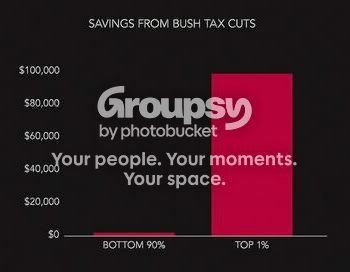
And in one of the most dishonest displays I’ve ever seen, he actually puts up this chart:
And Matt Damon says “most of the benefits of these tax cuts went to the wealthiest 1% of Americans.” (Which is another irony I couldn’t seem to get passed, hearing an asswipe who makes 8 figures per movie talking about wealthy Americans as if they’re the scum of the Earth.)
But gee…The people who pay the most in taxes saw the most savings when tax rates were cut. So you mean if I pay $1 million in taxes, and tax rates go down 10%, I actually get to keep $100k more of my money that I earned…and the guy who pays $0 in taxes…he doesn’t save anything? What the hell. Yeah I see what he’s getting at. That’s fucked up. If you virtually don’t pay any taxes already and rates go down, you should actually get money. That’s only fair. Oh wait…They did.
Yes. The bottom 40% of “income tax payers” didn’t pay any income tax starting as early as 2002…thanks to those “only for the rich” Bush tax cuts. In fact, not only did they not pay any income tax, they got checks from the government.
That’s right:
As a result of the 2001 tax cuts enacted by a bipartisan Congress and signed by President George W. Bush, the share of taxes paid by the top 10% increased to 72.8% in 2005 from 67.8% in 2001, according to the latest data from the Congressional Budget Office (CBO).
Contrary to the myth that Mr. Bush cut taxes only for the wealthy, the 2001 tax cut reduced taxes for every income-tax payer in the country. He reduced the bottom tax rate to 10% from 15% and increased the refundable child tax credit to $1,000 from $500 per child, both cuts that President Barack Obama says we should keep. In so doing, millions of lower income taxpayers were removed from the tax rolls, shifting the remaining burden to those at the top, even after their taxes were cut.
According to the CBO, those who made less than $44,300 in 2001 – 60% of the country – paid a paltry 3.3% of all income taxes. By 2005, almost all of them were excused from paying any income tax. They paid less than 1% of the income tax burden. Their share shrank even when taking into account the payroll tax. In 2001, the bottom 60% paid 16.3% of all taxes; by 2005 their share was down to 14.3%. All the while, this large group of voters made 25.8% of the nation’s income.
When you make almost 26% of the income and you pay only 0.6% of the income tax, that’s a good deal, courtesy of those who do pay income taxes. For the bottom 40%, the redistribution deal is even better. In 2001, these 43 million Americans, who earn less than $30,500, made 13.5% of the nation’s income but paid no income tax. Instead, they received checks from their taxpaying neighbors worth $16.3 billion. By 2005, those checks totaled $33.3 billion. [More than double].
-Wall Street Journal, APRIL 13, 2009
So let’s recap…thanks to the “only-for-the-rich Bush tax cuts”, not only does almost 60% of the country pay zero income tax, the bottom 40% actually gets money every the rest of the country pays taxes. Yeah. That Bush is really a shill for the rich isn’t he.
And then of course the film concludes with a nonsense summary that sounds like it came right out of Newsweek:
“For decades the American financial system was stable and safe. But then something changed. The financial industry turned its back on society, corrupted our political system and plunged the world economy into crisis. At enormous cost, we’ve avoided disaster and are recovering.”
Heaven help us.

…which of course I ended up finding out was pretty much the case.
I didn’t realize Tucker’s review was only a couple weeks old (thanks for sharing, GooPC). In the comments a blogger linked to their review as well. Both are quite good.
That’s weird. It got taken down from archive.org too.
This.
I think he actually believes that business cycle didn’t exist until the 1980s. Lol.
Anyone else find it ironic that the producers of this film are having it taken down wherever it can be viewed for free?
Uh…not really. It’s a Hollywood film demonizing Wall Street. It’s not like it was promoting the repeal of IP laws.
Meltup is a good film, but I don’t know what you’re talking about. It does a good job outlining the current situation and what’s coming, but it says virtually nothing about how we got here. (And there’s only a single 10 second clip from Woods.) Inflation.us’s first documentary Hyperinflation Nation covers it a bit, but even that film is geared mostly to the present and the future.
Again, Overdose is the best film I’ve seen for explaining what led to the crisis from a more or less Austrian perspective. If there’s a better one out there, I’d love to see it.
In case anyone had trouble viewing the version John James posted. I clicked on it and read that it is a private video. This version should work and there are other versions easily available on YouTube in case it one day doesn’t work.
John James,
I just finished watching Overdose and thought it was pretty good- far better than Inside Job. It does a nice job of providing the information as to what caused the problem and then tracing its effects as it worked its way into the system inevitably leading to the crash. Recommended.
Also, I hear there is a new documentary in the making that covers the crash from an Austrian perspective (largely based on Meltdown by Tom Woods) featuring interviews from Ron Paul, Joseph Salerno, Peter Schiff, Bob Murphy, Jim Rogers, Roger Garrison, Mark Thornton, Jim Grant and others.
The producers are also releasing interviews from the film on YouTube periodically until its expected release in the fall of this year. Here’s a playlist:
http://www.youtube.com/watch?v=powBre4-k68&list=PL64073F854D97250D&index=1&feature=plcp