Each person decides what is right and wrong, but they only decide what they consider to be right and wrong. This doesn’t mean everyone’s morality is correct, it means that any given person’s morality is correct insofar as they are talking about what they consider to be right and wrong. In other words, Obama thinks it’s moral to aggress against others in order to fund wars (in this case it is further aggression). I think this is wrong. We are not both correct at the same time in the same way. According to my worldview, I am right and Obama is wrong. According to Obama’s worldview, he is right and I am wrong. But we are not both right at the same time any more than we are both wrong at the same time.
@ Malachi
I’ve been planning on writing a more rigorous essay on morality for a while now. Just haven’t gotten around to it. (Probably because writing a essay isn’t fun, even when the subject is interesting, morality can be interesting at times but usually it is dry.)
gotlucky, not much emphasis was placed on morality being a social construct in my post, the fact it is a social construct is of crucial importance in the context of the discussion. Sociality is what makes it impossible for each person to have their own morality. Besides the view you propose would be a very weak morality, setting aside that it lacks a social element which morality must have, surely you would agree that we can determine that some “moralities” are superior to others based on how they affect society? If we can’t determine which morality is superior then each morality has the same merit. (ie Each person’s morality is right.)
Well I agree with morality being a social construct. If you wrong yourself, are you the plaintiff or the defendant? If you wrong yourself, which part of you was in the right? It doesn’t make much sense. The reason I didn’t address this in your post was because I agreed with it. I addressed the part that I disagreed with, which was that everyone would be right at the same time. But if we follow that train of thought, we can say that everyone is wrong at the same time too. So it only makes sense to say that someone is right according to his worldview, not that everyone is right.
Everyone does have their own morality. Everyone has their own opinions on what is right and wrong. If two people are in an accident, it is usually the case that someone had right of way. This would mean that, according to the relevant norms, someone acted rightly and the other wrongly. But, just because we can point to norms and laws does not mean that people do not have opinions about what those norms and laws ought to be. So while you may find a high degree of agreement about what morality/ethics/norms/customs/laws are, this does not mean that each person cannot have their own morality. When people agree, it is intersubjective agreement. The subjects still retain their opinion on morality.
I’m not proposing a view. It’s a description about what morality is. I’m not saying that Obama ought to be viewed as right. I’m saying that according to his worldview, he is right. According to mine, he is wrong.
If people want to live in a society based on social cooperation, then libertarianism is superior to other views on politics. This does not make libertarianism objectively superior. It depends upon one’s goals. The Castros love their system; they get to rule a whole country. Their goal is not social cooperation. Their goal is to be the rulers of the Cuban people. Their system is far superior to libertarianism regarding that goal.
But my desire is to have a society based on social cooperation. So as far as I’m concerned, libertarianism is superior.
If we can’t determine which morality is superior then each morality has the same merit. (ie Each person’s morality is wrong.)
“Objectively, the pink unicorn doesn’t exist, and action isn’t immoral.”
You say the state exists, and various types of aggression. That is what we know is the case. I listed things which exist currently. We are not talking about a concept that we have not agreed to.
But instead of confronting the various types of aggression and their justifications, you fast forward to the future where they don’t exist. This is to avoid the question completely with a hypothetical. Obviously this assumes that all people in all systems do not wish for the same obedience. For instance, modern statist might wish for total cooperation wherein there is no violence, either initial or retaliatory. This could be done through increased propaganda and ideological training to a common cause. This is a wish of any system ideally. However, differing and conflict demands corrupt this possibility. And one must minimize violence before getting rid of it entirely. We agree that ostracism is better, but one cannot ostracize a stabbing or rape or someone walking away with your children or car.
There is no reason to think something is a market if no retaliation is possible, whether to person or property. Since all would be owned in common in that case. Just like there is no reason to think you own your own body if the same is not possible. For instance, if murder, rape, and assault are okay. If there is a hive where people take what they want, there is no need for a market. But this is the same problem as socialism. Somehow in such a society everyone knows what everyone else needs without prices; and presumably also without one who makes plans. This is also seems to be an impossibility, but at least we can say that your vision is not a market.
"Morality is subjective because it is Mind Dependent"
This would mean that nearly everything is subjective.
Including numbers, colors, any type of measurement, etc. It is subjective initially, but can be put into an objective system quite easily. In this case, called ethics.
You’re confused or we’re talking past each other. We were talking about free markets because you were suggesting (presumably that they were the libertarian ideal, which you were proposing I was against) they depended on aggression. The free market is a theoretical model of property exchange in the absence of aggression. My point then was that no, it doesn’t need aggression, it is in fact free of it by definition.
Now you’re talking about markets in general. To me that seems off topic. Judging by your brilliant first post in this thread, I know you have clarity in thought so I’ll try to assume the failure in communication here is mine. Again, it would help if you respond with at least a few direct quotes to help me understand where you’re coming from.
I’m not proposing a scenario where retaliation is impossible. Again, “To be clear, I’m opposed to claiming that one has objective grounds to use aggression, initial or retaliatory. That doesn’t mean I’m opposed to aggression, just to people using manipulation to convince others that aggression can be objectively justified.”
I was willing to give you the benefit of the doubt but this is testing my patience. Where did I ever propose a hive where people take what they want??? A market is an exchange of property, a free market is such without aggression. I already said I support free markets, “I support that theoretically markets free of aggression are certainly the most efficient, and probably the closest to any universally acceptable view of being consistently “morally right”.”
Also, we are in agreement about the fact that in practice, in reality, aggression and dominance hierarchies are fundamental characteristics of the psychology of homo sapiens in society. My main point has been that there aren’t objective grounds by which to justify aggression (i.e. it’s just a brute fact), and the implication I raised was that libertarians are a scary bunch because like statist they seek to justify and legitimize and institutionalize aggression on moral grounds.
Please at least quote me saying that. I really think we can avoid the confusion here if you talk about what I actually say, in context, instead of talking about your interpretation of what you think you remember me saying.
@ John Ess
Correct, many things are indeed subjective, such as language, numbers, ethics, etc. etc. There is nothing wrong with those things being subjective, unless people take it to the extreme. Moral objectivists find it difficult to accept that morality is subjective, they believe that if it is subjective then it is somehow meaningless, yet so many important things are subjective without it diminishing them. Language is subjective, without a mind there would be no language, does that make language less significant? I think not.
I’ll go into more detail in another post.
You might find this article on Mathematical Platonism interesting. I am leaning towards that idea, that math is really objective and abstract. The way that I’ve been leaning towards viewing certain concepts as obective instead of subjective has to do with properties versus values. Properties are the qualities that make up an object, and values are the qualities that subjects perceive in an object. Consider sound, for instance. We perceive sound as something we hear, but sound is really just waves moving through space. There are actual properties of sound, but as subjects we perceive sound differently than what it really is.
In terms of math, the way I see it is that the concept of adding or uniting or increasing is a property of addition. It wouldn’t be addition if it were subjective, as the very properties that make addition addition would be different. While the abstract concept addition seems to require a subject to think it, I don’t think that makes it subjective. After all, dogs are not subjective; they are concrete objects. And when we think of the abstract concept “dog”, this does not make “dog” subjective. It’s just an abstraction of dogs.
The problem with arguing against moral objectivism is that it is not a monolithic position. It is a just the name given to a group of related positions on morality. So statements like the following don’t actually address the issue:
The first quote assumes that all theories of moral objectivism rely on an objective theory of value, while the second assumes that they claim mind independence; neither of which is necessarily the case. To complicate matters further, Objectivists reject the objective-subjective dichotomy in favor of an intrinsic-objective-subjective trichotomy, where the term “intrinsic” functions as the opposite of subjective while “objective” functions as a middle ground between the two. Essentially, an “object” is always in relation to a mind.
Moral objectivists (or at least big-O Objectivists) don’t deny that morality is mind dependent, they deny that mind dependence is the defining characteristic of subjectivity. If we break up existence into the mind dependent and mind independent, we find a whole lot of things end up being mind dependent: emotions, values, concepts, language, numbers, abstractions, hallucinations, pain, etc. The problem is that there is a difference between a concept and a hallucination. Even though a concept is mind dependent, its existence straddles consciousness and external reality. As a result, it can still be recongnized as right or wrong – that is, you can hold a concept of a square, and be wrong if your concept has 5 angles or sides of varying lengths. As such, it makes no sense to call concepts (language, etc.) subjective without any qualifications.
This is essentially the view that a lot of moral objectivists hold regarding values. Yes, they are subjective in the sense that they are mind dependent they aren’t qualities instrinsic to objects. However, it just doesn’t follow from this fact that values cannot be considered right or wrong from the view of a third-party, and to call morality subjective obfuscates this distinction.
You ignored the rest of my paragraph. Jokes are not intrinsically funny. Jokes are not objectively funny. Jokes are only subjectively funny. There may be universal or near universal beliefs about the characteristics of funniness, but jokes are neither intrinsically nor objectively funny. It’s the same with morality. The act of killing another human is homicide. Homicide is not intrinsically right or wrong. Homicide is not objectively right or wrong. Homicide is only subjectively right or wrong.
Even within libertarianism, homicide is not necessarily right or wrong per se. It depends upon context. And if you take Gandhi, he considered homicide to be always wrong. But where in the act of killing another human is there some essential quality of rightness or wrongness? These qualities don’t exist intrinsically or objectively within the act of homicide. They only exist insofar as a subject considers the action to be right or wrong.
And Neodoxy made an excellent point:
While it’s true that there is nothing stopping people from calling a polygon with three sides and three angles a square, this is an entirely different animal. The Japanese don’t call a polygon with three sides and three angles a triangle. Neither do the French. Or the Germans. Or the Russians. Etc. The concept of a polygon with three sides and three angles is just that, an abstract concept. We might see concrete triangles in the physical world. But a triangle is a polygon with three sides and three angles. Those are the qualities that may a triangle a triangle, or whatever word you might want to use.
But the act of killing another human being, what we call homicide (and the Germans, French, Japanese, Russians, etc. all have different sounds and symbols for this concept), those are the qualities of that concept. Some people choose to equate homicide with murder under all circumstances. Other people do not. But so what? The fact is that the act of killing another human being is the act of killing another human being. There are not other “intrinsic” or “objective” qualities to it.
If someone views homicide as wrong, that is their value. It is not an intrinsic or objective quality of homicide. Subjects must attribute the qualities right and wrong to homicide. This is why morality is subjective.
The third party is necessarily a subject. This third party has his own values. So sure, the third party can consider something to be right or wrong…but so what? I’ve already said that.
GotLucky,
Is your main point that only agents can value and as such saying anything has value independent of actors is nonsensical? Even if this is the case it does not follow that morality is necessarily subjective as there could be norms which have value to all actors in the long run which they do not at present recognise. Analgously an agent may well like driving his car on ice near a cliff edge so much that he fails to notice the cliff and as such falls off which he didn’t want to.
Further, is it possible that some agents are qualitatively different, apart from agency of course (it seems you are treating all agents equally which you haven’t yet justified)? If so would this have any bearing on your moral theorising?
gotlucky,
Correct me if I’m wrong, but this seems to be your general argument:
- Right and wrong are simply peoples attitudes towards behaviors
- Attitudes towards behaviors are subjective
- Therefore, morality is subjective
First off, the initial premise is the very point of contention. When people are arguing about whether morality is subjective or objective, they are really arguing about what it means for actions to be right or wrong. You haven’t really made a case why it must be a matter of personal opinion.
Second, I think even if we accept that right and wrong are subjective is some sense, it doesn’t follow that morality is subjective in all senses. Consider money, for example. A dollar bill is money because people value it as a medium of exchange; it doesn’t have an intrinsic quality of “moneyness.” However, we do not generally call money a subjective matter. If any given person ceases to use the dollar as a medium of exchange, it doesn’t stop being money. At best you might say it ceases being money for that individual, but what if I’m the only person who values sand as a medium of exchange – does that make sand money, for me? Of course not, because it is still not actually a medium of exchange.
I think its clear that there is a diference between something being money and being considered money. So the question is whether there’s a difference between something being right and being considered right? And additionally, what kind of facts would we need to actually answer this question?
I would say it is compatible.
Morality is subjective but I do think that some basic forms of ethics are universal or objective. I refer to Stefan Molyneux universally preferable behaviour. An example, where he uses logic to show that stealing is universally perceived as a bad or wrong. By definition if someone does not mind an item being “stolen” then the item is not actually stolen. Libertarianism is quite clear about the non aggression principle and the right to self ownership. These are not so much as objective but universal. Even if someone is born in a muslim family and believes that culture but one day suffers trauma due to the culture, that person is free to seek arbitration and security in a liberation society. Conflicts between two parties with different sets of ethical value systems, would be forced in to finding a middle ground or the conflict would remain unresolved. Over which form of ethical values would eventually turn out to be dominant would be subject to the region and historic culture of that area. But that variation in values can be observed in the current legal system between different countries and between different regions within countries. So it would be reasonable to presume that this would be the case within a libertarian society.
In some ways though it would be incompatible as types of cultures or ethical value systems that violated the nap would not be tolerated within the region where libertarianism is present. Especially if it started to create a lot of conflicts. So it is compatible but only to some extent, I would say it is lenient or broad or not petty. Libertarianism only needs a few basic principles, god needed 10, the government needs 35608.
If that’s how you’re defining “objective morality” (i.e. “everyone agreeing to universal ethical principles”) then objective morality certainly can exist, because everyone can agree to universal ethical principles. But that in no way means everyone will.
Aside from that, what do you mean by “valid system”?
In theory, everyone can agree to a particular way to settle disputes, but again that doesn’t mean everyone will. However, I think one advantage that voluntaryism has over other ways to settle disputes is that it’s more abstract and therefore more encompassing. For example, if two people decide to settle a dispute by waging a duel, that’s fine with me. They clearly agreed to it in advance, they’re aware of the risks, etc. I may not want to resolve a dispute that way, but how they resolve their dispute between themselves isn’t my business.
“Do you happen to think that political philosophy is objective, while personal ethics is subjective?”
No. This gives an outline really.
"Rasmussen and DenUyl are not satisfied. The view just canvassed confines ethics to rules that apply to everyone. Questions about the good life have no objective answers: here mere preferences reign supreme. In brief, the right is prior to the good:
“The general tendency has been to consider the good as essentially privatized and the right as universalized. The good. . .has come to be regarded as the object of one’s own interest, the object of one’s desires, or those things one regards as beneficial. It is said to stand in contrast to what one may do with any right. What one may do by right is what is allowed to, or demanded of, or required by, all agents equally and universally. . .there is an inevitable tendency in the distinction between the good and the right to deprecate the moral nature of the good to the enhancement of the right. In other words, what is impartial and universal tends to take precedence over goods, which are, almost by definition now, partial and particular.”(pp.22, 26)
They defend instead an Aristotelian view. The good for a person does not consist of his whims and desires, whatever they may be—far from it. Rather, each person has a natural end or function: his leading a flourishing life. This view, which they term perfectionism, “holds that eudaimonia [happiness or flourishing] is the ultimate good or value and that virtue ought to characterize how human beings conduct their lives.”(p.111)
Does not a problem at once threaten them? They deny that the good life reduces without remainder to preferences: the good is objective. Yet they are also favor a political system in which people are free to act as they please, so long as they do not initiate or threaten force or fraud. But are there not many actions that fall within these bounds that an objective ethics would condemn? Suppose that I spend most of my days drinking myself into a stupor. I threaten no one with force, but surely I am not living in accord with my Aristotelian natural end. I am doing what is objectively wrong: how then can I have a right to do it?
Many supporters of natural law view matters exactly as these questions suggest. There can be no right to violate the demands of morality. Thus, Heinrich Rommen, a distinguished historian of natural law, remarked that rights are: “the sphere of right that is ‘given’ with the nature of a person.”(p.64) Your rights are defined by your duties, and there cannot be a “right” to do what is wrong.
The authors answer with their key thesis: The mandates of personal ethics do not directly determine the nature of political arrangements. Liberalism is not “a ‘normative political philosophy’ in the usual sense. It is rather a political philosophy of metanorms. It seeks not to guide individual conduct in moral activity, but rather to regulate conduct so that conditions might be obtained where moral action can take place. To contrast liberalism directly with alternative ethical systems or values is, therefore, something of a category mistake.”(p.34)
The combination of an objective personal ethics with a political system of freedom is, then, logically consistent. But why should we adopt it? Why not, rather, enact a political system whose metanorms require that people conform to their objective end?
The authors’ version of ethics excludes this suggestion. They embrace “individualistic perfectionism.” There is no fixed pattern to which every individual, in his pursuit of eudaimonia, must conform. Rather, “the generic goods and virtues that constitute human flourishing only become actual, determinate, and valuable realities when they are given particular form by the choices of flesh-and-blood persons. The importance or value of these goods and virtues is rooted in factors that are unique to each person, for it is not the universal as such that is valuable. . . Human flourishing is not simply achieved and enjoyed by individuals, but it is individualized.”(pp.132-33)"
The above post is how I would have responded previously when I was entrenched in natural rights. I like Rothbard, don’t see a conflict. As such though, I prefer to adopt AE as it is a stronger argument (per Rothbard’s opinion as well).
Re: “The argument that most of us use to advocate libertarianism as a political philosophy is the Non-Agression Principle, that no individual can initiate force against another individual. However, on the surface this seems to rely on the idea of objective morality, that everyone can agree to universal ethical principles. My question is if the existence of objective morality is necessary for libertarianism to be a valid system?”
This is how I’d quickly respond now. Ethics has nothing to do with libertarianism. So it’s irrelevent.
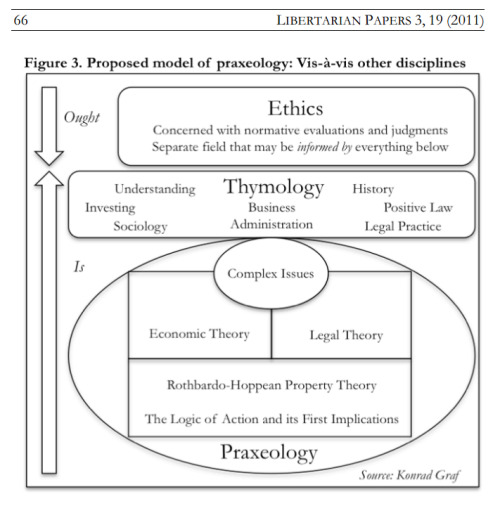
Deductive legal theory, when properly applied in a given context, objectively and descriptively defines the parameters of what justice is in relation to questions of property rights, contracts, torts, and other legal matters. This yields a deeper-than-expected foundation for the traditional libertarian insistence on not mixing law with morality and the corollary opposition to “legislating morality.” Legal theory is a discrete field that, like Mises’s conception of economic theory, can provide descriptive, categorical input for use in “ought” considerations, even as legal theory and ethics remain distinct in foundations, scope, and method.
The above is an excerpt from:
"If you’re just starting out it is probably best to study the classics and introductory books. However, understanding the framework of knowledge, praxeology — the science of human action — and where the two important fields of economics and jurisprudence (political philosophy) reside is very helpful. This is the most cutting edge article out there that exists today.
“Action-Based Jurisprudence: Praxeological Legal Theory in Relation to Economic Theory, Ethics, and Legal Practice” by Konrad Graf
Action-based legal theory is a discrete branch of praxeology and the basis of an emerging school of jurisprudence related to, but distinct from, natural law. Legal theory and economic theory share content that is part of praxeology itself: the action axiom, the a priori of argumentation, universalizable property theory, and counterfactual-deductive methodology. Praxeological property-norm justification is separate from the strictly ethical “ought” question of selecting ends in an action context. Examples of action-based jurisprudence are found in existing “Austro-libertarian” literature. Legal theory and legal practice must remain distinct and work closely together if justice is to be found in real cases. Legal theorizing was shaped in religious ethical contexts, which contributed to confused field boundaries between law and ethics. The carrot and stick influence of rulers on theorists has distorted conventional economics and jurisprudence in particular directions over the course of centuries. An action-based approach is relatively immune to such sources of distortion in its methods and conclusions, but has tended historically to be marginalized from conventional institutions for this same reason.
I don’t think the above will be bested in a very long time. It is a big read for a journal article, but do not let that put you off. It is well worth it. If you’re not a fan of reading online, I would suggest printing it out - which can be done very easily for around $5. It’s something you will come back to often. A one stop shop for understanding Austro-Libertarianism in one read."
Conza, what are your definitions of “objective” and “ethics”? I’d very much appreciate it if you answer in your own words rather than quoting someone else at length.
Bump. This thread was getting interesting then everyone kind of disappeared.
Sorry I took so long to respond. Last week was really busy for me, and I only had time for a couple of short posts throughout the week.
Right, I think you summed up my point accurately. What you go on to describe after sounds more like universal (or near universal) qualities of morality or value, but not inherent qualities. In other words, most people prefer life to death for themselves (as the people who actually prefer death for themselves commit suicide). But this does not mean that life has an inherent quality of goodness or value. It’s just near universally preferred. People tend to like being alive, but this doesn’t mean that they would like being alive under all circumstances. Some people prefer death because of severe depression, shame, physical pain, etc.
Regarding the person driving on the icy edge of a cliff, does he not enjoy the risk? Falling off is not his intention, but the act of driving on an icy cliff seems like the sort of thing a daredevil would do. But even if he is doing it because he wants to go from A to B (and the icy cliff is inbetween), we can still say that he preferred the risk (even if he didn’t “enjoy” it) over not taking the risk. So if he drives off the edge, he probably didn’t want it nor does he consider it a good thing, but he still considered the risk to be worth it.
Do you mean the difference between children and adults, between humans and chimps, or between anarchists and statists, maybe something else?