“I was just reading a Block critique of Friedman, and one of his main claims is that Friedman is mistaking deontological libertarianism as a theory of morality instead of a theory of law. Besides the fact that its incredibly confusing to call a legal theory “deontological” and treat it as wholly seperate from morality, and the fact that the seminal work of deontological libertarianism is called The ETHICS of Liberty, Block seems straight up wrong in his distinction.”
Haha, what? No he’s not. Strictly concieved it’s a theory of punishment.
“THIS is why the libertarianism of Rothbard, Block, et al. is a moral theory and not a legal one.”
Again, no.
““Action-Based Jurisprudence: Praxeological Legal Theory in Relation to Economic Theory, Ethics, and Legal Practice”–Libertarian Papers vol. 3, no. 19”, specifically:
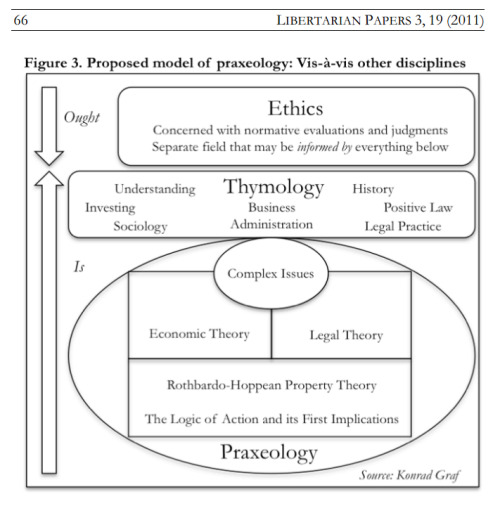
Part IV, “Ethics: Disentangling Law and Morality,” makes a case for removing legal theory from its loose historically evolved association with ethics, viewed as a field that addresses “ought” questions, or the selection of ends in action. It discusses factors—particularly the development of law within religious intellectual and institutional contexts—that have contributed to legal theory’s historical placement and associations with morality. It also examines historical and present-day factors contributing to the evolution of confused conventional formulations of economic and legal concepts. Such factors inhibit the kind of clear thinking in law and economics that could challenge status quo practices and beliefs. It argues that a praxeological approach to jurisprudence is positioned to supply such clear thinking, just as the praxeological approach to economics—causal-realist, counterfactual, deductive economic theory—has done, most famously under the label “Austrian” economics. It also further clarifies the foundations of the rights theory presented in Part I by discussing whether such rights could apply to non-human species.
Ethics: Disentangling Law and Morality
Some factors in the association between law and morality
Libertarians have often pointed out that just because something may be morally wrong does not imply that it should be illegal. Better distinguishing legal concepts from ethical ones and locating legal theory within the a priori domain of praxeology puts this division on a robust theoretical foundation. Conceptions of the relationship between ethics and praxeology are still valuable, in this view, but certain concepts that are sometimes treated under “ethics” are viewed instead as praxeological categories. Having proposed discrete field boundaries for praxeology, economic theory, and legal theory in Part I, we now consider the nature of ethics itself to further clarify the natures and positions of law and morality from a praxeological perspective.
The word “ethics” appears in titles of works that have contributed to the Austro-libertarian legal-theory tradition, for example, The Ethics of Liberty and The Economics and Ethics of Private Property. These works do discuss ethics, as such, to varying degrees. However, they employ praxeological definition and deduction and typically address proto-legal praxeological or legal-theory topics, such as property, torts, contracting and lending.
Placing deductive legal theory within praxeology enables its reconstruction as a categorical and definitional assessment of what types of actions are NAP infringements—separate from moral assessment of such infringements. In this view, an example of an ethical statement would be, “One should not violate rights.” Legal theory helps to make this goal actionable by supplying information concerning the question: “What is ‘violating rights?’”
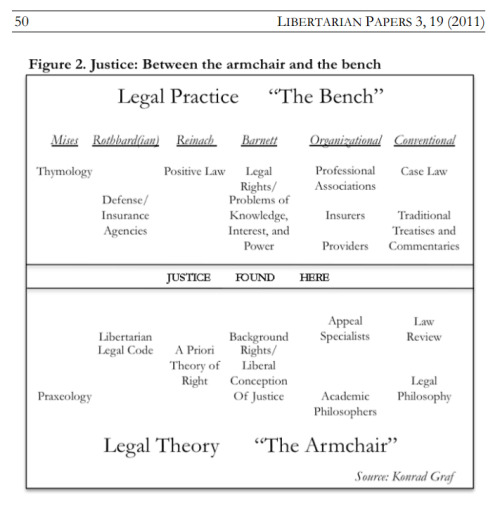
Huerta de Soto, in a chapter called “The Ethics of Capitalism” (2009, Chapter 12), argues that “efficiency” and “morality and justice” only appear to be competing values if we have an unrealistic, static theory of what “efficiency” is. The discussion interchanges or pairs terms such as morality and justice (170, 172). The model proposed here treats these with greater differentiation. In this view, justice lies within a deductive legal-theory domain, not the “ought” domain of ethics.
Moreover, if deductive legal theory and economic theory are siblings within the same field of praxeology, it should also be unsurprising that properly formulated concepts from each branch are in harmony with one another, as Huerta de Soto argues that they are in this case. Indeed, he writes of justice that:
What is just cannot be inefficient, nor can what is efficient be unjust. The fact is that, under the perspective of dynamic analysis, equity or justice and efficiency are simply two sides of the same coin…This…not only allows efficiency to be appropriately redefined in dynamic terms, but also throws a great deal of light on the criterion of justice which should prevail in social relations. This criterion is based on the traditional principles of morality which allow individual behavior to be judged as just or unjust in accordance with general and abstract juridical rules regulating, basically…property rights… (173).
Thus, when it comes to specifics, the bedrock of Huerta de Soto’s argument often returns to principles of justice, effectively defined in terms of property rights. Nevertheless, it should be noted that some of his arguments may well also apply to more strictly ethical as distinct from property-rights considerations.
Ethical systems as sets of claims about specific categories of means and ends
The focus of ethics as an “ought” field is on the teleological realm of ends, as contrasted with both the “is” realm of causality as treated by the natural sciences and the “must necessarily be” realm of a priori deduction. At the same time, many ethical statements also assert specific relationships among means and ends and recommend certain types of ends and means over others. As Rand put it, “What is morality, or ethics? It is a code of values to guide man’s choices and actions—the choices and actions that determine the purpose and the course of his life” (1961, 13).
Huerta de Soto likens the role of ethical principles to “automatic pilots” (173) that provide ex ante guides for action. He contrasts this with attempts to weigh each and every action in terms of perceived costs and benefits. He demonstrates how such an attempted pragmatic approach is actually a largely hopeless and ill-conceived task from the point of view of economic theory (170). Covey (1989) similarly reformulates traditional ethical principles in contemporary terms as “habits” or “practices.” Such habits have various degrees of likelihood of creating long-term patterns of individual and group success, patterns that are demonstrably superior to the results of attempts to weigh the “costs and benefits” of each action in advance in the absence of such guidelines.
In general, the above accounts conceive of a given code of ethics as a specific body of knowledge or know-how. In praxeological terms, knowledge or know-how can be described as functioning in the context of action in the way that a recipe does for a cook (Kinsella 2011, 1–2). Like recipes, ethical claims often take the form of “Perform action (or action set) of type X and expect to get result (or result set) of type Y.” An ethical code, like a cookbook, provides sets of claims and instructions regarding what the good is (which things to cook) and how it is to be pursued (how to cook them). Even though traditional ethical systems have often also tended to emphasize topics such as what not to cook and how not to burn the casserole, they nevertheless also advance some positive conception of the “good.”
Ethical codes thus provide specific sets of claims about the range of possible ends and means available to actors along with asserted sets of causal relationships among these various ends and means. Ethical codes that contradict laws of human action, or any other laws or principles pertaining to the reality of action as such, or the contextual reality in which given actions occur, are less likely to be successful than those that are better informed by such laws… pg 56.