We are used to hate the state. We call it tyrannical, aggressive and so forth. However essentialy there is no difference between a state and a privately owned land except the usually larger size of the former. Even in an-cap society you would have private cities and regions that will make taxation obligatory and perhaps provide a range of public services. Would you be against that? Probably not. You would claim that it is not a monopoly and you can always move to another land if you wish. But the same is true for states as well. It is unfortunate of course that there are no libertarian states in the world, but theoretically you could say that the world itself is an-cap and the states in it are private lands.
Wait wait wait…
What do you mean make taxation “obligatory”? I’d definitely have a problem with that.
I’ve been thinking about this “states as private companies” idea for a while, and my latest theory is that the main difference is in the heads of the people - right know a lot of people believe it’s ok to have a “rental agreement” with the state that can be unilaterally changed on the fly - you just cannot add a clause to your “social contract” to prevent this tampering. If we eliminate the state overnight, the situation will recreate itself. I am afraid the people must change their beliefs before changing the social structure. Schelling point comes to mind…
Its not a unilateral decision, it is decided by a vote, just like in a co-op.
Ironically, even statist acedemics argue that co-ops are very inefficient form of organization (they even have scientific models proving that).
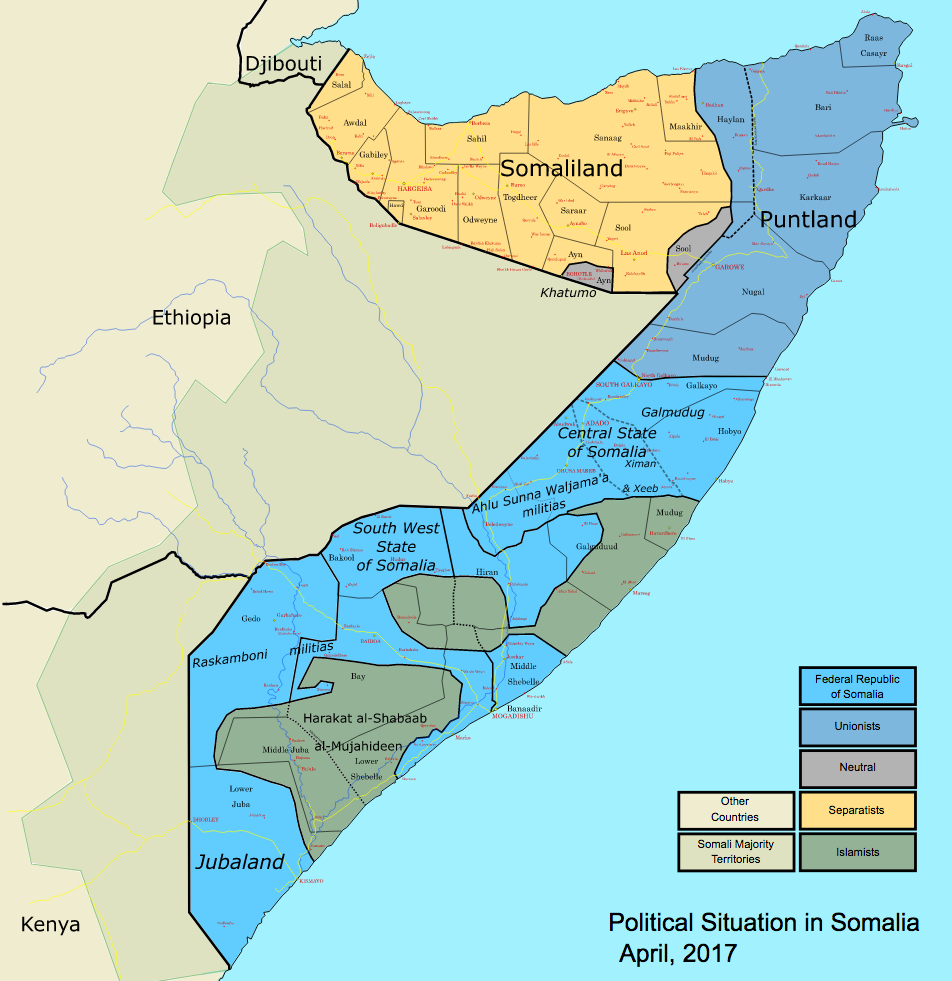
In many parts of Somalia you pay taxes as small governments have emerged in some regions. I haven’t checked it myself, but someone told me that David Friedman thinks “private” states emerging is probably possible under anarchy and it’s what I believe will happen anyway(with them becoming fully functional).
Looking at this they seem to be bigger than I thoght they would be:
Wait wait wait…
What do you mean make taxation “obligatory”? I’d definitely have a problem with that.
He means rent. John X buys up (almost) all the land in Y territory and charges everyone rent to live there.
No problem until this goes on for a few generations and John’s parasitic ancestors feel entitled to this contract merely through tradition.
Perhaps a new landowner will lower his rents. Perhaps not
Robert Nozick proposes that in Anarchy, State, and Utopia: the invisible hand would produce a traditional government even if beginning with private defense agencies.
No problem until this goes on for a few generations and John’s parasitic ancestors feel entitled to this contract merely through tradition.
In what sense are they not entitled to it in the scenario you contrived?
Robert Nozick proposes that in Anarchy, State, and Utopia: the invisible hand would produce a traditional government even if beginning with private defense agencies.
Nozick also introduces a barrage of assumptions to make his case work for him concerning firm efficiency in delivering law-related services. For the invisible hand to actually do so, you need to accept all the assumptions he introduces.
Robert Nozick proposes that in Anarchy, State, and Utopia: the invisible hand would produce a traditional government even if beginning with private defense agencies.
I’ve heard a lot about that book and still need to read it someday. I definitely agree though.
Pretty amazing for a book to solicit agreement when you have no idea how he even frames the argument.
Yes, the State is just like peaceful cultivation and ownership of land.
Clayton -
We? Not we. I hate the state. You love the state. You have made it clear in many posts that you want the state to put people in mental institutes for “their own good,” to kill palestinian civilians, and to maintain insanely expensive and overcrowded prisons.
Africa is about the last place on Earth that anything good will happen with this mentality. I’m putting my money on Ancapiturkistan…
Humans have existed in something resembling a civilized society for lets say about 8,000 years now. In that time there were almost no improvement in the average human condition before the year 1800, god alone knows how many overall people, and what percentage of the human race at each respective times were killed off by the restrictions of the state. In two hundred years the average human’s condition was improved by almost all other advances in human history combined, it obviously didn’t take that much, and the technology necessary needed (even if we assumed it wouldn’t have been developed in a freer world, a preposterous one I feel) wasn’t around material improvement was still totally possible within the technological limits, and the technology would have become more more and more available as this civilizing took place.
One could, however, argue that these events of the old days were caused more by barbarity than the state. Fine. Today states are still around with their protectionism and nationalism which seriously decrease the quality of billions of people’s lives. But let’s just look at the death tolls for “its not so bad”, because what I just said can’t be calculated.
Since 1800
Napoleonic Wars 3.5 Million dead, 1 million civilians
Crimean war 374 thousand dead
American Civil War 200 thousand dead
Native American Massacres> 10 million, no one really knows, likely about three quarters of those are civilians if not more
European Colonization and rule? I have absolutely no idea, let’s call it 5 million, were dealing with the kind of atrocities where one can throw off numbers like this without fear of being too high.
World War I About 16 million, 6.8 million of those were civilian
Russian Civil war about 1 million, I can’t find out how many were civilian
Deaths caused by stalin, about 8 million, practically all civilian “military” casualties were purged
World War II 60 million, about 40 million of those were civilian
I don’t know how many died from the famines and the purifications by Mao but I’m sure they were at least 10 million. At least 9 million civilian.
Scores of millions died in the cold war conflicts, less civilians for once.
Do I really need to go on? Fine, call these radicle cases, It harms the standard of living dramatically for the common person through restriction, business cycle perpetuation, education hampering, destruction of the medical system, crime caused by prohibition, hampering markets, ECT.
To me the three greatest sins of the state are:
-
Legitimizing Mob Rule and making it seem like the BEST system imaginable
-
Solidifying and embodying nationalism, the idea that you are the brother to one, and alien to another, because of a trick of geography enforced by law. This is what i like to call Neo- Feudalism, because that’s what it is
-
Legitimizing Mass theft and blind faith/presumption (taxes are the latter caused by the former )
The state historically is so bad, and in many places of earth it is currently that bad. Certainly worth fighting against. And the things that you are talking about are minor local governments which usually wouldn’t even be govt. as we understand the term, they would be minimal if they existed at all, and usually voluntary, or at least easy to move out of. The worst that could happen would be panarchism… Which would at least be interesting and almost certainly still much better than the current system.
So you tell me, is the state that bad?
A State taxes. A tax is not a voluntary transaction. It is the opposite - a coerced one. A State coerces you to give some of your property, if you don’t it, takes away all of your property.
On the other hand, a landlord, we assume a landlord that legitimately acquired his land, does not coerce you into doing anything. If a property owner, he is the one who chooses who get access to his property and who don’t. If he chooses to grant you access in exchange for something you can either accept the deal or not. You will accept it depending ot the contrasted marginal utility of what you gain in exchange for what you forgo.
Unfortunately, data kills your argument. With the largest governments ever known, our current world has the lowest rates of violence ever: http://www.edge.org/3rd_culture/pinker07/pinker07_index.html.
Pinker makes a lot of assumptions that don’t seem to be true at all in day to day life. Life spans may been shorter in the past, but even a thief or someone who wanted to steal property could only kill a couple of people before being killed himself. Aside from that, like with many things, Pinker’s statements probably say more about him than reality.
Must be nice to substitute facts with ideology.