Part One of a series of films exploring a society where there is law and order, but no government.
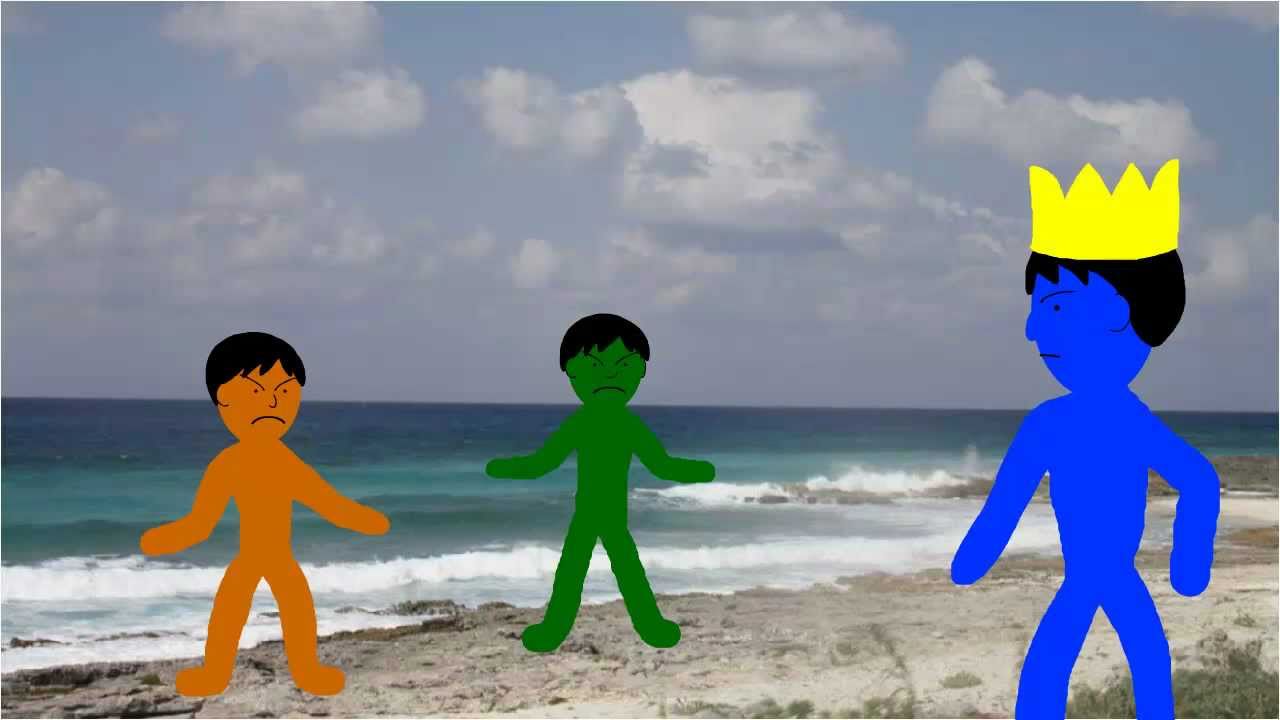
This part introduces the definitions of law and government, illustrating the concepts using a simple desert-island scenario.
Part One of a series of films exploring a society where there is law and order, but no government.
This part introduces the definitions of law and government, illustrating the concepts using a simple desert-island scenario.
“That means you could steal from us…and order us around…and call it legal…”
@6:21 The crown slowly descends on to Charlie’s head “That’s Right. I am the State.”
I went lollerblading.
Really excellent work. My only nitpick is that I cringed a little when you say that judges “produce laws”, they don’t produce laws, they produce agreements or settlements. “Law” is simply a useful fiction, it’s a reification of something that actually does not exist at all, it is just the expected consequences of a particular course of action. Another way to say it is that, in a society without a monopolist of law, there is law but there are no laws. If most thieves have to settle for 3x payment if they get caught, then prospective thieves will anticipate that this is the consequences if they are brought to suit for their theft. It doesn’t mean that 3x payment will necessarily be the consequences… it could be more or it could be less depending on what the victim is willing to agree to. I think of the customary terms of settlement of torts in the same sense as going prices. No one would ever pay $1,000 for an orange, not because the price of oranges has been “set” at some lower value but simply because you could go to any grocery store and buy an orange for much less than $1,000. Similarly, in a society without a law monopolist, no one will ever agree to having their hand cut off in punishment for stealing an orange because you could go to any arbitrator and get the same opinion: “that’s excessive.” If a particular victim insists on having the thief’s hand cut off as punishment for stealing, the matter will simply have to be handled through direct conflict, that is, by the respective security providers which each party has retained.
Anyway, I just want to congratulate you, this was obviously a lot of work and you’re right on the mark.
Clayton -
Going by personal experience, if don’t explain as soon as possible how people who wouldn’t agree to be judged would be handled in a stateless society most people will think you are nuts and won’t bother listening to you. I believe you should address that asap.
Agreed - I think OP should make a prequel to Part One that shows how Adam and Ben handle the situation before Charlie arrives… they just get in a fist-fight and each end up bruised with broken teeth and unable to eat apples for a couple days. It is true that a monopoly on law largely eradicates the problem of direct violence in the handling of disputes. However, the question of whether operating a law monopoly is itself just is rarely, if ever, raised (Hans Hoppe addresses this at length in his works) and the question of whether the benefits of a law monopoly (little, if any direct violence in the settlement of disputes) is worth the costs (expansive, tyrannical, omnipresent government, aggressive police state, corrupt officials, jaded, apathetic judges, etc. etc.) is hardly ever discussed (David Friedman discusses this to an extent).
Clayton -
+1
These were my comments to Graham:
I think it’s really good. I especially like the diagram regarding scarcity and the needs for dispute resolution, and also the act where the one guy is crowned king.
{snip}
My main criticism is the use of the concept law. You’re saying a ruling creates a law, but if I look up the meaning of the term law it talks about rules. To me, the ruling is the interpretation of the law.
I recognize that it can be so that there is no agreement and arbitrator setup before a dispute occurs (as I described in my video also), but when there is an agreement and agreed arbitrator then job of the arbitrator is purely of interpretation. When there is not an agreement setup beforehand then the role of an arbitrator (if it gets to that) is first to identifiy what the rules are and then to interpret them. This identification can be based on what is the custom in agreed upon arbitration, and also what will be considered fair by the population at large (and future customers).
Maybe your phraseology is still correct in that sense, but at least what I’m saying here highlights that the term ‘law’ is a difficult one, and maybe we should adopt other terms such as ‘ruling’ and look at the whole problem from that angle (you see that I didn’t use the word law in my video at all).
I do want to point out that your video does illustrate/introduce the problem and the possible solution really well, which is what matters. So if you keep it like this and the part 2 can use the same phraseology and work to a coherent model, then that’s great.
==and==
In my view, I see no reason to go to a third person to settle a dispute when he has nothing to base it on. Only if there is a person who has credibility in the eyes of other members of society would I go to him, and because I believe that person could interpret the (societal) custom, and not create it out of thin air.
So what I do think would happen in the case of an arbitrational void, is that people immediately start setting up voluntary arrangements to deal with such uncertainty. And once that is done, you have something to fall back on, namely people who are considered more reputable than others, and there will be precedence in cases.
Clayton - thanks for the compliments,
There may be some merit in using the terms law and laws as you suggest.
I like speaking of laws as a “product” that is supplied, demanded, produced and consumed because it makes it clear that you can apply general economic principles to the law industry. (I suppose you would call it the “settlement industry” or “arbitration industry”?). For example we have “bad laws” or “bad law” right now, partly due to the calculation problem… even if we assume government tries its very best to produce court settlements in accordance with individual opinions on justice, it can’t, because it can’t calculate.
Presumably “bad laws” is redundant to you, as you would say “all laws are bad”? But also “law is good”? In your vision of a free society, there is “law” but “no laws”? And does it still make sense to talk of a “law monopolist”, or must you instead talk of an “arbitration monopolist”? At the moment, I feel your definitions just add confusion to what is already a difficult topic to explain.
Also: How do you define order? Would the phrase “order without law” be meaningful with your definition of law? When was there order and when was there law (if ever) in my desert-island story?
Sure, and I agree with your sentiment here. I think we can speak of a “law industry” and “law services/legal services” to refer to the line of work which lawyers and arbitrators ply. A lawyer sells his expert knowledge of the law and arbitration. But lawyers don’t make law. An arbitrator sells his spotless reputation and expert dispute-resolution skills but he no more makes law than a lawyer does.
It is the disputants who ultimately “make” law. I put “make” in quotes to denote that this is not an intentional process but is, rather, a by-product of the immediate task at hand - settling the dispute. I see this process as a direct analogue to the way prices emerge. Each individual buyer and seller is contributing to the “setting” of the market price but no one actually sets the price. The price just emerges from the independent, uncoordinated actions of many individuals involved in exchange. If I sell you an apple for $1, I didn’t make the price of apples $1. But the fact that you were able to purchase an apple from me for $1 is part of the reason that apples do not go for $1,000 each. No one settlement of a dispute sets the customary terms for settling disputes. But out of many settled disputes there emerges a range of possible terms of settlement. If I stole your car, you would never agree that I should get off scot free. But then, you probably wouldn’t demand that I be outlawed, either. So, you’d settle for something in between. And you’re probably like most people in this regard. When many cases of car theft have been settled, a pattern will emerge and this pattern is what I believe we are referring to when we speak of the law.
No, law industry is fine because the primary tool of arbitrators and lawyers in settling disputes is appeal to the law. In other words, let’s say I steal your car and you’re a particularly vindictive person. You sue me and you demand that I be outlawed so you can hire a bounty hunter to hunt me down and kill me - I think of outlawry as the “death sentence” of free-market law. I stole the car because I was desperate to feed my kids - I’m not an evil person - and I appeal to this in the dispute. You will not listen. My lawyer could ask when has anybody ever been outlawed for stealing one car? If you still will not budge, then arbitration has failed and the matter falls back to our respective security companies. But now the question is between you and your security company… will they accept the legal risk of taking direct, violent action against me (possibly getting involved in violent conflict with my security company) when I had agreed in arbitration to the customary punishment for the crime that I committed and when you are asking for a punishment which no one in the history of the world has ever agreed to bear? Almost certainly not. So, now you’re out of luck. By being unreasonable in your demands in arbitration, you’ve left yourself with no options. You might be able to take me back to arbitration but then you refused on record to agree to the customary punishment which means that I can simply point to that and say “you yourself said you don’t want the customary punishment, so I refuse to agree to anything as large or larger than that.” In other words, by being unreasonable, you’ve only cost yourself.
100% agreed.
Well, all statutes (what are commonly called “laws”) are either bad or unnecessary… kind of like how all price controls are either bad or unnecessary. If you put a price cap of 1 penny on apples, this is bad. If you put a price cap of $1,000 on apples, it’s unnecessary.
Yeah, there is law (conventions regarding the reasonable resolution of disputes) but there are no statutes because there is no State to issue them. This is a thought-experimental society, of course.
The State’s courts and the bars constitute a law monopoly because they control who may practice law, that is, who may work in the law industry.
I hope I’m clarifying. Arbitrators assist disputants in reach mutually agreeable terms of settlement, otherwise called “a settlement.” Many settlements over time results in patterns of customarily accpetable resolutions. These patterns are what I believe to be law per se.
Kind of. The boundary between law and social norm is very fuzzy. This is especially obvious in the old common law systems where social norms were dominant arguments in determining resolutions to disputes. Social order is possible with only social norms and not law per se. I think the difference between mere social norms and law is the division of labor, that is, the emergence of specialized legal professions such as arbitrators, lawyers, legal historians, legal philosophers, expert investigators, scientific witnesses and so on.
A major theme of Mises’s work is that cooperation comes naturally to humans. We don’t need a big billy-club-in-the-sky thumping us over the heads all day long to keep us from murdering each other to extinction. The division of labor creates a selfish interest in cooperation because participating in peaceful cooperation is simply more enriching than engaging in conflict (the State and certain classes of private crime are notable exceptions to this). (Watch this. Read this. And this.) I think order is present in every ‘social’ species, humans included. As far as law, I think that it emerged sometime after humans learned to speak and engage in extended reasoning since this is what makes legal arguments unique from, say, poetry.
Clayton -
Nice but my suggestions.
Legislation ≠ law. Nor do rulings or desisions, they are a product as some have suggested. Law / ethics - universal. Seems that you imply it is not. The same - that it can be ‘created’, not discovered. Which is wrong.
Daily Bell: Are there any good laws and regulations?
Dr. Hans-Hermann Hoppe: Yes. There are a few, simple good laws that almost everyone intuitively recognizes and acknowledges and that can also be demonstrated to be “true” and “good” laws.
If there were no interpersonal conflicts… and we all lived in perfect harmony there would be no need for any law or norm. It is the purpose of laws or norms to help avoid otherwise unavoidable conflict. Only laws that achieve this can be called good laws. A law that generates conflict rather than help avoid it is contrary to the purpose of laws, i.e., bad, dysfunctional or perverted law.
Conflicts are possible only if and insofar as goods are scarce. People clash, because they want to use one and the same good in different, incompatible ways. Either I win and get my way or you win and get your way. We cannot both be “winners.” In the case of scarce goods, then, we need rules or laws helping us decide between rival, conflicting claims. In contrast, goods that are “free,” i.e., goods that exist in superabundance, that are inexhaustible or infinitely re-producible, are not and cannot be a source of conflict. Whenever I use a non-scarce good it does not in the slightest diminish the supply of this good available to you. I can do with it what I want and you can do with it what you want at the same time. There is no loser. We are both winners; and hence, as far as non-scarce goods are concerned, there is never any need for laws.
All conflict concerning scarce goods, then, can be avoided if only every good is privately owned, i.e., exclusively controlled by one specified individual(s) rather than another, and it is always clear which thing is owned, and by whom, and which is not. And in order to avoid all possible conflict from the beginning of mankind on, it is only necessary to have a rule regulating the first, original appropriation of previously un-owned, nature-given goods as private property. In sum then, there are essentially three “good laws” that assure conflict-free interaction or “eternal peace:” a) he who first appropriates something previously on-owned is its exclusive owner (as the first appropriator he cannot have come into conflict with anyone else as everyone else appeared on the scene only later); b) he who produces something with his body and homesteaded goods is owner of his product, provided he does not thereby damage the physical integrity of others’ property; and c) he who acquires something from a previous or earlier owner by means of voluntary exchange, i.e., an exchange that is deemed mutually beneficial, is its owner.
Also I disagree with defining government in that way, i.e self-governance. If you called it the state, sure. You also call out anarchy = chaos… come again? No ruler ≠ no rules…
I part ways with Rothbard/Hoppe on the objectivity of ethics (and, therefore, law). Everyone sees it their own way and conflicts can arise whenever people disagree about something, even if they have to create the scarcity in order to fight over it (“I don’t care that there are infinitely many apples available, I want the very apple in your hand”). Reason is a precondition to law but law is not the product exclusively of reason. In fact, feelings and emotions play a huge role in determining what people will settle for (for example, victims are more likely to demand lesser damages if they believe the tort was unintentional but not grossly negligent).
Reason is not some divine-like entity dwelling in the aether from which we download our inspired legal truths. Hoppe’s position suggests that there are just a handful of simple rules that, if followed, will result in a world where conflict is automatically minimized - just by following these handful of rules. The fact of the matter is that the rules required to prevent and avoid conflicts are immense and there is no guarantee that any rule-set, however perfect, will not eventually lead to conflicts as circumstances change. Law must be ever-changing along with the circumstances of human affairs.
Clayton -
"I part ways with Rothbard/Hoppe on the objectivity of ethics (and, therefore, law). Everyone sees it their own way and conflicts can arise whenever people disagree about something, even if they have to create the scarcity in order to fight over it (“I don’t care that there are infinitely many apples available, I want the very apple in your hand”).
Sorry but no.
“Ethics - the validity of the principle of self-ownership and original appropriation - is demonstrably not dependent and contingent upon agreement or contract; and the universality claim connected with Rothbard’s libertarianism is not affected in the slightest by the circumstance that moral discussants may or may not always come to an agreement or contract. Ethics is the logical-praxeological presupposition - in Kantian terminology: die Bedingung der Moeglichkeit - rather than the result of agreement or contract. The principles of self-ownership and original appropriation make agreement and contract - including that of not agreeing and contracting - possible. Set in motion and stimulated by the universal experience of conflict, moral discussion and argument can discover, reconstruct, explicate, and formulate the principles of self-ownership and original appropriation, but their validity in no way depends on whether or not this is the case, and if so whether or not these formulations then find universal assent.” - Hoppe, Intro to TEOL.
“Reason is a precondition to law but law is not the product exclusively of reason. In fact, feelings and emotions play a huge role in determining what people will settle for (for example, victims are more likely to demand lesser damages if they believe the tort was unintentional but not grossly negligent).”
lmao, so what?
“Reason is not some divine-like entity dwelling in the aether from which we download our inspired legal truths. Hoppe’s position suggests that there are just a handful of simple rules that, if followed, will result in a world where conflict is automatically minimized - just by following these handful of rules. The fact of the matter is that the rules required to prevent and avoid conflicts are immense and there is no guarantee that any rule-set, however perfect, will not eventually lead to conflicts as circumstances change. Law must be ever-changing along with the circumstances of human affairs.”
"One common, flip criticism by opponents of natural law is: who is to establish the alleged truths about man? The answer is not who but what: man’s reason. Man’s reason is objective, i.e., it can be employed by all men to yield truths about the world. To ask what is man’s nature is to invite the answer. Go thou and study and find out! It is as if one man were to assert that the nature of copper were open to rational investigation and a critic were to challenge him to “prove” this immediately by setting forth on the spot all the laws that have been discovered about copper.
Another common charge is that natural-law theorists differ among themselves, and that therefore all natural-law theories must be discarded. This charge comes with peculiar ill grace when it comes, as it often does, from utilitarian economists. For economics has been a notoriously contentious science — and yet few people advocate tossing all economics therefore into the discard. Furthermore, difference of opinion is no excuse for discarding all sides to a dispute; the responsible person is the one who uses his reason to examine the various contentions and make up his own mind.[22] He does not simply say a priori, “a plague on all your houses!” The fact of man’s reason does not mean that error is impossible. Even such “hard” sciences as physics and chemistry have had their errors and their fervent disputes.[23] No man is omniscient or infallible — a law, by the way, of man’s nature." - Rothbard, TEOL.
I’m sorry, please ellimunate me on a scenario were the laws in the previous post stipulated by Hoppe would be invalidated? Then make the case that Hoppe’s position would become untenable.
Hoppe’s position presupposes the objectivity of boundaries in the physical world. There are no objective boundaries in the physical universe. We can objectively observe different properties in different regions of the physical universe (i.e. temperature in this place is high, but in this place is low, etc.) but that is not the same thing as having objective boundaries. The physicist can say “This is a hydrogen atom, not an oxygen atom” because he is measuring objective attributes of the thing in question. But a judge cannot say, “This is Clayton’s car, not Conza’s car” simply by measuring objective attributes of the car. Rather, the judge must utilize human ideas about what constitutes physical boundaries (i.e. the car itself, but not necessarily all the unattached contents of the car) and what constitutes a greater claim to rightful possession (“I had it first” or “I exchanged something for it with its previous rightful possessor”, etc.) over a lesser claim to rightful possession (“I like it and I want to have it”).
This is easier to see in the case of the human family. A child is human in every sense that an adult is human. Nevertheless, we recognize the right of parents to engage in behavior towards their children that could be aggression if committed against an adult peer. For example, if my 5-year old is about to step out into a busy street, I’m well within my rights to seize his shoulder and bodily drag him back onto the sidewalk, even though it might cause some pain in his shoulder and even though he might be extremely upset about being impeded in his chosen path. If an adult were about to step out onto a busy street, however, I have no business reaching out and seizing that person by their shoulder. I am certainly opening myself up to lawsuit for aggression if the person does not appreciate my good-Samaritanism or, in fact, resents it and is angered by my impeding them on their chosen path.
That the very same action results in two different legal outcomes means there must be a defining difference between the adult and the child. Yet it cannot be DNA. Weight, brain size, age in years, and so on are all perfectly arbitrary categories. The fact is that we accept that parents may fret over their children in ways that they may not fret over the children of others or interfere with other adults because there is something special in the parent-child relationship, that is, the parent has a legitimate interest in preserving his child’s life and well-being. Such a recognition is actually contrary to the homesteading/self-ownership principles, that is, it results in legitimized coercion from parents to children.
But man’s nature is really beside the point in a conflict. If a man rapes someone, it is no defense to say “it’s in my nature”. Even if he trots out all the biological facts that might be used to show that humans have a biological disposition to rape, it is of no use. The fact is that the victim demands restitution as a result of his nature and the terms on which he will agree to settle the matter reveal his nature, they cannot be determined on his behalf by an objective exposition of his nature (by Rothbard, Hoppe or a judge).
And this is the central issue - do the parties to a dispute speak for themselves or does someone else speak on their behalf? In a society without law monopolists, I contend that individuals would always speak on their own behalf except where they are prevented by force or where human custom (as in the case of children, the infirm, mentally handicapped, etc.) dictates that someone else must speak on their behalf. The rules regarding who may speak on behalf of whom would emerge through a process of trial and error.
Clayton -
“There are no objective boundaries in the physical universe.”
An excellent video, though I’d say that ignoring democracy and comparing every state with tyranny is not something that is going to be very convincing to non libertarians.
I agree. Legislation means statutes, and that’s a government thing. What is your definition of “law” and “laws”?
Where do I imply it is not?
Interesting. You feel that a distinction between government and state is worthwhile? I think Hoppe uses the terms interchangeably.
What? Why wouldn’t I “call out anarchy = chaos”?
@Phaedros: Care to provide an example of one?
There is an onjective boundary between the surface of water and the air above it.
http://en.wikipedia.org/wiki/Law_of_identity
Without recognizing boundaries, or identities or separateness, one cannot reason at all. There is obviously an objective boundary between you and me as well.
Well, I beg to differ. We can list the properties of water which water satisfies and we can list the properties of air which air satisfies and we can say “here is air” and “here is water” but there is nothing objective about the distinction itself between air and water… both are made of the same stuff and that stuff is made of the same stuff and so on and so forth down to the quantum foam. That doesn’t mean that air and water do not have different properties as a matter of objective fact. They are distinguishable and we can reason about them because the universe obeys the law of identity. But the universe itself does not distinguish between air and water… both are expressions of the same physical reality and follow the same physical laws. It is human brains that distinguish between air and water and impose perceptual boundaries between them.
There is a caveat here… there is a reason why the human brain distinguishes the boundaries it does. It actually comes from the theory of computation… search “Solomonoff induction” for more info. To the extent that we take information to be an objective attribute of the physical world, we can say that the boundaries between physical objects are themselves objective in that those boundaries represent the most efficient way to encode information about the physical world, that is, to perform induction about the future state of the physical world (which is a primary concern of the human brain - in fact, all brains). But I do not think this is at all what Hoppe or Rothbard have in mind.
Clayton -
I am arguing that an arbitrator does “make” law, and that he also “produces” law. Lawyers are completely different; they play the relatively trivial role of advisors to the disputants. The arbitrator / judge is the central figure.
Yes, but that’s a technicality really. We are supposing that the disputants cannot resolve the dispute between themselves. The disputants don’t do any “making” … they are locked at a stalemate, where violence is the only option left besides bringing in a third party. It is the arbitrator who is doing the “making” of the law here. Unless by “making” you include “accepting” or “agreeing to” what the arbitrator says, but this is trivial.
Yes, I agree. But a by-product is a product. It is produced, albeit unintentionally. Perhaps we could say that Charlie “by-produced” a law?
I agree with your whole analysis here, except I think there is a gap. After the dispute has moved ‘up a level’ and is between the security agencies, why couldn’t one of them simply pay-off the other one? One agency pays the other to stand-down. It is a good trade all round. The agency that makes the payment obviously feels it is worth it as it will get them more customers, and the agency that receives the payment feels the loss of some its customers is worth the money it receives.
That does help clarify, thank you. I like the idea of “law” being a pattern. I would say that law is a pattern of laws. That is, I use the word laws as a kind of shorthand for the mouthful that is “customarily acceptable resolutions”.
Thank you. My target audience is 1) minarchists who find anarchy appealing, but are having some trouble imagining how it could work, and 2) anarchists who have difficulty describing a working free society to others.
I may cover democracy in a later video, but I am hoping viewers will recognize that a democratic government is… a government. My comparison is government vs. no government. Democracy changes nothing about what I have said… a democratic government is still an aggressive monopolist that gets to be judge in cases involving itself, and is therefore tyrannical.