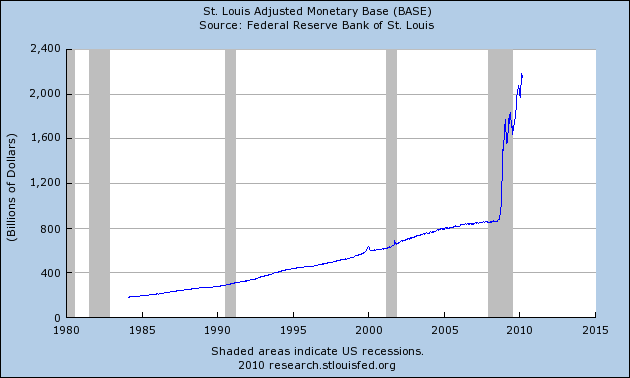
According to the St. Louis Federal Reserve publication Monetary Base in an Era of Financial Change, the adjusted monetary base is an index that measures the effects on a central bank’s balance sheet of its open market operations, discount window lending, unsterilized foreign exchange market intervention, and changes in statutory reserve requirements.
The Adjusted Monetary Base is the one monetary component completely under the control of the Federal Reserve.
This current expansion in the Adjusted Monetary Base is the largest expansion since the statistic has been being tracked. This expansion is larger than the expansions during the Y2K/“dot com bubble” and the attacks of September 11th, which some have suggested acted as the catalyst for the current crises.
If those bailouts were not inflationary it would explain why prices of most things have trended downward this year, at least since March. I thought those actions were inflationary and bought silver in March at its peak. Oh well.
The new money would go to the banks or holders of illiquid MBS. Too bad I don’t own any MBS.
The monetary base is not money. It is what money is backed with.
Bank accounts are money. Banks are afraid of a run on their accounts. They are withholding credit, therefore the Fed has to produce a lot of reserves to induce the banks to lend again.
The monetary base is physical money. A large increase can be expected to multiply throughout the economy via fractional reserve banking and postpone the real crisis.
That will only happen if the banks are willing to engage in fractional reserve banking. If they fear a run and their own bankruptcy, they will want to increase reserves and stop lending. In order to meet interest rate targets, the Fed will have to radically boost the monetary base, but the total consequence of this will be null on inflation. The “real” money supply remains the sum of bank accounts, and if the banks are not making new loans, this sum is not changing.
Yes, this worries me too, especially in connection with the bailout. It is unknown if the $700bln will end up as physical money on the market or as a M3 increase. This depends on which assets will be bought and who owns them.
In the first case, I expect to see inflation taking its toll quite rapidly.
In the second case, $700bln is not much for M3, since it already is like $10000bln [1]. But it is expected some of the “help” will be used to pay other debts to smaller investors/firms, which will probably want to cash them out (since they’ve already incurred severe losses). So I believe some money will still end up in M0.
In any case, the Fed would probably want to burn some US$ resulted from paying back debts that aren’t totally dead. Which would probably result in budget deficit and higher taxes. Even if they plan to sell the debts later, they’ll probably do so at a lower price.
If this new money does not get loaned out immediatly and postpones the crisis, people may take the money from the mattress and put it back in the banks. This will usher in a new wave of lending and the “real” money supply will increase dramatically. Base money is federal reserve notes, they are the “gold” now. Checks, credit cards, deposits, debit cards, bonds, and stocks are denominated in Federal Reserve notes and when redemmed will get you federal reserve notes. Not a very stable money but money none the less.
In the link I provided there was an interesting explanation of possible events.
Listen, it is not new money. It is not money. Bank credit is what people use as money. If they stop thinking bank credit is money, only then does the monetary base become money.
Bank credit is stagnant. That is why the economy is experiencing deflation. Bernanke wants to stop deflation by increasing the monetary base. If the banks are afraid to lend, this will have no impact whatsoever. It only increases reserve ratios.
What exactly do you think they are going to do with it, wipe their asses? This money will either be withdrawn or loanded out multiple times. If it gets withdrawn the reserve ratio will shrink back to the 10% level or whatever level it is supposed to be at. When the crisis is perceived to be over that money will be rediposited and will then be loaned out.
This $150 billion increase in the base in one week could represent more than a trillion dollars in new bank credit. More likely it will be turned into federal reserve notes to keep banks alive when the runs start to become more frequent. This is what is meant by the helicopter analogy.
monetary base = real money(coins and notes) + fiduciary money created by Fed(and put in bank’s reserves) which can be used to create credit money by banks
Is it or not?
And second question. Why do we have price deflation if M1 is increasing?
That’s imprecise. Banks can create as much credit as they want at their whim, but the risk of a run on their accounts compels them to keep reserves of “monetary base” on hand to meet potential withdrawals. In the classical model the risk of a run never changes and thus there is a strictly linear relationship between the monetary base and the money supply. But when the risk of a run fluctuates, that relationship breaks down. It may be that banks temporarily adopt a full-reserve policy if confidence in their credit has broken down completely.
Are you sure there is price deflation? Is M1 the true money supply?
As far as I know M1 is the best index of money supply which is published. Real money supply is something between M1 and M2(acorrding to Murray Rothbard opinion). However there are so many financial instruments which are so complicated that it’s hard to judge which should be part of money supply and which shouldn’t.
And if banks are adopting full-reserves policy than money supply should decrease, not increase like it is now.
Why do you think that? If banks want to adopt a full-reserve policy and the central bank supplies unlimited reserves, there is no reason for banks to contract credit.