As I say, it’s a convention of the interface. How do I know it’s a convention of the interface? That is a model that seems to fit the data. It’s like if I say, “That bleep means the mouseclick won’t be processed.” How do I know? From experience. I could be wrong, but that interpretation has seemed to serve me well my entire life, or my entire time of working with the Windows OS.
Note that this reflects the level of certainty I have about logical conclusions (what are tagged “logically necessary conclusions” in my mind): it’s to the level where if I were to doubt (the usefulness of) it, I would have to doubt (the usefulness of) everything I think I know. So people say, “If A implies B and B implies C, but A doesn’t imply C, then everything I know is in question! It is meaningless [read: useless] to question that!”
In the end, I can’t know what the computer “really means,” I can simply choose interpretations that seem more useful to me, based on experience. I am here saying that the fundamental conception of these matters in terms of “true and false” is not as useful to me as a conception in terms of “more useful and less useful to me.” And I am suggesting the same may be true for everyone who is looking at this level of analysis.*
*…and possibly even at everyday levels of analysis - I’ve often shot myself in the foot by saying something just because it was “true” yet very un-useful to say at that time And I think that was a direct result of my superstition about “truth,” that is, thinking there was some objective truth knowable and statable by me, rather that just useful or less useful notions on which to base the actions I take.
Right, the reason I prefer not using the word “reality” is that it carries extra baggage about there being some objective outside world, even though I cannot speak of such a thing other than as a model for my subjective pursuit of happiness.
Quick clarification: Not all sensory data are premises (thoughts); only interpretations can be. I may have been sloppy about that at times. In other words, this following collection of dots (analogous to sensory data) may not be a premise in my mind:
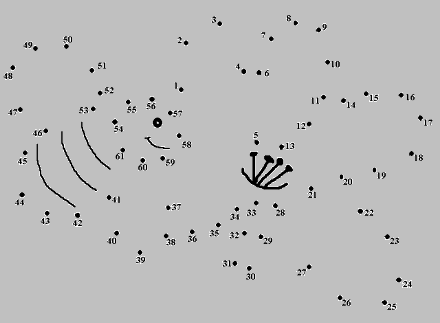
…but this may be:
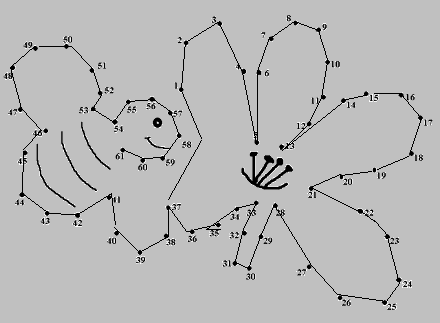
I might call it in words, “A bee is approaching a flower.”* (Statement X) That is a model to fit the data, but in normal English we’d call it a premise once we try to deduce something from that model. Importantly, X does not follow from any premises, but is instead a model that seems to usefully fit the data. I could have connected the dots a different way to get a different model, and possibly that one would have been more useful to me.
*Of course, other interpretations are possible, down to the particularities of one’s mental interface. Perhaps the fact that it’s on a grey background makes it, “A bee might be approaching a flower,” or even “A bee isn’t approaching a flower.” Or perhaps this one image contains a wealth of significance in my thought interface that would take pages or volumes to elaborate in words.
I think you and other readers may be thinking at this point, “But you said a belief was just what follows from your premises, and now you’re saying a useful model can also be a belief.” Well I’ve been loose at times with my levels of analysis, or in what context some of my statements were to apply. So I will try to give a quick recap of my conception of how I think the belief-deriving process works:
- I experience sensations.
- I connect these sensory “dots” to form concepts/thoughts/premises (which also present to me as sensations) that I deem more or less useful to me to “act as if” in order to experience more satisfactory sensations than I am now.
- I also logically deduce things from these premises, or maybe my subconscious does (probably some kind of interplay between conscious and unconscious). I can of course also deduce from previous deductions.
How do I know all this? Just from experience, the same way I know that when my mouse arrows changes to an hourglass I “know” that that means I cannot click on anything for a while (this is a useful model for my interfacing with the computer to experience the output I want to experience when I want to experience it).
I suppose reasoning is characterized by logical deduction from beliefs amid a continual stream of new data (including raw sensory data, ideas from others, forgotten but just-now-recalled memories, and new hypotheses filtering up from the subconscious).
I deem what I have commented on here to be useful to me, and I suspect to others, but that’s of course on the assumption that this whole endeavor - epistemology, economics, praxeology, forum discussion, philosophy bar none - is actually useful. It may not be. When we engage in such thinking, we do so on the assumption that it is a useful endeavor, that it is going to get us more happiness, one way or another, to assume the axioms of Euclid (for example).
In my conception this would be, “the conclusions (tagged as being) deduced from the model are tagged as being deduced from the model.” So it wouldn’t really be saying anything.
Perhaps you’re referring to the fact that our models purport, in some fashion, to be more than just models, but actually about “real reality.” Indeed, this seems a necessary trick for my mind to pull on me, as it would not be very useful for me to consider these matters of epistemology at such a deep level at all times. But what is “reality” other that “what matters for my utility in the long term” as opposed to other sensations that don’t? It seems to me just a word I use to describe that set of sensations that appears to have more bearing on my long-term happiness, and that I can manipulate only through certain means (commonly called a body) rather than just by pure thought. Those sensations that can be manipulated by pure intention are commonly referred to as “fantasy” or some such, and are deemed of less value because they don’t “matter.” And indeed, my experience has shown that they have less bearing on my long-term happiness than that set of sensations that I name “reality.” (Strictly speaking, I’m again being imprecise by equivocating on “reality” - the raw sensory data vs. my model based on that data.)
Side remark:
I mean statistical data in the sense of “I’ve noticed that when I do X, then Y usually results.” This is a big discussion in the pickup community, where some guys will look at things in terms of, “You run this canned spiel, don’t care about her response, and you’ll get this result 30% of the time.” Or salespeople, musicians, etc. But perhaps the best pickup artists, salespeople, and musicians will also use an empathic/theory-of-mind approach. Perhaps the art of human interaction is to do both, and in fact mold your theory of the other person’s mind in response to feedback until you get so close that you’ve almost “gotten inside their head,” although that probably requires a rich and authentic input from the other party.