Yes. (Or if we end up needing to use the Goedel sentence, G = “G doesn’t follow from the premises of the theory T.”) Now above you wrote:
When you wrote that, I assume you meant as an underlying assumption that “truth is a norm of assertion.” Or in other words, there’s no need for the word “true” except as a grammatical device or clarifier, because it is inherent in the act of uttering a statement as a statement that it is purported by the speaker to be accurate.
Now it still seems there should be no objection to including the word “true” or similar terms in some instances, as long as it is fully understood by all parties that this is nothing more than a clarifying device, and adds no actual information or meaning. Hence we can say “X follows from the premises” is just a roundabout way of saying “X”. Please stop me here if this is incorrect.
If you agree with the above, it seems that “This statement doesn’t follow from the premises” can be rewritten in longhand form as “That this statement doesn’t follow from the premises, follows from the premises.” Converting, we get: “This statement follows from the premises, and this statement doesn’t follow from the premises.” However, this is just a garden variety contraction.
Possible objection: I made the above substitution with the promise that the change could not be construed as adding any actual information or meaning, just clarification, and yet now the result is that a Goedel sentence is merely a trivial self-contradictory statement. Therefore I must have added actual information or meaning after all, because the conclusion reached has changed.
Answer: The issue of whether Goedel sentences are trivial or not is the very issue in question. Worded more relevantly, the issue of whether the Goedel sentence will turn out to be trivial once clarified is the very matter in question. Hence even if the above substitution is only clarifying and does not add any actual information or meaning, it can still change our conclusion as to the triviality of Goedel sentences if we weren’t seeing the matter clearly before.
Now I can imagine that the above might be wrong. Even if so, I believe the following criticism of Goedel sentences is correct:
Can you truly conceptualize it, other than formally? Strange as it may sound, I am saying that it is not possible (or no one ever seems to explain how it is possible) to think the thought that corresponds to “This sentence doesn’t follow from the premises.”
Unless I’m forgetting some other odd sentence forms, all other types of sentences that are well-formed and non-contradictory seem to be conceptualizable in some not-purely-formal way, at least to anyone who claims to understand them. Since this is the case for all other types of sentences, the underlying obvious fact that “words are just devices for communicating thoughts” is normally not referenced at all, as it simply doesn’t matter because we are otherwise always dealing with statements whose thought correspondents are clear to all parties. It normally does not need to be pointed out.
However, in these rare cases where the thought correspondent of the statement is not obvious, it seems the burden is on the speaker to clarify or add some explanatory remarks as to how to form or identify the corresponding thought, since the thought is tacitly purported to be both actually thinkable and obvious from the words as stated. (If you say the same applies to concepts like Riemann’s “point at infinity” or just the idea of infinity itself, I would agree - what I am saying may support mathematical constructivism/intuitionism to some degree or other.)
I am very glad you see this, Zavoi. This is more or less where I’m at. And here is my central claim: a thought cannot refer to itself, or if it can, no one seems to be able to tell me how. For example, the first obvious way in my mind, since I seem to think primarily in pictures, would be to conceptualize it as follows:
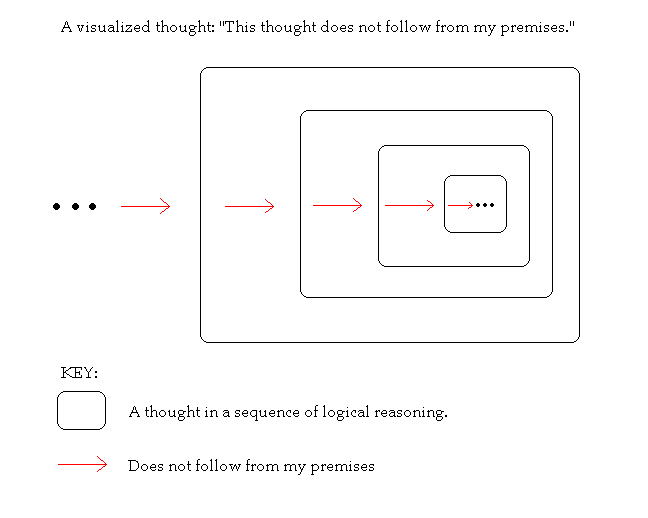
Note this is an infinite regress in pictures with no end in either direction. There is no defined point of evaluation, as far as I can tell, even if we can really say it’s possible to think it at all (depends on whether it’s possible to really think “infinity” other than formally).
Of course, a reasonable objection to my posting the above picture is that it’s a strawman: “That is not what I meant by ‘This sentence does not follow from the premises’.” But then I must ask, “What did you mean?”
And naturally, no one said we had to conceptualize it in pictures, but my question remains as far as how is one supposed to conceptualize it. In the absence of guidance, I can only try and fail to interpret these words into thoughts so many ways until I say, “All right, although it may appear to be obvious what you mean by that because it’s a well-formed sentence, it’s actually not obvious what you mean when I take it to the level of thought. So I can only await clarification.” Again, for most statements that I claim to understand, the understanding itself gives the answer to my concern. Here is a rare exception, so it seems the speaker of the statement would need to clarify.