http://www.youtube.com/watch?v=UrY5AakRrgo
What the title says.
http://www.youtube.com/watch?v=UrY5AakRrgo
What the title says.
No it isn’t.
I wonder which government funded Isaac Newton.
Astrophysicist Neil deGrasse Tyson’s claim that the private sector will not undertake “large, expensive, dangerous projects with unknown risks” is debatable. If I pick a large-scale private project, Tyson can say that it was not large enough, not expensive enough, and not dangerous enough, so we’re comparing phantom apples to phantom oranges at this point.
NASA did undertake “large, expensive, dangerous projects with unknown risks” that the private sector may not have duplicated on its own. That means the project had more costs than benefits. Thus it failed capitalism’s profit-and-loss test. ABC News reported, ““Why are we wasting billions of dollars on the space program?” ask many visitors to ABCNews.com and other Web sites. 40 years after Neil Armstrong took that one small step on the lunar surface, NASA still provokes the same argument. “For all the trillions of dollars we have spent on the space program, all we have are some moon rocks, several tons of space junk and a dozen and a half or so dead astronauts,” wrote a person commenting on a recent story we posted about a space shuttle mission. In fact, public opinion has always been split. In a July 1967 Harris poll, two years in advance of the first moon walk, 43 percent of Americans were in favor of the effort, 46 percent opposed – hardly a rousing endorsement. And in 1970, a year after the landing, 56 percent said it had not been worth its allotted $4 billion a year for nine years.”
Space exploration may be exciting and give beautiful photos, but the cost was probably too high for the private sector at first. Over time, who knows what would have happened. It is easy to say, ‘look at the space shuttle’, but commonly unseen are the exorbitant costs.
Obviously the private sector is able to undertake large, expensive, and dangerous projects. The Great Northern Railroad, ocean liners, steel mills, mining operations, offshore oil-drilling platforms, and nuclear reactors are all examples of this. What Dr. Tyson is really saying is that he doesn’t think the private sector would allocate resources the way that he and his fellow astrophysicists would want it to - i.e., he thinks it would allocate less to them and more to other things. But that would be up to the private sector, wouldn’t it?
“It is no crime to be ignorant of economics, which is, after all, a specialized discipline and one that most people consider to be a ‘dismal science.’ But it is totally irresponsible to have a loud and vociferous opinion on economic subjects while remaining in this state of ignorance.”
― Murray N. Rothbard
This is all the more true of someone who ought to understand the nature of specialization, such as Tyson.
Clayton -
Either Dr. Tyson is ignorant of economics or he understands that, if he were to be honest and say “I and my fellow astrophysicists want more resources than we think the private sector would provide”, people would respond to the effect of “So what?”
Bigger than an aircraft carrier. There only a few dozen aircraft carriers (public sector) in the world - the private sector operates fleets of hundreds of oil tankers.
You can almost buy one of the Air Force’s most expensive fighters - the flying pork-project F-35 JSF - for the price of this rig… as much as a half-billion dollars. Operating costs are around $500K per day.
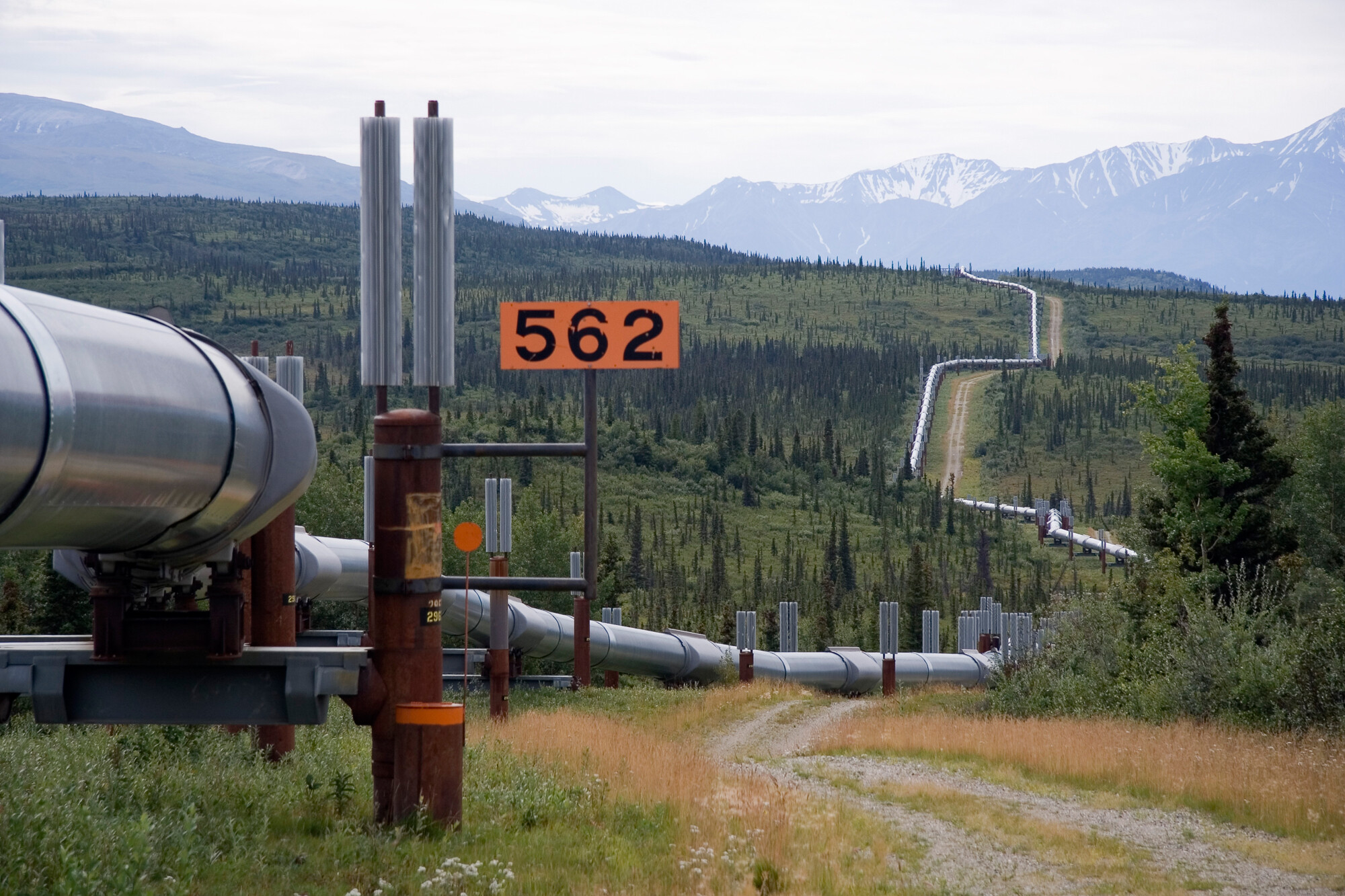
The Trans Alaska Pipeline System was designed and constructed to move oil from the North Slope of Alaska to the northern most ice-free port in Valdez, Alaska.
Length: 800 miles.
Diameter: 48 inches.
Crosses three mountain ranges and more than 30 major rivers and streams.
Cost to build: $8 billion in 1977, largest privately funded construction project at that time.
Construction began March 27, 1975 and was completed May 31, 1977.
First oil moved through the pipeline on June 20, 1977.
More than 16 billion barrels have moved through TAPS.
First tanker to carry crude oil from Valdez: ARCO Juneau, August 1, 1977.
Tankers loaded at Valdez: 19,625 through April 30, 2008.
The mission of Alyeska’s Ship Escort Response Vessel System is to safely escort tankers through Prince William Sound.
$8B in 1977 roughly equivalent to $45B today, enough to buy two dozen B-2 bombers or 8 Gerald R. Ford class (most modern) aircraft carriers or build 20 NASA space shuttles at the price of the USS Endeavour.
I think what he really means is that the private sector isn’t wasteful enough. QED
Clayton -
Here are some comments of mine I made on Tyson’s recent essay for Foreign Affairs: Innovation, Innovators, and the Market.
Tyson is probably right that, up to date, the private sector (for the most part) would be unwilling to be liable for the risks of space exploration. This is not a case against privatizing space exploration, though. Tyson hasn’t looked at the opportunity cost of public space exploration: all the private investment and growth we had to forego to fund NASA and other organizations and projects. Also, it’s not exactly clear what internalized benefits public space exploration has brought us. Everyone likes to talk about how space exploration is an investment for the future generations, but it’s not very clear how this is so — most people just assume that these benefits exist. As for externalized benefits (e.g. run-off technologies), what about all the benefits (both exteralized and internalized) we had to forego in terms of opportunity cost?
What the private market does, though, is reduce the risk of an investment. Once the costs of space exploration fall, the private market will investment towards these ends. But, then we know that space exploration is worth it, because the consumers (society) are demanding it.
Oil exploration is a great counter example to that claim. Literally billions must be invested to get large scale production. And there is significan risk, if you’re off in your calculations and plans, you could spend 80-100 million drilling into a salt dome and get a dry well. The difference is that if you waste 80 million in the oil industry, you’re fired.
Here’s another great counterpoint:
http://gizmodo.com/5904081/new-asteroid-mining-company-will-add-trillions-of-dollars-to-worlds-economy
Like others have said, the fact that nobody would have produced the space shuttle privately probably means that it shouldn’t have been built. I used to love that thing when I was a kid, but as time marched on it became apparent that it was a giant boondoggle that held back space exploration for decades. Fortunately, with the various space tourism rocket planes, other private launch craft, and the space mining company mentioned above, we will see some real progress within my lifetime.
Shooting massive amounts of resources into space, that could have made health care more abundant for millions of people, to add useless theoretical knowledge to astrophysics journals, that less than a percentage of the population understand or care about?
…the market wouldn’t do this? Damn right the market wouldn’t do this! If markets frittered away societies wealth on shiny monuments like that, we would still have bronze age stagnation instead of rising standards of living. Indeed, the great thing about market allocation is that it prevents such waste from happening.
Is there a version that doesn’t say “shit”?
But how do you convince folks that pyramids and moonwalks are impressive at a glance, but not helpful to society as a whole? Unfortunately it’s very easy to ignore the Broken Window fallacy and the unseen when you’re looking at a pyramid or the Taj Mahal.
Richard Branson’s Virgin Galactic and the X-prize beg to differ.
I wonder which government funded Isaac Newton.
Didn’t Newton participate in some scientific society which received government funding?
That may not have been the best example. I don’t know enough about the Royal Society (pretty sure that’s what it’s called) to say whether it was privately funded or not, but I would guess it received some revenue from the crown. But i think it would be harder to make the case that Newton and the other incredible Renaissance men from that era were so spectacular because of the funding they received from the gov. Again, though, sloppy example.
Let me ask ya’ll something.
At which institution did the following occur:
The invention of the internet? (not Al Gore’s house)
The invention of the transistor?
The development of the jet engine?
The development of the space rocket?
The discovery of the double helix?
The start of the human genome project?
Bonus points: How many of these organizations were public research universities, public private partnerships, or government labs?
Extra credit: How can Neil Degrasse Tyson possibly think the government has done anything to advance science?
Part of the problem with this whole line of thinking is “hero worship” or “magic organization” thinking. Einstein did not devise the theory of relativity. Most of the ideas that comprise the substance of both the Special and General Theory of Relativity already existed prior to Einstein. He was more of a systematizer and he hammered out a lot of details through sheer sweat of the brow. But he he is held up in the popular consciousness as the consummate genius who gave birth, de novo, to an entire science. Juvenile rubbish.
It doesn’t even make sense to say “the Internet” was invented at all. It’s like asking who invented travel. Communicating is something that computers do. Communicating with each other (network) was unremarkable. Internetwork communication was an art form in its own right but it was more a matter of impedance-matching between incompatible communications protocols. TCP/IP and “the” Internet (ARPANet) was just one particular internetwork whose protocols happened to outlive others and ended up forming the historical foundation on which the modern Internet is built.
Hardly the story of Edison’s lightbulb.
The transistor was the idea of specific men, especially William Shockley. They worked for Bell Labs. But the pedigree of the transistor lies in the vacuum tube which had been already developed into a science and industry of its own by thousands of specialists.
The jet engine and the space rocket - because of their dual use as military technologies - were indeed heavily funded by military research early on. However, it is a simple fallacy to argue that if any non-military uses of military goods manages to spin off of military research that all the funding is therefore justified. This is the moving-goalpost fallacy. We (libertarians) say “the government is not the source of innovation and progress” - statists strawman this into a claim that the government has produced no innovation or progress whatsoever. Well, they can hardly avoid making some inadvertent progress or innovation when they are consuming half of the national product, now can they? Doesn’t make it money well spent.
It’s funny that you mentioned who started the Human Genome Project as what’s more interesting is who finished it. First. And it wasn’t the government (extra credit if you know who it was without having to Google it).
Clayton -
And they didn’t get started until government made the initial investment and established GenBank. Neither of them “completed” the HGP. Public and private efforts complemented each other and published their own parts of the genome.
Let me ask you something: do you think that those projects would have never been attempted, let alone completed, without government assistance?