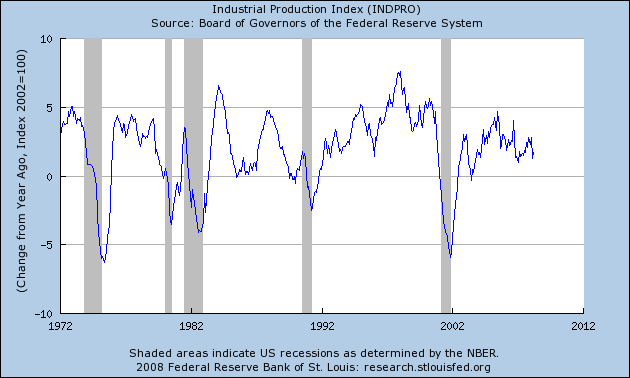
I came across this article where a blogger rants calling anyone a fearmongerer who dares to call the current state of the US economy a recession (the following comments are even worse). This is on a tech blog, not an economic one, mind you. I stopped reading it after the first paragraph because his argument appears to stem from an emotional objection to a recession than an intellectual objection. This wishful thinking seems to be pretty commonplace in regards to the economy. I do believe we are in a recession, though I’m no economist (I’ve only been visiting mises.org regularly for the past few months). I believe the folks here at mises predicted a recession many months before the media ever picked up on it. I’m hoping someone here can give me a real assessment of the situation, and perhaps leave an intelligible comment for the blogger, Mr Mark Hopkins, and his visitors. Thanks [:)]
I think it may be too soon to call what we’re in a recession. Technically, a recession is defined as two consecutive quarters of falling GDP. There is obviously some concern though, just take a look at the current fed interest rates…
Haha, that’s what some university professor taught my class in history when we were studying the Great Depression. On the test for it I essentially had to say building pyramids would be “good for the economy”.
Do you dispute the fact that we have positive real GDP growth? First quarter 2008 numbers can be found here. As far as I can tell the media blew this slowdown out of proportion. The interesting thing is that the inflation caused by the Fed trying to avoid a recession will probably cause a recession.
Dude, the entire banking structure almost imploded…
Looks like a recession to me, everything is slowing down except exports (at fire sale prices) and government spending.
There’s even a chance that the 0.6% growth could be a statistical anomaly and the figures are revised downward at a future date, they do that all the time especially around events that don’t exactly fit the model when they “seasonally adjust” the figures.
They are only delaying the inevitable and are making it worse in the process.
There’s actually a whole theory that describes events like this…
I don’t know how meaningful macro statistics like the GDP are, much less when they are manipulated to discount inflation and treat government spending the same as private spending.
I think the only pertinent question is, are the activities that were enabled by the expansion of money and credit being liquidated, and they undoubtedly are. Activities supported by the pool of real savings are doing fine, as they always will.
Actually New Keynsians have written whole books about the problems with GDP but without any better alternative that is readily available there isn’t much sense in not using it. On a whole it helps to understand what is happening in the macroeconomy and shouldn’t just be thrown out without a better measure to replace it. It is just one tool among many.
Inquisitor can give you some good criticisms of macro-economics–IIRC he’s tied down in exams at present.
Economies are way too complex and dynamic to stick a single label on them. I know some businessmen who are going bankrupt. I know others who are shopping for their next Mercedes. My grandfather told me the same thing about the “Great Depression.” His father was disabled, and he worked as a butcher to support the family. He told me he never lacked for work.
I can, but the one Jon posted deals sufficiently with GDP as a measure of growth IMO. Reisman’s measure of production is a superior one to the GDP. In general, it’s best not to trust measures like the CPI, GDP &c. because they’re constructed to omit significant data, and tend to have bad economics behind them. Reisman’s GNR is one example of a measure of production better than GDP. As for general criticisms of macroeconomics, Garrison’s “AS AD: A sad development in economics” (IIRC) is a good introduction.
Not to be argumentative, but why do we need GDP to determine recessions? As an entrepreneur, I want more specificity (I may have made that word up) about what is happening in the economy, than generalizations like growth/recession.
GDP suffers from lagging. I don’t think it is useful except to confirm market behavior that has already occurred.
Where does he outline this measure and how is it collected? Is it explained in his book? Thanks for the Garrison tip. I still don’t think we should throw current New Keynsian and neoclassical macroeconomics out the window just because it is flawed but I will familiarize myself with the concepts you have directed me to. Also I agree that the CPI is mostly bunk.
If anyone is wondering I am not really an Austrian but something of an Austro-New Keynsian. Anyway, I don’t think praxeology is the only way to do good economics. To me it is just one tool of many.
He offers a general outline in that article I posted.
Praxeology is the foundation of all economics - it is not a tool, it is the discipline’s very basis. If, however, you can incorporate Keynesian insights that are not nonsensical, then all the better; there’s nothing wrong with that. Personally, I think the Austrians can gain far more from the Public Choice school, and that is where they should be directing fruitful discussion towards, and not the (neo-)Keynesians. Just so you’re aware, Reisman is an Austro-classical economist; he’s attempted a fusion of Austrian and classical economics, so he might interest you. Garrison has also written extensively on a possible Austrian macroeconomics (in his Time and Money), and I believe he demonstrates in which regards it is superior to competing alternatives, so be sure to pick it up if you’re interested.