Just a quick note: the word “idea” may need to be clarified at some point.
So simple ideas would be sensations like blue, textures, tastes, pain, pleasure, etc.? Or models based on them? In other words, dots or connected dots (as in the bee and flower example)?
I may agree with your conclusion here, but in case it turns out to be important I’d like to nitpick that sensations (simple objects) are foundational, and relations can only be experienced as sets of sensations - for example I can see “A chair is in my room” as a circle representing my room and a dot representing my chair, with the dot inside the circle. That picture is set of visual sensations. But I (may) still agree that objects and relations are good fundamental basis for a language.
I see what you’re getting at now. One thing that may be important is to define “relation” more carefully. Also, the question of whether the fundamental objects are “dots” or “connected dots” looms large in my mind at this point.
If you’ve been following my conception in the Quine thread, you may be reminded of two quotes from people who’s names I have forgotten, that go roughly: “Science is an empirico-deductive discipline,” and “Science is just doing what everyday people do everyday, but in a more careful way.” My conception is essentially that all of human reasoning is empirico-deductive, when those terms are understood with all the caveats I mentioned in that thread (which turns out to be a vastly different understanding than the standard one). I…
(1) …experience dots (sensations),
(2) …connect the dots (form models I deem useful for anticipating the future states of my sensations), and
(3) …logically deduce new results from those models.
The “empirical” aspects are 1 and 2 (with again the important caveats that 1 does not refer to any “observation” of some “real world” but just of pure sensation, and that all conscious thought is also just sensation), and the deductive aspect is 3.
So can you perhaps list some relations that you see as fundamental? For example, physical containment (“X is in Y”) doesn’t seem completely fundamental, because it presupposes spatial relations and suggests certain facts about physical reality, such as that objects cannot pass through each other. Of course, since we seem to live in a world with such a physical reality, the language would be useful for talking about that world, but it would be a language purpose-built for one particular understanding of the physical world (one particular idealized model). So it wouldn’t necessarily be useful when we delve deep enough into physics until those relations were broken down further. However, I hasten to add that any pictorial model I might propose would probably suffer from the same limitations. I don’t see our conceptions as necessarily in conflict; I am posting to gain ideas from you and others, and from the discussion, just as much as to suggest my own.
–
Another quick aside: I just made a major leap in my understanding, or at least in how to explain it.
Remember how Mises says in Human Action that all the theorems of mathematics are already contained in their axioms, and that a sufficiently intelligent being would understand them all in one swoop? I made the same argument here, where I said that 2+2 just means 4. I said that if you told the axioms of Euclidean geometry to a sufficiently intelligent being, then told that being an advanced theorem, it would reply, “You already told me that!” (See also my very brief response to this misguided LessWrong post (that post notwithstanding, I highly recommend Eliezer Yudkowsky’s other writings).) I made the same argument in the context of causality in physical models in this recent thread. I make many points that touch on the same in the Quine thread.
I had had trouble explaining this before, but in pictures these points are already made for me. For a simple example, 2+2 conceived on my visual field really is just the same as 4 conceived on my visual field, going something like this:
2 looks like: . .
2+2 looks like: . . . .
4 looks like: . . . .
And for a more impressive example, imagine that we have laid out the following diagram instead of a bunch of axioms of the form “Ireland is in the British Isles,” “Ireland is not in the United Kingdom,” etc.:
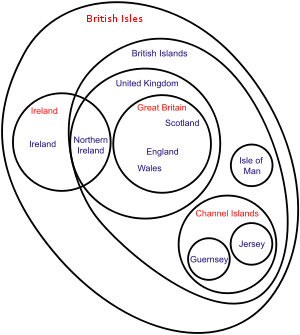
Then upon hearing someone say, “From the [written] axioms we have mathematically derived the following theorem: Every country that is in Great Britain is in the United Kingdom,” a sufficiently intelligent being (in this case, you or me) would reply, “That was already contained in the [diagrammed] ‘axioms.’ There is no need to ‘deduce’ it! At most you could say you’re just pointing it out.”
So… this suggests that much of what we regard as difficult thinking that has in some cases taken centuries for people to work out might be trivially easy if done in pictures. It’s just that the pictorial representations have not been ambitious enough, probably in part because people would be resistant to learn very complex diagramming schemes.
And also, I think this means we are engaged in the same enterprise: we both want to create better engines for basic communication “language,” but I am emphasizing the visual aspect (or really all sensations, but visual seems the most practical for now).
I think success in this area would mean great strides toward AI, and even if not, it would still mean tremendously much for human communication and hence our understanding of each other.
That is really interesting. It may be better than English at handling voice and the nouns/adjectives.
However, you seem to be saying that we need grammatical voice to give speakers the flexibility to rearrange objects without changing the meaning of the relation. But it strikes me that we only need both “something killed him” and “he was killed” because something doesn’t normally include people. If we had a normal English construction that just said something like “X killed him,” would there be any use for passive voice? And if we could say “I killed X” we wouldn’t need anti-passive, right? From those examples it seems (on my admittedly rudimentary consideration of this so far) that maybe the only reason we need grammatical voice is because we don’t have sufficiently non-specific words like the mathematical “X” - because “something” implies a thing not a person, etc.
And I also suspect voice could be partially or completely done away with in a visual language.